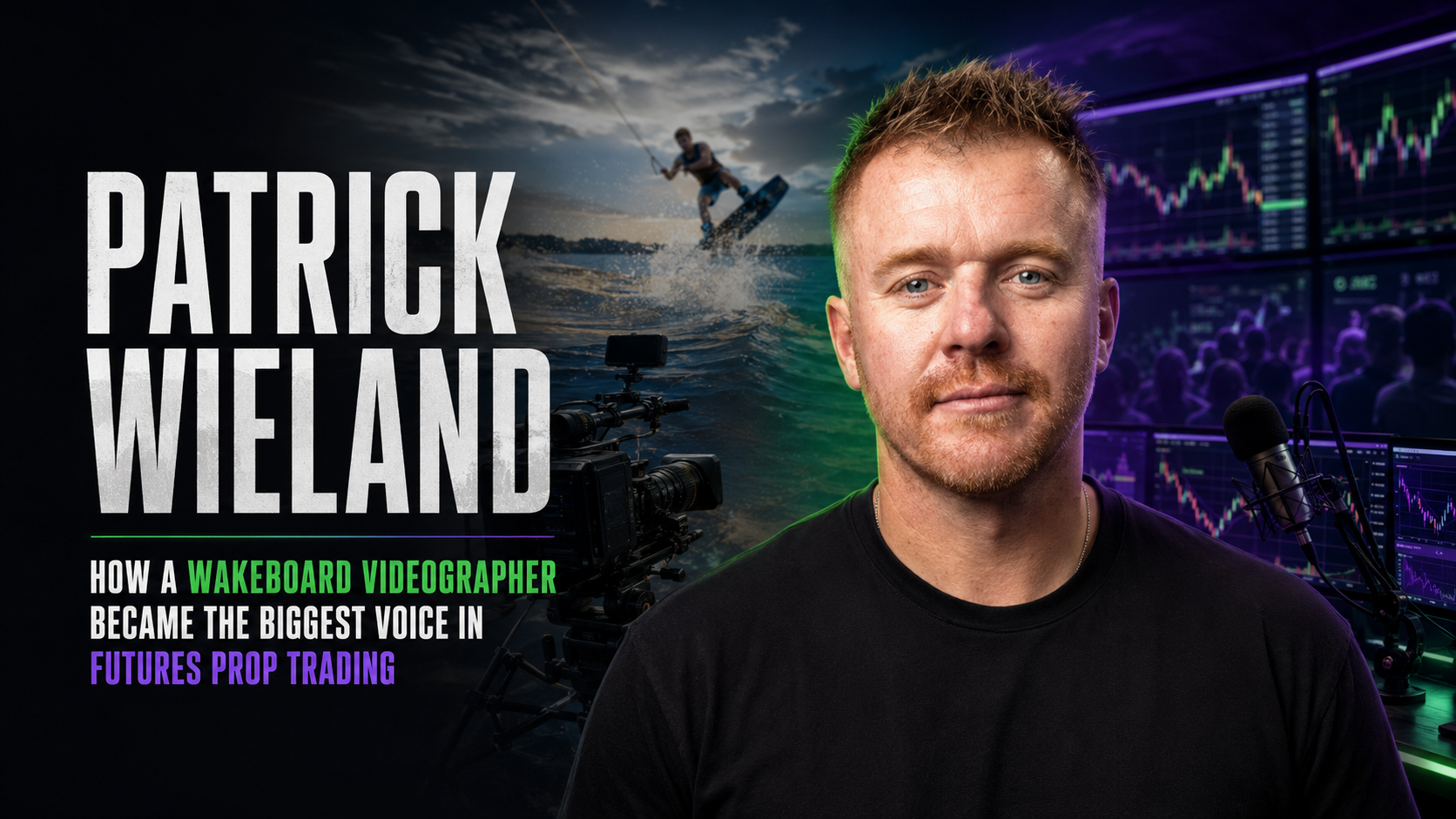
Patrick Wieland: How a Wakeboard Videographer Became the Biggest Voice in Futures Prop Trading
The most influential individual voice in futures prop trading started as an award-winning action-sports filmmaker. An independent profile: the decade of daily live streams, the rise of OnlyPropFirms from channel to network, the affiliate economics he is unusually candid about, what the critics say, and what working traders can genuinely take from his run.
 Tradeify
 Apex Trader Funding
 Take Profit Trader
Last updated: July 28, 2026
If you have spent any time at all in the funded futures world, you have encountered Patrick Wieland: on your YouTube homepage at the 9 AM bell, in a prop firm's promo code, in a clip circulating through trading Discord, or in an argument about him, because he generates those too. He is, by any reasonable measure, the most influential individual voice in futures prop trading: a former award-winning action-sports videographer who has spent close to a decade live-streaming his trading nearly every market day, built an audience in the hundreds of thousands, and turned that daily grind into OnlyPropFirms, a media brand at the center of the industry we cover. This profile looks at how he got here, what he actually built, how the business of being Patrick Wieland works (a subject he is unusually candid about), what his critics say, and what working traders can genuinely take from his run.
Disclosure: this is independent editorial. We have no affiliation with Patrick Wieland or OnlyPropFirms, he did not participate in or review this article, nothing here was paid for, and profiling someone is not an endorsement of any product, firm, or strategy. Facts below come from his own published channels and sites and other public sources; figures he has discussed about his own results are self-reported and not something anyone outside his accounts can verify.
From Wakeboard Camera to the Opening Bell
Wieland's origin story is genuinely unusual for finance, and it explains more about his success than any trading credential could. He grew up in Florida around the wakeboarding and watersports scene, saved up for a camera, and turned filming his friends into a career: by his own account he became one of the most respected wakeboard videographers in the world, with awards for cinematography and editing to show for it. Somewhere in the years of travel between events, day trading grabbed him, and he did the thing that would define everything after: he pointed the camera at himself and hit record. Nearly a decade later, the through-line is obvious. Trading YouTube is full of people who trade better than they communicate; Wieland arrived as a world-class visual storyteller who then learned to trade in public, and in a medium where attention compounds, that ordering turned out to be the winning one.
The Daily Grind: What the Channel Actually Is
The core product has barely changed in years, which is itself the point: live futures trading, every weekday morning around the 9 AM ET hour, streamed from his BDH studio in Florida, typically fast momentum trading in Nasdaq futures around the killzone-hour volatility every guide on this site dissects. Around the live core sits the supporting catalog: prop firm breakdowns and industry commentary, beginner education, and interviews with industry figures. His own about page cites an audience past 200,000 subscribers, and his self-applied title ("YouTube's Best Day Trader") tells you everything about the confidence of the branding. The volume of output is the underrated stat: streaming your wins and losses live, daily, for years, in front of an audience that screenshots everything, is a workload and an exposure level that almost nobody in trading media has matched, and it is the foundation the entire business stands on. Notably, his streams carry blunt disclaimers about the loss rates of day traders, a level of on-screen honesty about the odds that plenty of smaller creators still avoid.
Why He Became the Biggest Voice in Funded Futures
- He was early to the funded-account story. Wieland was documenting evaluation and funded-account trading before the space boomed, and when the boom came, the audience searching for it found a creator with years of archive already waiting.
- Relentless consistency. Daily live sessions for years built the habit loop that algorithms and audiences both reward. Traders talk about showing up every session; his channel is that principle applied to media.
- Production instincts from a previous life. The filmmaking background shows in pacing, energy, and watchability. His streams are entertainment-grade in a niche where the median competitor is a webcam and a P&L.
- A personality that forces a reaction. Loud, brash, impossible to mistake for anyone else. Polarizing is a growth strategy in the attention economy, and he runs it natively rather than performing it.
- The model he trades is the model his audience lives. He trades prop firm capital: evaluations and funded accounts, with risk limited to fees, the exact structure our business model guide describes. His viewers are not watching an unreachable fund manager; they are watching their own situation played at higher volume.
OnlyPropFirms: From Channel to Network
The strategically impressive move came when Wieland converted personal attention into an owned platform. OnlyPropFirms launched as his answer to the choice-overload problem in prop: a hub for comparing firms, surfacing deals and discounts, and centralizing industry content, wrapped around the recognition that no single firm fits every trader. It has since grown into something closer to a small media network: alongside his own 9 AM session, the site's daily lineup includes the D-Money Show at noon and the Denny Dollas Show in the evenings, plus news, market content, and his course. Whatever you think of any individual recommendation on it, the structural lesson is one every creator and site owner in this industry (ours included) can respect: he stopped renting his audience from an algorithm and built a destination he owns, then widened it beyond himself. That is how a streamer becomes an institution.
The 2-Hour Trading Day
His flagship educational product is the 2-Hour Trading Day course: roughly six and a half hours of video lessons around a $200 price point, teaching his approach to trading a short, focused morning window with defined setups, risk management, and routine, bundled with a morning checklist and a digital guide to funded trading. The premise (trade the high-volume open, be done by lunch) is genuinely sound structure and matches how most successful funded traders in evaluation data actually operate. Our standard guidance applies to his course as to every course in this industry, at any price, from anyone: no course substitutes for your own testing, so take any taught method through the same frozen-parameter backtest and sim protocol our strategy guides lay out before real fees ride on it. A $200 course is cheap tuition if you test it and expensive folklore if you do not.
The Business of Being Patrick Wieland, Honestly
Here is where this profile earns the word "factual," and where Wieland himself deserves more credit than the discourse usually gives him. The economics of his position are an open book largely because he has been open about them: affiliate revenue, not trading, is widely understood to be his primary income, and he has acknowledged as much rather than performing the fiction that content is charity. He is broadly regarded as the single largest affiliate in futures prop, which means firms compete for his placement, his promo codes move real volume, and a mention on his stream is one of the most valuable advertising slots in the niche. He has also publicly discussed strong trading results of his own in recent years; those figures are self-reported, unverifiable from outside, and should be held exactly as loosely as any influencer's stated P&L, his or anyone's.
What should a trader do with that knowledge? The same thing you should do with every affiliate in this industry, explicitly including the site you are reading: apply the incentive lens. Affiliate economics mean the recommender earns when you buy, which does not make the recommendation wrong and does not make it disinterested. The intelligent posture is neither cynicism nor faith: take the deal (a working discount code is a working discount code regardless of who profits from it), verify the firm independently on current payout conduct (which is literally what our daily scores exist for), and weight any influencer's firm rankings as one input from a party with a stake. Wieland's relative transparency about his model makes that calibration easier with him than with creators who pretend the stake does not exist, and that transparency has, if anything, become the industry's norm-setter.
The Critics, Fairly
No profile of Wieland is honest without acknowledging that he is among the most argued-about figures in the space: loved and hated is the standard framing, and rival affiliates and skeptics have long contested how much of his identity is trader versus entertainer, pointing at the affiliate-first income structure and the fact that trading firm capital caps his personal downside at evaluation fees. Parts of that critique are simply restatements of facts he concedes; parts are the ordinary friction of a small industry where the critics often compete with him for the same commissions, which readers should weigh when consuming takedowns and hagiographies alike. Our view is boringly procedural: the entertainer-versus-trader debate is unresolvable from the outside and mostly beside the point. Judge the verifiable things: the consistency of the output, the usefulness of any specific piece of information, the real terms of any deal, and the current conduct of any firm being promoted, checked against sources with no stake in your click. That standard is not special treatment for Wieland; it is how this site says every voice in the industry should be read, including our own.
What Traders Can Actually Take From His Run
- Consistency is the moat. A decade of daily sessions built something no marketing budget replicates. The same principle passes evaluations: the passer profile in the industry data is defined by routine, not brilliance.
- The risk-limited model he trades is the rational one. Trading firm capital with downside capped at fees is precisely the structure our guides recommend traders exploit deliberately: on purpose, with sizing discipline, rather than by accident.
- Transparency wins long games. His openness about the affiliate reality bought him durability through controversies that have ended less candid creators. In an industry that runs on trust, admitting your incentives is a strategy, not a confession.
- Own your platform. The channel-to-OnlyPropFirms move is the masterclass: audiences rented from algorithms are fragile, destinations are assets.
- And the standing caution: nobody's live stream is your backtest. Enjoy the show, take the discounts, verify the firms, and test every strategy yourself before fees ride on it.
Patrick Wieland FAQ
Who is Patrick Wieland?
A Florida-based day trading streamer and media entrepreneur, formerly an award-winning wakeboarding videographer, who has live-streamed his futures trading nearly every weekday for close to a decade, built a YouTube audience past 200,000 subscribers, and founded OnlyPropFirms, a prop firm comparison and content hub with a daily multi-show lineup.
Does Patrick Wieland really trade?
He trades live on stream daily, primarily prop firm evaluation and funded accounts in Nasdaq futures, which caps personal downside at fees. Results he has discussed publicly are self-reported and unverifiable from outside, which is the correct standard to apply to every trading influencer's stated P&L.
How does Patrick Wieland make money?
Primarily through affiliate partnerships with prop firms, where he is widely regarded as the largest affiliate in the futures space, plus his roughly $200 trading course, his media properties, and his trading itself. He has been notably open that affiliate revenue leads, which makes calibrating his recommendations easier, not harder.
What is OnlyPropFirms?
The platform Wieland founded to compare prop firms, surface deals, and host daily trading content, including his own morning session and additional shows from other hosts. It functions as a deals-and-media hub built on his audience; as with any affiliate platform, ours included, verify firms independently on current payout conduct before buying.
Is the 2-Hour Trading Day course worth it?
Its core premise, trading a short high-volume morning window with defined risk and routine, is structurally sound and matches how successful funded traders operate. Whether the specific method works for you is answerable only by your own testing: run it through a frozen-parameter backtest and sim forward-test before evaluation fees depend on it, the same standard we apply to all paid education.
Should I buy a prop firm account through his links?
A working discount is a working discount regardless of who earns the commission. Make the firm decision independently first, based on current payout conduct and rule fit (our daily-refreshed scores and guides exist for exactly that), then use whichever legitimate code prices it best at checkout.
Independent editorial profile based on publicly available sources, including the subject's own published websites and channels; the subject did not participate in, request, or review this article, and no compensation was involved in any direction. Self-reported figures are presented as claims, not verified facts. Nothing here is an endorsement of any person, product, course, or firm, nor financial advice. Prop trading involves risk of losing evaluation fees; most participants do not reach a payout.