
Tradeify
 QuantTower
 NinjaTrader
 Tradovate
 TradingView
 ATAS
ATAS
 Sierra Charts
 WealthCharts
 MotiveWave
 Rithmic
Tradovate
Rithmic
Tradovate
 Rise
Rise
 Plane
Plane
 Wire
Wire
 ACH
ACH
 Crypto
| Date | Overall Score | |
|---|---|---|
| 2026-09-17 | 3.6 | |
| 2026-09-15 | 5.8 | |
| 2026-09-14 | 3.0 | |
| 2026-09-13 | 5.1 |


Last updated: July 8, 2026
Tradeify Review: Rules, Accounts, Payouts, Discounts & Trader Details
Tradeify is a US-based, futures-only prop firm founded in 2024 by Brett Simberkoff that has grown fast — crossing $200 million in trader payouts and building a strong Trustpilot footprint in under two years. Its 2026 lineup ("Tradeify 3.0") runs three account families on one-time pricing with no monthly fees: Growth and Select evaluations, plus Lightning instant funding. All three use an end-of-day trailing drawdown, a 90/10 split, and a clear path to a real-capital Elite Live account.
Quick verdict: Tradeify suits futures traders who want one-time pricing, no activation fees, and a choice of how their funded phase behaves. Before you buy, know the differences: Growth adds a daily loss limit and a 35% funded consistency rule but passes fast; Select drops the funded consistency rule entirely (on Flex) and lets you pick Daily or Flex payouts; Lightning skips the evaluation but carries the strictest, escalating 20%→25%→30% consistency rule. Payout caps and the drawdown-that-never-falls are the traps to plan around.
Tradeify Quick Facts
| Category | Details |
|---|---|
| Firm Name | Tradeify |
| Website | tradeify.co |
| Help Center | Tradeify Help Center |
| Company / Founder | US-based; founded June 2024 by CEO Brett Simberkoff |
| Support | Help center and ticket support; active payout-proof reporting |
| Markets | CME futures only (index, energy, metal, agricultural, and micro contracts) |
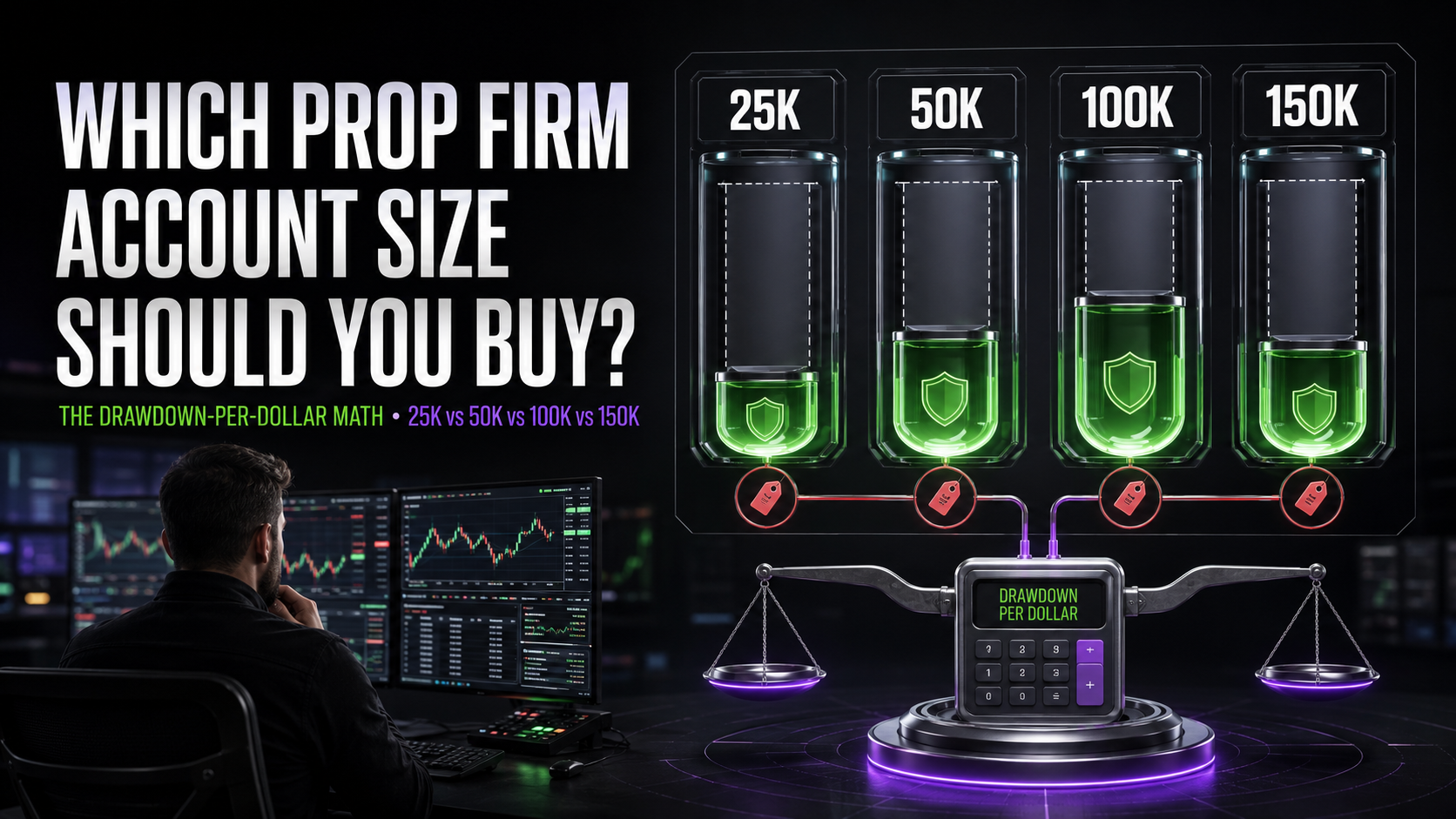
| Account Sizes | $25K, $50K, $100K, and $150K |
| Trading Environment | Simulated evaluation and Simulated Funded accounts, with a real-capital Elite Live stage |
| Profit Split | 90/10 (Growth and Lightning give 100% on your first $15K in total payouts) |
| Max Funded Accounts | Up to 5 Simulated Funded accounts (up to $750K combined) in any mix of Growth, Select, and Lightning |
| Payout Processor | Rise (plus other rails); most payouts processed within 24–72 hours |
How We Reviewed Tradeify
This review is built from Tradeify's own materials: the homepage and pricing reference, the Funded Trader Agreement, and the help-center articles covering Growth, Select, and Lightning account rules, drawdown mechanics, the consistency rule, and each program's payout policy. Pricing, rules, payout caps, and the current promo were checked in early July 2026.
A quick note on naming: Tradeify relaunched as "3.0" in 2026, moving to one-time pricing, adding platform choices, and renaming its plans. What used to be "Advanced" is now Select, and "Straight to Sim" is now Lightning; "Growth" kept its name. Activation fees were removed across the board. Older reviews that mention monthly subscriptions or a $125 activation fee are out of date, and we've used the current terms throughout.
Tradeify Account Types
All three families share the same account sizes, the same EOD trailing drawdown, and a 90/10 split — the difference is how you get funded and how the funded phase behaves.
Growth is the fast, structured evaluation: no consistency rule to pass (you can clear it in a single day), but the funded account adds a daily loss limit and a flat 35% consistency rule. Select is the flexible evaluation: no daily loss limit, a 40% consistency rule during the evaluation only, and — after you pass — a permanent choice between two funded paths. Select Flex pays every 5 winning days with larger caps, no buffer, and no consistency rule; Select Daily pays daily with smaller caps and a buffer requirement. Lightning skips the evaluation entirely (instant funding) for a higher one-time fee, with tighter risk parameters and an escalating consistency rule. Reach three payouts on one account (or ten across all) and you're eligible for a mandatory transition to a real-capital Elite Live account.
Tradeify Account Comparison
| Family | Funding Route | Drawdown | Daily Loss Limit | Consistency Rule | Profit Split | Listed Price (from) |
|---|---|---|---|---|---|---|
| Growth | 1-step evaluation (fast pass) | EOD trailing | Yes (funded) | None to pass / 35% funded | 100% first $15K, then 90/10 | $99 (25K) up to $369 (150K) |
| Select Flex | 1-step evaluation (3-day min) | EOD trailing | No | 40% eval only / none funded | 90/10 from first payout | $109 (25K) up to $369 (150K) |
| Select Daily | 1-step evaluation (3-day min) | EOD trailing | Yes (funded, buffer) | 40% eval only / none funded | 90/10 from first payout | $109 (25K) up to $369 (150K) |
| Lightning | Instant funding (no eval) | EOD trailing (tighter) | Yes (except 25K) | 20% → 25% → 30% escalating | 100% first $15K, then 90/10 | $345 (25K) up to $796 (150K) |
Growth and Select share the same profit targets and trailing drawdown at each size — roughly $3,000 profit target and $2,000 drawdown on the $50K, scaling to $9,000 and $4,500 on the $150K. Position limits run from 1 contract on the $25K up to 15 minis (or the micro equivalent) on the $150K, and you choose minis or micros, not both. Lightning uses the same drawdown style but with tighter overall risk and a daily loss limit on everything except the $25K.
Tradeify Cost to First Payout
Tradeify's pricing is refreshingly predictable: a one-time purchase, no activation fee, and no separate exchange or data fees — commissions on your trades are the only ongoing cost. What shapes your time-to-cash is the consistency rule and payout cap on your chosen family, plus the buffer on Select Daily and Growth.
| Family / Size | Price (before promo) | Activation Fee | Min. Days to First Payout | Min. Payout | First-Payout Cap | Practical Takeaway |
|---|---|---|---|---|---|---|
| Growth $50K | $145 | $0 | 5 winning days ($250+) | $500 | $1,500 | Cheapest structured path, but a 35% funded consistency rule and DLL apply. |
| Select Flex $50K | $165 | $0 | 5 winning days | Per policy | Up to $3,000 (50% of profit) | No funded consistency rule and no buffer — widely seen as the strongest account. |
| Select Daily $50K | $165 | $0 | Daily once buffer built | $250 | $1,000/day | Fast daily cash, but you must build a ~$2,100 buffer first. |
| Lightning $50K | $492 | $0 | No minimum day count | $1,000 | $2,000 | Instant funding, but the escalating consistency rule and no resets raise the risk. |
The most important cost nuance at Tradeify is the difference between a profit goal and a payout cap. Your profit goal unlocks the ability to request; the cap limits what you can actually withdraw. On a $150K Lightning account you might need $9,000 of profit to unlock Payout 1 but can only take $3,000 that request — the rest stays in the account toward future payouts. Plan your withdrawals around the cap, not just the goal.
Tradeify Rules Explained
EOD Trailing Max Drawdown
Every Tradeify account uses an end-of-day trailing max drawdown. The floor trails your highest closing balance — as your end-of-day balance grows, the floor rises by the same amount, but it never falls back down. Because it only recalculates at the close, intraday swings you recover from don't move it, which is friendlier for scaling in or holding through normal volatility. Once your EOD balance clears the drawdown amount plus $100, the floor locks permanently at your starting balance plus $100 (for example, $50,100 on a $50K).
Daily Loss Limit
Growth and Select Daily carry a daily loss limit in the funded phase (Lightning has one too, except on the $25K). Select Flex has none. The DLL is a soft breach — hit it and your trading day ends, but the account survives and resets tomorrow. That's more forgiving than firms where a daily limit kills the account outright.
Consistency Rule
This is where the families diverge most. Growth funded accounts use a flat 35% rule (your best day must be ≤35% of cycle profit). Select applies 40% during the evaluation only, then drops it entirely once funded (both Flex and Daily). Lightning uses an escalating rule: 20% on your first payout, 25% on the second, and 30% from the third onward. The formula is always largest single day ÷ cycle profit.
Minimum Trading Days
Growth can be passed in a single day but needs 5 winning days ($250+ on the $50K) before a funded payout. Select requires at least 3 trading days to pass. Lightning has no minimum day count — you can request as soon as you hit the profit goal and satisfy the consistency rule.
Hours & News
Tradeify allows news trading with no restrictions across all families — trade FOMC, NFP, and CPI freely, with no buffer windows. It follows standard CME Globex hours; positions must be flat before the daily maintenance window, but overnight holding within the Globex session is allowed. Microscalping is limited: at least 50% of your profit must come from trades held longer than 10 seconds.
Tradeify Consistency Rule Example
Take a Lightning $150K account after your first payout, where the consistency rule steps up to 25% for Payout 2. Your profit goal resets to $4,500 in fresh profit, so your largest single day can't exceed $1,125 (25% of $4,500). Bank $1,500 on one session and you're at 33% — over the line — and the payout is held until you add smaller green days that bring your biggest day back under 25%. A safe rhythm is roughly $1,125 a day across four days. On Growth's flat 35% rule the same math applies at a looser cap; on Select Flex, there's no funded consistency rule at all.
Tradeify Rule Traps to Watch
Important Rule Risks
- The EOD trailing floor never falls — after withdrawing profit, a single bad day can put you close to breach.
- Lightning's escalating 20%→25%→30% rule is the strictest at the firm, and Lightning accounts have no resets.
- The payout cap is separate from the profit goal — hitting the goal doesn't mean you can withdraw all of it.
- Your Select payout path (Daily vs Flex) is a permanent choice made after passing.
Before You Buy
- Pick your platform group carefully — it affects pricing and can't be changed after purchase.
- Choose Growth for a fast structured pass, Select for flexibility, Lightning only if you're already profitable.
- On Select Daily and Growth, plan around the buffer before expecting to withdraw.
- Don't jump straight to five accounts — five drawdown floors and consistency scores get hard to manage.
Payout Rules
All Tradeify funded accounts pay a 90/10 split, with Growth and Lightning giving you 100% of your first $15,000 in total payouts before dropping to 90%. Payouts are requested from the dashboard once you meet your family's profit goal and consistency rule, and are processed through Rise (plus other rails), typically within 24–72 hours. Profit is reconciled daily in the early evening EST.
| Family | Payout Frequency | Consistency | Buffer | Min. Payout | Typical First-Cap ($50K) |
|---|---|---|---|---|---|
| Growth | Every 5 winning days | 35% funded | Safety net applies | $500 | $1,500 (scaling to $3,000) |
| Select Flex | Every 5 winning days | None (funded) | No buffer | Per policy | Up to $3,000 (50% of profit) |
| Select Daily | Daily (after buffer) | None (funded) | ~$2,100 buffer | $250 | $1,000/day |
| Lightning | Instant, no min. days | 20% → 25% → 30% | Profit goal per cycle | $1,000 | $2,000 |
Two things to keep straight. First, payout caps rise with each successive payout number up to a point, then hold — so early cycles pay less than later ones. Second, every withdrawal reduces your cushion against the trailing floor, so pulling too aggressively can leave you a bad session away from breach. After roughly 3 payouts on an account (or 10 across all accounts), Tradeify may transition you to a real-capital Elite Live account with uncapped daily payouts and a performance reward pool — a transition that's at Tradeify's discretion and mandatory once selected.
Platforms & Data
Tradeify supports a wide platform lineup, organized into groups you select at checkout. Listed platforms include Tradovate, NinjaTrader, TradingView, Quantower, Rithmic, Sierra Chart, and Tradesea. Real-time CME data and exchange fees are included in the account price — a genuine plus for predictable budgeting.
Listed Platforms
- Tradovate
- NinjaTrader
- TradingView
- Quantower, Rithmic, Sierra Chart, and Tradesea
- Real-time CME data and exchange fees included
Platform Notes
- Your platform group is chosen at checkout, affects pricing, and can't be changed after purchase.
- Third-party platform licensing (e.g. some NinjaTrader setups) may carry its own cost.
- News trading and automated bots are generally allowed; microscalping under 10 seconds is limited.
- Hedging across accounts and other prohibited practices can terminate the account.
Fees, Resets & Refund Policy
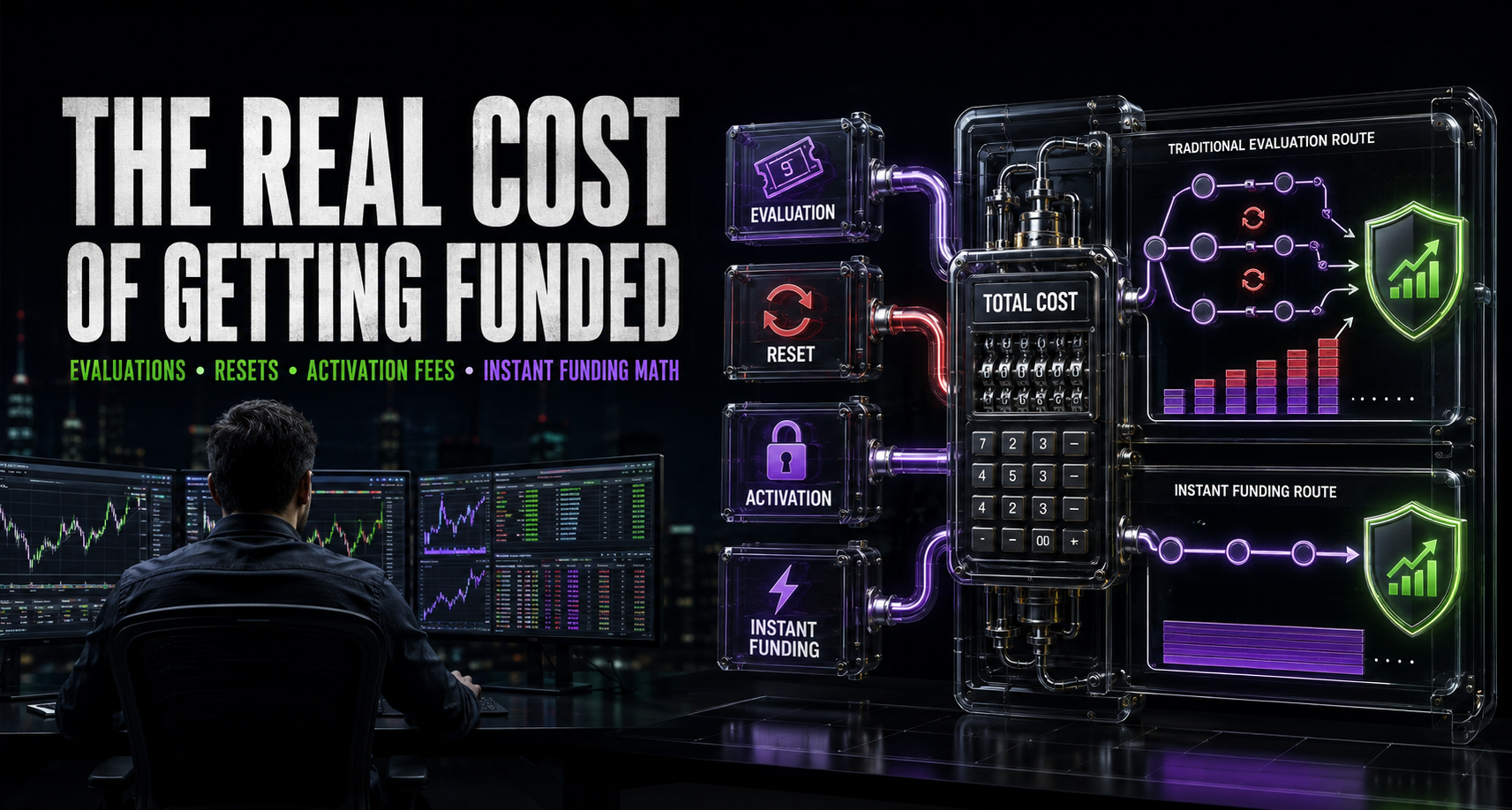
Every Tradeify account is a one-time purchase — no monthly subscription and no activation fee to move from a passed evaluation to a funded account. There are also no separate exchange or data fees; commissions on your trades are the only recurring cost. Growth and Select evaluations can be reset for a reduced fee if you fail (roughly $85 on the $50K, $169 on the $100K, and $189 on the $150K). Lightning accounts cannot be reset — if one fails, you buy a new account.
All sales are final per Tradeify's terms, so evaluation and Lightning purchases are non-refundable. There's a permanent 5-account bundle discount (5% off, auto-applied) on Growth and Select 25K/50K evaluations that stacks with promo codes, but 100K/150K sizes and Lightning accounts aren't bundle-eligible.
| Fee Type | Tradeify Policy / Details |
|---|---|
| Account Fee | One-time purchase by family and size; no monthly subscription |
| Activation Fee | $0 on all current account types |
| Reset Fee | Reduced-price resets on Growth/Select (about $85 / $169 / $189 by size); Lightning has no resets |
| Data / Exchange Fees | Included in the account price; commissions apply per trade |
| Bundle Discount | 5% off five same-size Growth/Select 25K–50K evaluations; stacks with promo codes |
| Refunds | All sales are final; purchases are non-refundable |
Tradeify Discount Code
Tradeify runs frequent promotions, commonly around 40% off. The code featured on its own site is DASH, which drops a Select 25K to roughly $65 and a Lightning 150K from $796 to around $478. Because Tradeify rotates codes and lets various partners issue their own, the exact code can change — but a 40%-class discount has been the standard headline, and it stacks with the permanent 5-account bundle discount on eligible evaluations.
| Promotion | Details |
|---|---|
| Current Code | DASH (featured on Tradeify's site) |
| Typical Discount | Advertised around 40% off |
| Applies To | Growth, Select (Flex & Daily), and Lightning across all sizes |
| Stacks With | The permanent 5% bundle discount on eligible 25K/50K evaluations |
| Best Practice | Enter the code at checkout and verify the final price before purchasing |
Pros & Cons
Pros
- One-time pricing with no activation, exchange, or data fees
- Three families to match your style, including instant funding
- Trader-friendly EOD trailing drawdown on every account
- 100% split on your first $15K (Growth and Lightning)
- Select Flex has no funded consistency rule and no buffer
- Unrestricted news trading and a strong public payout record
Cons
- Lightning's escalating consistency rule is strict, with no resets
- Payout caps limit how much you can pull per request
- The trailing floor never falls, tightening room after withdrawals
- Rise KYC onboarding can be slow for some traders
- Select payout path is a permanent choice
- Young firm — founded in 2024, with limited long-term history
Who Tradeify Is Best For
- Futures traders who want one-time pricing with no hidden exchange or data fees
- Traders who value a choice between fast passing, flexible funded rules, or instant funding
- Select Flex fans who want no funded consistency rule and no buffer
- News traders and swing traders who hold through the Globex session
- Traders targeting a real-capital Elite Live path with a reward pool
Who Tradeify May Not Be Ideal For
- Traders who make most of their profit in single large days (consistency rules bite)
- Traders who want uncapped per-request payouts from day one
- Instant-funding buyers who dislike Lightning's escalating rule and no-reset policy
- Traders who need to switch platform groups after purchase
- Traders who require a long, established company track record
Best Alternatives to Tradeify
Traders comparing Tradeify may also want to look at firms with a longer track record, a different funded structure, or an even simpler rule set.
| Alternative | Why Compare It |
|---|---|
| Apex Trader Funding | Worth comparing for a longer track record, a larger multi-account ceiling, and a choice of drawdown models. |
| Take Profit Trader | Useful for day-one, uncapped withdrawals and zero funded consistency rule. |
| Lucid Trading | A fast-paying newer firm with EOD drawdown and near-instant payouts to compare on speed. |
Tradeify FAQ
Is Tradeify legit?
Yes. Tradeify is a US-based futures prop firm founded in 2024, with a strong Trustpilot rating across thousands of reviews and public payout proof exceeding $200 million. Its main caveat is youth — it has under two years of operating history.
What's the difference between Growth, Select, and Lightning?
Growth is a fast evaluation with a funded DLL and 35% consistency rule. Select is a flexible evaluation (40% eval consistency only) that lets you pick Flex or Daily payouts, with no funded consistency rule. Lightning skips the evaluation for a higher one-time fee but uses an escalating 20%→25%→30% consistency rule and has no resets.
What drawdown does Tradeify use?
End-of-day trailing on every account. The floor rises with your highest closing balance but never falls, and it locks permanently once your EOD balance clears the drawdown amount plus $100.
How do Tradeify payouts work?
All accounts pay 90/10 (Growth and Lightning give 100% on your first $15K). You request from the dashboard once you meet your family's profit goal and consistency rule; payouts run through Rise and typically process within 24–72 hours. Caps limit how much you can withdraw per request.
Does Tradeify have an activation fee?
No. Every current account type has a $0 activation fee, and there are no separate exchange or data fees — just the one-time purchase and trading commissions.
Can I trade news on Tradeify?
Yes. News trading is allowed with no restrictions across all families, including FOMC, NFP, and CPI, with no buffer windows or profit caps around events.
How many accounts can I hold?
Up to 5 Simulated Funded accounts at once (up to $750K combined) in any mix of Growth, Select, and Lightning. Once you move to an Elite Live account, you can't hold other Tradeify accounts at the same time.
What is the Tradeify discount code?
The code featured on Tradeify's site is DASH, advertised around 40% off, and it stacks with the permanent 5-account bundle discount on eligible evaluations. Codes rotate, so confirm the current offer and final price at checkout.
Recent Updates
- July 8, 2026: Refreshed the full page across Growth, Select (Flex & Daily), and Lightning — current rules, pricing, payout caps, platforms, and the DASH promo, using official sources.
- Tradeify 3.0 launched: Moved to one-time pricing, removed activation fees, added platform choices (including Tradesea and Rithmic), and renamed Advanced to Select and Straight-to-Sim to Lightning.
- $200M payout milestone: Tradeify announced surpassing $200 million in trader payouts.
- Lightning & Elite updates: Lightning risk parameters were tightened and consistency now escalates (20%→25%→30%), while the Elite Live rewards program added a scaling and double-payment layer.
Final Verdict
Tradeify has become one of the more compelling newer futures firms by getting the fundamentals right: one-time pricing with no activation, exchange, or data fees, a trader-friendly end-of-day trailing drawdown, unrestricted news trading, and a genuine path to real capital. The three-family structure is smart — Growth for a fast structured pass, Select for flexibility (Flex in particular removes the funded consistency rule and buffer), and Lightning for traders who just want to start funded.
The trade-offs are the consistency rules and the caps. Lightning's escalating rule is strict and offers no resets, Growth carries a 35% funded rule and a DLL, and every family limits how much you can withdraw per request while the trailing floor never falls back. Add a young track record and occasional Rise onboarding friction, and the takeaway is clear: Tradeify rewards traders who match the right family to their style and manage withdrawals with discipline. For that trader — especially with the current 40%-off pricing — it's a strong, transparent option well worth comparing against the rest of the field.