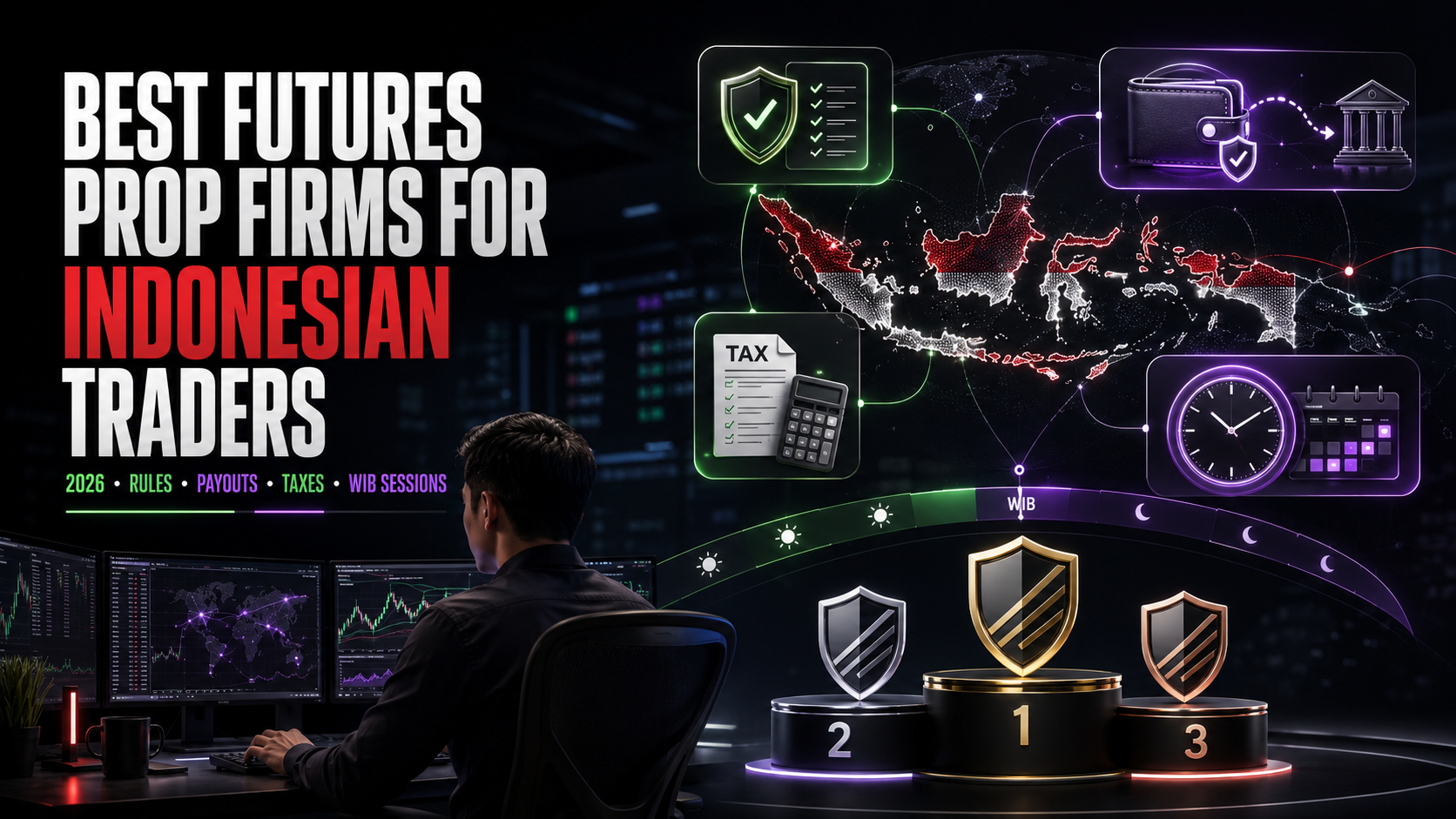
Best Futures Prop Firms for Indonesian Traders (2026): Rules, Payouts, Taxes & WIB Sessions
Where international futures prop firms stand under Bappebti and OJK, how to pay from Indonesia, rupiah payout routes via Wise and Indodax, the halal question, taxes, and CME hours in WIB. Trader scores refresh daily.
 Tradeify
 My Funded Futures
 Top One Futures
 Alpha Futures
 Apex Trader Funding
 Topstep
 Take Profit Trader
 Trade Day
 Funded Next Futures
Last updated: July 13, 2026
Indonesia is one of the three biggest prop trading markets on earth, behind only the US and India. Unlike most of the world, Indonesian traders arrive with a regulator-shaped map already in their heads. Bappebti licenses domestic forex brokers, blocks the illegal ones, and has trained a generation of traders to ask "is this legal?" before "is this profitable?" That instinct is exactly right, and this guide answers both questions for international CME futures prop firms: where they sit legally, how money gets in and out of rupiah, what the tax office expects, and which firms are treating traders well right now.
How we rank: our trader scores are based only on each firm's most recent reviews and refresh daily. A firm that paid reliably in 2023 but is delaying payouts today will score poorly here, and a newer firm treating traders well right now can outrank a legacy name. That is deliberate. In this industry, a firm is only as trustworthy as its latest payout. Scores shown were current on July 13, 2026, so check each firm's page for today's number.
Is Futures Prop Trading Legal in Indonesia?
Yes, and the reason why is worth understanding, because Indonesia's regulatory landscape is more developed than most countries where prop trading is booming.
Futures and commodity derivatives in Indonesia fall under Bappebti (Badan Pengawas Perdagangan Berjangka Komoditi), the futures regulator under the Ministry of Trade, which licenses domestic brokers and actively blocks illegal platforms. Financial services more broadly sit with OJK. International prop firms fit neither box: they operate outside Bappebti's jurisdiction as overseas service providers, and no Indonesian regulation prohibits a resident from buying an evaluation. What you are purchasing is a service. You pay for access to a simulated evaluation account, and if you pass, you trade a simulated funded account with performance-based payouts. You are not opening a foreign brokerage account or depositing trading capital abroad.
Three practical notes flow from this:
A prop firm claiming Bappebti or OJK regulation is a red flag, not a comfort. These firms are not licensable under either framework for this activity, so any such claim means the firm either misunderstands Indonesian law or is misrepresenting itself. Legitimate international firms simply state their own jurisdiction.
Nobody regulates these firms on your behalf. Bappebti protects you from illegal local brokers; it cannot help you if an offshore prop firm stops paying. The firm's current behavior is your only real protection, which is exactly why we track recent reviews daily instead of leaning on reputations.
Access can be a practical issue. Indonesia's internet filtering has blocked various offshore trading platforms over the years. The major CME futures firms are generally reachable, but before paying any firm, confirm you can reliably access its dashboard and platform from your own connection. A firm you cannot log into on payout day is a problem no rulebook fixes.
We are a review site, not lawyers or tax advisors. Nothing here is legal, tax, or religious guidance. For anything involving Bappebti compliance, your SPT, or Sharia questions, consult a qualified professional.
What Actually Matters for Indonesian Traders
1. Getting money in
Domestic e-wallets (GoPay, OVO, DANA, ShopeePay) rule Indonesian daily life but do not cross borders, so they cannot pay an international evaluation fee. The working options: an Indonesian Visa or Mastercard enabled for international transactions (watch the foreign-transaction surcharge your bank adds), a Wise transfer, or, for firms that accept crypto, buying USDT on a Bappebti-licensed exchange like Indodax or Tokocrypto and paying from there. That last route is popular because it is fast and keeps trading activity separate from your primary bank statement, but it only works with firms that take crypto payments, and it puts the documentation burden on you.
2. Getting money out
This is where Indonesia has a quirk most guides miss. Since May 2024, Wise no longer lets Indonesian residents hold balances. The eWallet function was discontinued under local regulatory pressure. Wise still works for payouts, but the money cannot sit there: it converts to rupiah and lands in a local account in the same motion.
That leaves two clean routes:
- USD via Wise, auto-converting to IDR into a major bank (BCA, Mandiri, BRI, BNI, CIMB Niaga) or directly into a local e-wallet. Mid-market conversion rates typically beat bank wire spreads by a meaningful margin, and the transfer limit (up to IDR 10 billion per transaction) is far above any realistic payout cycle. This is the simplest, best-documented route.
- USDT into a Bappebti-licensed exchange like Indodax, for traders who want to hold dollar-denominated value rather than convert immediately, waiting for a favorable rate before cashing to rupiah. Crypto is legal and regulated in Indonesia (oversight has been migrating from Bappebti to OJK), but keep records of every payout, conversion, and date, because the reporting burden is yours.
The currency math is worth pausing on. With the rupiah around 16,000 per dollar, a single $5,000 payout converts to roughly IDR 80 million, which covers many months of middle-class living costs in most of Indonesia. That asymmetry is why prop trading has exploded here, and it is also why the payout rail deserves as much attention as the trading: on sums that meaningful, a 2 to 3 percent difference between Wise rates and bank wire spreads is real money.
3. Taxes
Indonesia taxes residents on worldwide income at progressive rates from 5% to 35%. Prop firm payouts have no dedicated category; they are generally treated as other income or foreign service fees, reported in your annual SPT under your NPWP. The tax-free threshold (PTKP, currently IDR 54 million per year for a single taxpayer) applies first, which genuinely matters for traders starting small: modest early payouts may fall partly or wholly under it. Regular non-employment income can also trigger quarterly PPh 25 installments rather than one annual bill.
Keep it boring: report the payouts, keep the receipts from whichever rail you chose, and if the amounts grow, spend a little of one payout on a konsultan pajak who has seen foreign income before. The traders who get hurt at tax time are almost never the ones who reported; they are the ones who let three years of crypto conversions pile up undocumented.
4. The halal question
In the world's largest Muslim-majority nation, this is not a footnote. We cannot issue religious rulings, and scholars genuinely differ on funded trading. What we can do is lay out the facts traders weigh: futures prop accounts are day-trading focused, with positions closed before the session ends, so there is no overnight swap interest of the kind that makes conventional forex accounts problematic; the instruments are exchange-traded CME contracts rather than OTC contracts-for-difference against a dealer; and the evaluation fee is a fixed service charge, not interest. Whether the evaluation structure itself raises gharar concerns is where opinions divide. DSN-MUI has issued guidance on currency trading; funded futures programs are newer ground. If this matters to you, take the specific firm's model to a scholar you trust before you pay.
5. Latency and session hours
The CME's matching engines are near Chicago, and from Jakarta the raw round trip runs roughly 220 to 250 milliseconds. That is fine for swing entries and most intraday styles, punishing for scalps. Scalpers rent a Chicago-based VPS running their platform (Tradovate, NinjaTrader, Quantower) and cut execution to single digits.
The schedule, meanwhile, favors anyone with a day job. Indonesia spans three time zones with no daylight saving; for WIB (Jakarta), the highest-volume US window lands mid-evening:
| CME / US Market Event | WIB (US Summer) | WIB (US Winter) |
|---|---|---|
| Globex week open (Sun 6:00 pm ET) | 5:00 am Mon | 6:00 am Mon |
| US cash open (9:30 am ET) | 8:30 pm | 9:30 pm |
| Peak volume window (9:30 to 11:00 am ET) | 8:30 to 10:00 pm | 9:30 to 11:00 pm |
| US cash close (4:00 pm ET) | 3:00 am | 4:00 am |
Add one hour for WITA (Bali, Makassar) and two for WIT. Trading the New York open at 8:30 or 9:30 pm WIB is very livable alongside work or study. Just check each firm's position-flat deadlines around the daily Globex maintenance break, which lands in the WIB early afternoon, and be honest with yourself about whether you can hold discipline at 1 am if your style needs the later session.
Which Futures Prop Firms Accept Indonesian Traders?
The firms below are widely reported to accept Indonesian residents and appear in our daily-tracked rankings. Scores shown are our current trader scores at the time of writing. These change daily by design, because they are computed only from each firm's most recent reviews. Before buying anything, check the firm's live page for today's score and the firm's own terms for current country eligibility.
| Firm | Trader Score (Jul 13) | Indonesia Angle |
|---|---|---|
| My Funded Futures | 10 / 10 | Strongest recent performer in our tracking; crypto payout options pair with the USDT-to-Indodax route for traders holding dollar value. |
| FundedNext Futures | 9.6 / 10 | Large existing Southeast Asian user base and broad payment options; newer futures program with a smaller recent-review sample. |
| Tradeify | 9.0 / 10 | One-time pricing with no activation or data fees keeps the card-surcharge math simple; has changed country eligibility abruptly before, so confirm Indonesia at checkout. |
| Trade Day | 8.7 / 10 | Smaller, steadier operation; recent reviews skew reliable on payouts. |
| Apex Trader Funding | 8.5 / 10 | Cheapest entry via near-constant promos, which matters when fees are paid in rupiah; recent reviews more polarized on verification and closures. |
| Topstep | 6.9 / 10 | Longest track record (2012), but our recent tracking shows a cluster of KYC and account-closure complaints. Document verification is where international friction bites hardest. |
My Funded Futures: 10/10
MFFU has been the strongest recent performer in our tracking, with recent reviews centering on fast, hassle-free payouts and responsive support. Its crypto payout options fit naturally with the Indodax/Tokocrypto route many Indonesian traders already use. Just keep the documentation discipline described above. Read our full My Funded Futures review →
FundedNext Futures: 9.6/10
FundedNext built one of the largest trader bases in Southeast Asia on the forex side, which translates into payment flexibility and support familiarity with the region. The futures program is newer than the firm's legacy business, and our score reflects a smaller recent-review sample, so weight it accordingly. Read our full FundedNext Futures review →
Tradeify: 9.0/10
One-time pricing with no activation, exchange, or data fees makes the total cost unusually predictable, a virtue when your bank adds a foreign-transaction surcharge to every dollar charged. Payouts run through Rise with crypto and bank rails. Recent reviews are strongly positive on payout speed and rule transparency. One caution: Tradeify has changed country eligibility abruptly before (Morocco, 2026), so confirm Indonesia remains supported at checkout. Read our full Tradeify review →
Trade Day: 8.7/10
A smaller, steadier operation with real-market execution focus and recent reviews that skew reliable on payouts. Worth a look for traders who prioritize operational consistency over aggressive pricing. Read our full Trade Day review →
Apex Trader Funding: 8.5/10
The volume leader on price. Near-constant promotions make Apex the cheapest entry point to a large evaluation, which matters more when every dollar of fee costs sixteen thousand rupiah. Its March 2026 overhaul moved to one-time fees with an EOD drawdown option. Recent reviews are more polarized than the top of this list: fast, smooth payouts for many, verification and account-closure complaints from others. At promo prices the risk-per-attempt is low, but go in with eyes open. Read our full Apex Trader Funding review →
Topstep: 6.9/10
The industry's longest track record (est. 2012) and the safest name historically, which is precisely why its current score is worth your attention: our recent-review tracking has picked up a meaningful cluster of KYC and account-closure complaints alongside the usual satisfied payouts. For Indonesian traders, KYC is not theoretical. Document verification is where international friction concentrates. This is a firm where "check today's score" is not a disclaimer, it is the whole point. Read our full Topstep review →
Also tracked: Take Profit Trader (7.8), Earn2Trade (7.2), and Lucid Trading (6.7) all accept international traders and appear in our daily rankings, each with sharper trade-offs in recent reviews. See their firm pages for current scores and details.
Promo codes and discounts change frequently. Any discount mentioned on our firm pages should be verified at checkout before purchase.
How to Choose: A Checklist for Indonesian Traders
Before You Pay
- Confirm Indonesia is accepted, in writing, on the firm's own terms page. Screenshots dated. Policies change.
- Confirm you can actually reach the firm's site and platform reliably from your own connection before money moves.
- Check today's trader score, not last year's reputation. Recent payout behavior is the only behavior that matters.
- Price the fee honestly: sticker price plus your card's foreign-transaction surcharge, or the Wise route. Compare once, keep the winner.
Before You Trade
- Pick your payout rail now: Wise-to-IDR for simplicity, or USDT-to-Indodax to hold dollar value. Keep every receipt from day one.
- Match rules to the 8:30 to 11:00 pm WIB window. Check daily loss limits and consistency rules against a one-evening-session rhythm.
- If you scalp, budget for a Chicago VPS. Around 240 ms from Jakarta is a real cost in slippage.
- Report the income. SPT filing with your NPWP, PTKP threshold first, and a konsultan pajak once the numbers grow.
Indonesia Prop Trading FAQ
Is it legal for Indonesian residents to join an international futures prop firm?
Yes. Futures and commodity derivatives fall under Bappebti, but international prop firms operate outside its jurisdiction as overseas service providers, and no Indonesian regulation prohibits residents from buying an evaluation. You are paying for a service, not opening a foreign brokerage account. Payouts must be declared as income in your annual SPT.
How do I pay a prop firm evaluation fee from Indonesia?
Indonesian Visa and Mastercard cards generally work with international firms, though foreign-transaction surcharges apply. Wise transfers are an alternative. Domestic e-wallets (GoPay, OVO, DANA) do not work internationally. Some traders buy USDT on a Bappebti-licensed exchange like Indodax or Tokocrypto and pay firms that accept crypto.
What is the best payout method for Indonesian traders in 2026?
USD via Wise converting to rupiah into a major Indonesian bank (BCA, Mandiri, BRI, BNI, CIMB Niaga). Since May 2024 Wise no longer lets Indonesian residents hold balances, so funds must convert and land locally in one motion. Traders who want to hold dollar value often take USDT payouts into a Bappebti-licensed exchange instead.
How are prop firm payouts taxed in Indonesia?
Indonesia taxes residents on worldwide income at progressive rates from 5% to 35%. Prop payouts are generally treated as other income or foreign service fees, reported in the annual SPT, with the PTKP tax-free threshold (IDR 54 million for a single taxpayer) applying first. Quarterly PPh 25 installments can apply to regular non-employment income. Consult a local tax professional.
Is futures prop trading halal?
Scholars differ, and we cannot rule on it. The facts traders weigh: futures prop accounts are day-trading focused with no overnight swap interest, the instruments are exchange-traded rather than OTC CFDs, and evaluation fees are fixed service charges. Whether the evaluation structure raises gharar concerns is where opinions divide. Consult a scholar familiar with DSN-MUI guidance before deciding.
What time do US futures trade in Indonesian time?
For WIB (Jakarta), the US cash session runs roughly 8:30 pm to 3:00 am, an hour later during US winter. The highest-volume window is the first 90 minutes after the US open, around 8:30 to 10:00 pm WIB in US summer. Add one hour for WITA and two for WIT.
Do I need a VPS to trade from Indonesia?
Not for swing or slower intraday trading. Jakarta to Chicago latency runs roughly 220 to 250 milliseconds, fine for most styles but costly for scalping. Scalpers typically rent a Chicago-based VPS to bring execution latency down to single digits.
Final Word
Indonesian traders come to this with an advantage and a burden. The advantage: a regulatory culture that already taught you to verify before you deposit, an instinct that transfers perfectly to an industry where the regulator cannot save you and the firm's recent behavior is the only truth. The burden: the money loop has more moving parts here than almost anywhere. A Wise that cannot hold balances, e-wallets that stop at the border, a crypto rail that is legal but paperwork-heavy, and a rupiah conversion where small percentages are real money.
So work the loop before the first trade: confirm eligibility and access, price the fee in rupiah honestly, pick one payout rail and document everything, file the SPT, and, if it matters to you, settle the halal question with a scholar before the first fee, not after the first payout. And because this industry's real risk is a firm that quietly stops paying, check the current trader score on the day you buy. That is the whole reason our scores refresh daily: yesterday's reputation is not today's payout.
Trader scores are generated from each firm's most recent public reviews, aggregated and summarized by our scoring system, and refresh daily. They do not represent our endorsement or criticism of any firm. Educational content only, never personalized financial, legal, tax, or religious advice. Prop trading involves risk of losing evaluation fees; most participants do not reach a payout.