
My Funded Futures
 QuantTower
 NinjaTrader
 Tradovate
 TradingView
 ATAS
VolSys
ATAS
VolSys
 Volumerica
Tradovate
Volumerica
Tradovate
 DXFeed
 Rise
Rise
 Wire
Wire
 ACH
ACH
| Date | Overall Score | |
|---|---|---|
| 2026-09-17 | 10.0 | |
| 2026-09-15 | 10.0 | |
| 2026-09-14 | 9.1 | |
| 2026-09-13 | 9.2 |








Last updated: July 8, 2026
My Funded Futures Review: Rules, Accounts, Payouts, Discounts & Trader Details
My Funded Futures (MFFU) is one of the most highly rated futures prop firms operating today — a US-based firm founded in late 2023 by Matthew Leech, carrying a Trustpilot score near 4.9 across tens of thousands of reviews and a reputation for near-instant payout approvals. Its 2026 lineup runs four single-step plans — Rapid, Flex, Pro, and Builder — each with its own drawdown style, payout cadence, and split, plus a genuine path from simulated funding to a real-capital live account.
Quick verdict: MFFU suits futures traders who want to match the plan to their style — fast daily payouts, cheap entry, larger sizes, or a beginner-friendly build. Before you buy, know the differences: Rapid pays daily at 90/10 but switches to intraday trailing once funded, Flex scales contracts by profit, Pro pays every 14 days with a buffer, and Builder is the cheapest 50K with a daily loss limit. It's billed monthly, and the 50% evaluation consistency rule on most plans is the main thing that slows a pass.
My Funded Futures Quick Facts
| Category | Details |
|---|---|
| Firm Name | My Funded Futures (MFFU / MFF) |
| Website | myfundedfutures.com |
| Help Center | My Funded Futures Help Center |
| Company / Founder | MyFundedFutures LLC, Fort Worth, Texas; founded 2023 by Matthew Leech |
| Support | Help center, live chat, and a large Discord community; fast payout approvals |
| Markets | CME futures only (index, energy, metal, agricultural, and micro contracts) |
| Account Sizes | $25K, $50K, $100K, and $150K (range varies by plan) |
| Trading Environment | Single-step simulated evaluation and Sim Funded accounts, with a real-capital live stage |
| Profit Split | 90/10 on Rapid; 80/20 on Flex, Pro, and Builder |
| Max Funded Accounts | Up to 5 Sim Funded accounts (10 total including evaluations); size limits apply |
| Payout Processor | Rise; most payouts approved within minutes to a few business days |
How We Reviewed My Funded Futures
This review is built from MFFU's own materials: the homepage and pricing, the help-center guides for the Rapid, Flex, Pro, and Builder plans, the payout and live-transition policies, and the drawdown and consistency-rule articles. Pricing, rules, payout caps, and current promos were checked in early July 2026.
A note on the moving target: MFFU restructured its lineup in July 2025 — the old Starter, Expert, and Milestone plans were retired and replaced with the current families, and activation fees were removed across the board. In January 2026 the Rapid split rose from 80/20 to 90/10 and daily loss limits were dropped from funded accounts on most plans. Any older review mentioning Starter/Expert/Milestone or activation fees is out of date, so we've used the current plans throughout. (MFFU is also not the same firm as Funded Futures Family, despite the similar name.)
My Funded Futures Account Types
Every MFFU plan is a single-step evaluation: hit the profit target while respecting the max loss limit, trade the minimum days, and you advance to a Sim Funded account. What separates the plans is how the drawdown behaves once funded, how often you can withdraw, and how big the split is.
Rapid is the flagship for active traders: a 90/10 split and daily payouts, but the drawdown switches to intraday trailing once funded — the most aggressive structure in the lineup. Flex is the low-cost, no-daily-loss-limit route with EOD trailing that stays EOD when funded, paying every 5 winning days at 80/20 with a contract-scaling plan. Pro targets serious traders who want full contract size immediately and larger accounts, paying every 14 days at 80/20 after clearing a buffer. Builder is the newest and most beginner-friendly — a 50K-only plan with a $1,000 soft-pause daily loss limit, no evaluation consistency rule (pass in one day), and 48-hour payouts. All four lead to a real-capital live account.
My Funded Futures Account Comparison
| Plan | Sizes | Funded Drawdown | Daily Loss Limit | Eval Consistency | Split | Payout Cadence |
|---|---|---|---|---|---|---|
| Rapid | $25K–$150K | Intraday trailing | None | 50% | 90/10 | Daily |
| Flex | $25K–$50K | EOD trailing | None (optional add-on) | 50% | 80/20 | Every 5 winning days |
| Pro | $50K–$150K | EOD trailing | None | 50% | 80/20 | Every 14 days (buffer) |
| Builder | $50K only | EOD trailing | $1,000 (soft pause) | None (50% at payout) | 80/20 | Every 48 hours |
Rapid, Flex, and Pro share the same profit targets and max loss limits at each size — roughly $3,000 target / $2,000 drawdown on the $50K, scaling to $9,000 / $4,500 on the $150K (the $25K is $1,500 / $1,000). All require a minimum of 2 trading days to pass. Contract limits differ by plan: Rapid is the most generous (5 minis on the $50K, up to 15 on the $150K), Pro is tighter, and Flex scales contracts by accumulated profit. Builder shares the same $50K target and drawdown but offers two max-loss options at checkout ($2,000 default or $1,500 for a lower price).
My Funded Futures Cost to First Payout
MFFU is a monthly subscription that rebills until you pass or cancel, with no activation fee — so your real cost depends on how fast you pass and which plan's buffer and cadence you're working with. Here's a practical view of the entry points on current discounted pricing.
| Plan / Size | Monthly (from) | Activation Fee | Buffer Before Payout | Min. Payout | Practical Takeaway |
|---|---|---|---|---|---|
| Builder $50K | ~$75–$153 | $0 | None (starts at $0 balance) | $500 | Cheapest 50K entry; 1-day pass, but a $1,000 daily loss limit applies throughout. |
| Flex $25K | ~$49–$95 | $0 | None (starts at $0 balance) | $250 | Lowest-cost route with no daily loss limit; contracts scale with profit. |
| Rapid $50K | ~$126–$157 | $0 | None | $500 | Daily payouts and 90/10, but the funded drawdown is intraday trailing. |
| Pro $50K | ~$113–$227 | $0 | $2,100 (one early payout allowed) | $1,000 | Full contract size and no per-request cap, but a 14-day cadence and buffer. |
The cost realities to weigh: because it's monthly, a slow pass multiplies your spend, so factor in more than one month if you're not confident of a quick pass. Pro adds a buffer you must clear before regular payouts (though it allows one early payout of up to 60% of profits before the buffer is met), and Flex and Builder start their funded balance at $0, so the account can sit slightly negative until the drawdown trails up to breakeven.
My Funded Futures Rules Explained
Drawdown: EOD vs Intraday
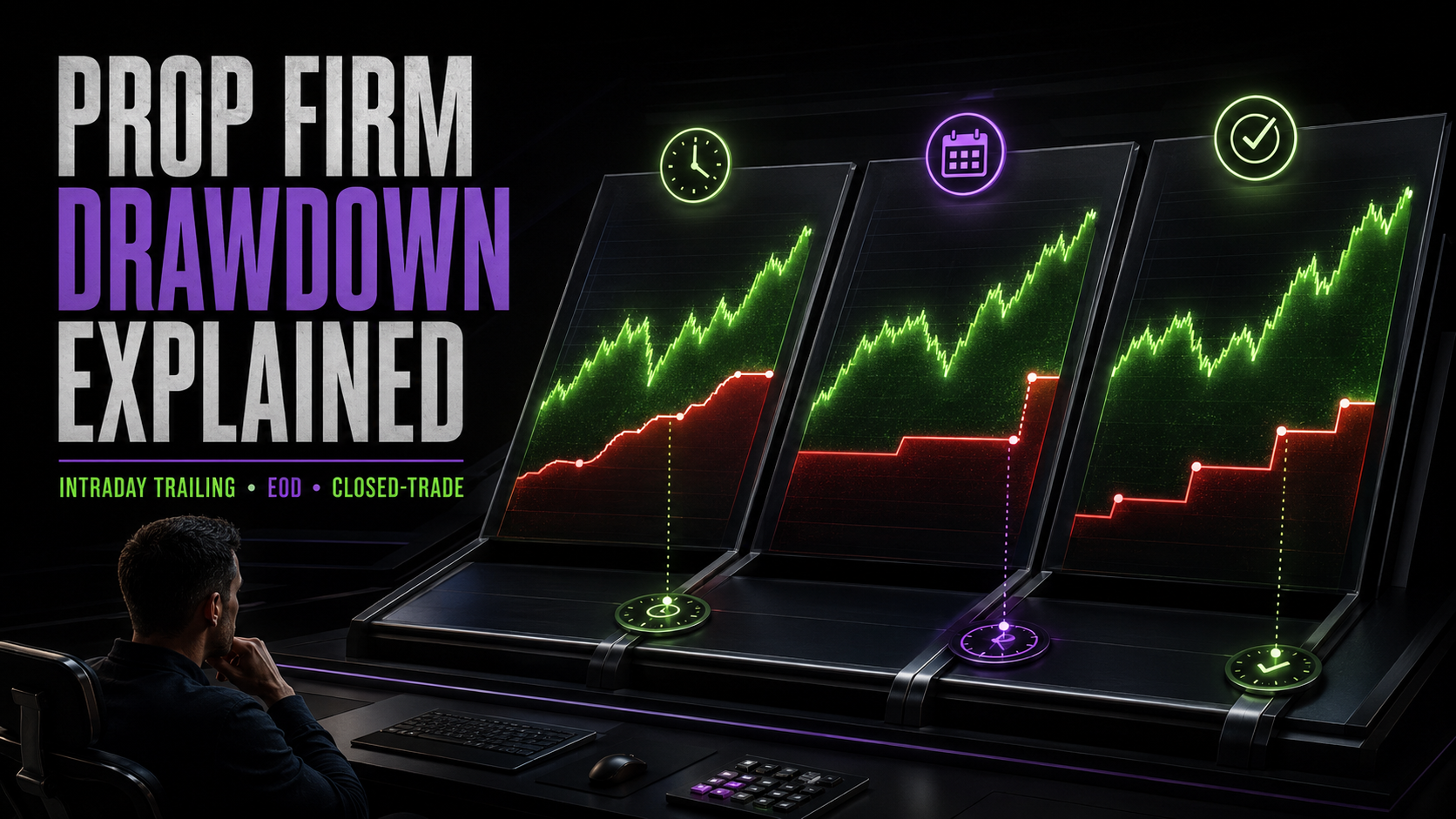
This is the most important distinction at MFFU. Flex, Pro, and Builder use an end-of-day trailing max loss limit — it only recalculates at the close based on your closing balance, so intraday swings you recover from don't move it. Rapid uses EOD trailing during the evaluation but switches to intraday trailing once funded, following your equity high-water mark in real time (including open profit). That switch is the single biggest trap for Rapid traders. On all plans, the trailing floor locks once it reaches your starting balance plus $100, then becomes static.
Daily Loss Limit
Most MFFU plans have no daily loss limit — the firm removed them from funded accounts in January 2026, leaving the trailing drawdown as the main guardrail. The exception is Builder, which carries a $1,000 soft-pause daily loss limit through evaluation, sim funded, and live. Flex also offers an optional daily-loss-limit add-on at checkout on the $50K. A soft pause ends your trading day but doesn't fail the account.
Consistency Rule
Rapid, Flex, and Pro apply a 50% consistency rule during the evaluation only — no single day may exceed 50% of your total evaluation profit. It disappears on funded Rapid and Pro accounts (Flex has none once funded either). Builder flips this: no consistency rule to pass, but a 50% rule applies at payout time in the funded stage. The 50% eval rule is usually what turns a would-be one-session pass into a one-to-two-week grind.
Minimum Days & Contracts
Most plans need a minimum of 2 trading days to pass; Builder can be passed in 1. Contract limits are fixed by plan and size on Rapid and Pro, while Flex scales your contracts up as your funded balance grows. Micros count 10:1 against minis on most plans (note Pro's funded micro scaling is 1:1).
Hours & News
MFFU allows news trading across evaluations and most funded stages, with the notable exception that Pro sim-funded accounts can't trade Tier 1 events (no positions or orders within two minutes of a T1 release). All positions must be closed before the session close — no overnight or weekend holds — and trading is suspended when a product trades within about 2% of its CME price limit. Automation and HFT-style strategies are restricted.
My Funded Futures Consistency Rule Example
Take a Rapid or Flex $50K evaluation with a $3,000 profit target and the 50% consistency rule. No single day may account for 50% or more of your total evaluation profit, so if you bank $1,600 on one session toward the target, you're over the line and need at least one more solid green day to bring that day's share back under 50% before the evaluation clears. In practice, that means a one-outlier-session pass usually turns into one-to-two weeks of structured trading. On Builder there's no eval consistency rule at all, but the same 50% test applies to each payout cycle once you're funded.
My Funded Futures Rule Traps to Watch
Important Rule Risks
- Rapid's drawdown switches to intraday trailing once funded — the same trading that passed can breach a funded Rapid account.
- The trailing floor locks at starting balance + $100 and never moves down, so a bad day after withdrawing can breach you.
- The 7-day inactivity rule on sim funded accounts is tighter than many competitors' 30-day rules.
- A live account breach triggers a 21-day cooldown with no trading or new purchases.
Before You Buy
- Pick EOD plans (Flex, Pro, Builder) if you dislike intraday trailing; Rapid only if you scalp tight.
- Cancel the monthly subscription manually if you stop — it keeps billing until you pass or cancel.
- On Pro, plan around the buffer and the 14-day cadence before expecting regular cash.
- Place at least one trade a week on funded accounts to avoid the inactivity close.
Payout Rules
Payouts run through Rise and are known for fast approvals — often within minutes, with funds typically landing in one to three business days. Splits and cadence depend on the plan: Rapid pays daily at 90/10, Flex every 5 winning days at 80/20, Pro every 14 days at 80/20, and Builder every 48 hours at 80/20. Minimum withdrawals are $250 (Flex), $500 (Rapid and Builder), and $1,000 (Pro).
| Plan | Frequency | Split | Min. Payout | Buffer / Cap | Path to Live |
|---|---|---|---|---|---|
| Rapid | Daily | 90/10 | $500 | No buffer | Auto at $10K profit in a day, or risk-team review |
| Flex | Every 5 winning days | 80/20 | $250 | Per-request caps by size | After 5 payouts or $100K withdrawn |
| Pro | Every 14 days | 80/20 | $1,000 | Buffer $2,100–$4,600; no per-request cap | 3 payouts or $20K milestone (review) |
| Builder | Every 48 hours | 80/20 | $500 | Capped $2,000/cycle, 5 cycles total | Auto after 5th payout |
A couple of things to plan around. On Pro, you must clear a buffer ($2,100 on the $50K up to $4,600 on the $150K) before regular payouts, though one early payout of up to 60% of profits is allowed first. On Rapid, hitting $10,000 of net profit in a single day auto-transitions you to a live account — and up to $5,000 of your sim profit is set aside in a Live Reserve during that transition (paid out later as a bonus or if the live account is breached, not forfeited). Live transitions are mandatory once you're selected, merging your sim accounts into one live account.
Platforms & Data
MFFU supports a solid mid-tier platform lineup. Commonly listed options include Tradovate, NinjaTrader, TradingView, and Quantower, backed by Rithmic/CME data. Real-time data comes with the platform connection, and there's no separate data subscription baked into the evaluation.
Listed Platforms
- Tradovate
- NinjaTrader
- TradingView
- Quantower (and Rithmic-backed connections)
- Real-time CME data included with the connection
Platform Notes
- Scalping is allowed, with a minimum trade requirement (trades of at least a few ticks).
- News trading is broadly allowed, except Tier 1 events on Pro sim-funded accounts.
- Automated bots and HFT-style strategies are restricted.
- Third-party platform licensing (e.g. some NinjaTrader setups) may carry its own cost.
Fees, Resets & Refund Policy
Every MFFU plan is billed monthly and rebills until you pass or cancel — there are no activation fees on any plan, and no separate data fee. If you fail an evaluation, you can purchase a reset at a reduced price rather than a full new evaluation. Because the model is a subscription, the key "fee" to manage is simply making sure you cancel if you stop trading, since it will keep charging otherwise.
Fees are generally non-refundable. Builder offers a lower price if you choose the tighter $1,500 max-loss option at checkout (versus the $2,000 default), trading a smaller cushion for a lower cost.
| Fee Type | My Funded Futures Policy / Details |
|---|---|
| Evaluation Fee | Monthly subscription by plan and size; rebills until you pass or cancel |
| Activation Fee | $0 on all plans |
| Reset Fee | Reduced-price reset available after a failed evaluation |
| Data / Platform Fees | Real-time data included with the platform connection; commissions apply on trades |
| Builder Max-Loss Option | $2,000 (default) or $1,500 (lower price, smaller cushion) chosen at checkout |
| Refunds | Fees are generally non-refundable; cancel the subscription manually to stop billing |
My Funded Futures Discount Code
MFFU runs some of the most aggressive, plan-specific discounts in the space — commonly 20% to 50% off — with codes that target individual plan families. Widely circulated current codes include RAPID (around 20% off Rapid), BUILDER (Builder from about $75), UNCAPPED (up to 50% off Pro for new users), and STEADY (Flex 25K discounts). Because MFFU rotates these often and tiers them by plan and new-vs-existing user, the exact code and percentage change frequently.
| Promotion | Details |
|---|---|
| Rapid | Code RAPID — advertised around 20% off Rapid accounts |
| Builder | Code BUILDER — Builder 50K advertised from about $75 |
| Pro | Code UNCAPPED — advertised up to 50% off Pro for new users |
| Flex | Code STEADY — Flex 25K discounts |
| Best Practice | Codes rotate and are plan-specific; enter at checkout and verify the final price |
Pros & Cons
Pros
- One of the highest-rated futures firms, with fast payout approvals
- Four plans to match cost, speed, and style
- No activation fees on any plan
- 90/10 split and daily payouts on Rapid
- No daily loss limit on most funded accounts
- A genuine path from sim funding to real capital
Cons
- Rapid's funded drawdown switches to intraday trailing
- Monthly subscription means a slow pass adds up
- Pro's buffer and 14-day cadence slow early cash flow
- 7-day inactivity rule is tighter than many competitors
- 50% eval consistency rule can delay a pass
- 21-day cooldown after a live breach
Who My Funded Futures Is Best For
- Active futures traders who want fast, frequent payouts (Rapid's daily 90/10)
- Cost-sensitive traders who want a cheap entry (Builder or Flex)
- Traders who prefer end-of-day trailing over intraday (Flex, Pro, Builder)
- Disciplined traders who stack steady green days rather than one big session
- Traders who value a real, structured path to live capital
Who My Funded Futures May Not Be Ideal For
- Scalpers who dislike Rapid's funded intraday trailing drawdown
- Traders who prefer a one-time fee over a monthly subscription
- Traders who make most of their profit in single large days
- Swing traders who need overnight or weekend holds
- Traders who rely on automated bots or HFT strategies
Best Alternatives to My Funded Futures
Traders comparing MFFU may also want to look at firms with a one-time fee, a longer track record, or a different funded structure.
| Alternative | Why Compare It |
|---|---|
| Apex Trader Funding | Worth comparing for one-time fees, a larger multi-account ceiling, and a choice of drawdown models. |
| Tradeify | A close peer with one-time pricing, EOD drawdown, and a similar path to live capital. |
| Take Profit Trader | Useful for day-one, uncapped withdrawals and a simple one-step evaluation. |
My Funded Futures FAQ
Is My Funded Futures legit?
Yes. MFFU is a US-based futures prop firm founded in 2023 by Matthew Leech, with a Trustpilot rating near 4.9 across tens of thousands of reviews and a reputation for fast payout approvals. Its main caveat is a relatively short operating history.
What are the My Funded Futures plans?
Four single-step plans: Rapid (daily payouts, 90/10, intraday funded drawdown), Flex (low-cost, EOD, contract scaling), Pro (larger sizes, 14-day payouts, buffer), and Builder (cheapest 50K, daily loss limit, 1-day pass).
Does the drawdown change after I pass?
On Rapid, yes — it uses EOD trailing during the evaluation but switches to intraday trailing once funded. Flex, Pro, and Builder stay on EOD trailing into the funded stage. This is the most important nuance to plan for.
Does MFFU have an activation fee?
No. Activation fees were removed across all plans in the 2025 restructure. The monthly subscription is the only mandatory cost, plus trading commissions.
How do My Funded Futures payouts work?
Splits and cadence vary by plan: Rapid pays daily at 90/10, Flex every 5 winning days at 80/20, Pro every 14 days at 80/20, and Builder every 48 hours at 80/20. Minimums range from $250 (Flex) to $1,000 (Pro). Payouts run through Rise, usually approved fast.
Is there a consistency rule?
Rapid, Flex, and Pro apply a 50% consistency rule during the evaluation only (removed once funded on Rapid and Pro; Flex has none funded). Builder has no eval consistency rule but applies a 50% rule at payout time in the funded stage.
How many accounts can I hold?
Up to 5 Sim Funded accounts at once (10 total including evaluations), with size-based limits — five at once if they're all 25K/50K, or up to three for 100K/150K. Extra passed evaluations go dormant until a funded slot opens.
What is the My Funded Futures discount code?
MFFU runs plan-specific codes such as RAPID, BUILDER, UNCAPPED (Pro), and STEADY (Flex), commonly 20–50% off. Codes rotate and are tied to specific plans and new-vs-existing users, so confirm the current offer at checkout.
Recent Updates
- July 8, 2026: Refreshed the full page across Rapid, Flex, Pro, and Builder — current rules, pricing, payout cadences, platforms, and plan-specific promos, using official sources.
- Rapid split raised to 90/10 (Jan 12, 2026): Applied to new and existing Rapid accounts, and daily loss limits were removed from funded accounts on most plans.
- Builder plan added: A beginner-friendly 50K plan with a $1,000 soft-pause DLL, no eval consistency rule, 1-day pass, and 48-hour payouts.
- 2025 restructure: The old Starter, Expert, and Milestone plans were retired for the current lineup, and activation fees were eliminated firm-wide.
Final Verdict
My Funded Futures has earned one of the cleanest reputations in the futures prop space by getting the essentials right: no activation fees, fast payout approvals, a broad set of plans, and a real path to live capital. The four-plan structure is genuinely useful — Rapid for daily-payout scalpers who want the 90/10 split, Flex for a cheap no-DLL start, Pro for larger sizes and uncapped requests, and Builder as an approachable, low-cost 50K.
The trade-offs are plan-specific and worth reading closely. Rapid's funded drawdown switches to intraday trailing (the firm's most aggressive structure), Pro's buffer and 14-day cadence slow early cash flow, the monthly subscription rewards a fast pass, and the 7-day inactivity rule is tighter than most. The takeaway: MFFU rewards traders who match the right plan to their style and manage the drawdown and consistency rules with discipline. For that trader — especially with the current plan-specific discounts — it's one of the strongest and most trusted options in the field, well worth comparing against the other major futures firms.