Prop Firm Drawdown Explained: Intraday Trailing vs EOD vs Closed-Trade
Roughly 70 percent of failed evaluations die on the loss limit, not the profit target, and most of those deaths come from misunderstanding the drawdown model. Here is how all four models work, the same trade surviving one and dying in another, and which firms use which.
 Tradeify
 My Funded Futures
 Top One Futures
 Alpha Futures
 Apex Trader Funding
 Lucid Trading
 BlueSky Funded
 Topstep
 Take Profit Trader
 Trade Day
 Phidias
 Earn2Trade
 Bulenox
 Funded Next Futures
 Blue Guardian Futures
 The Trading Pit
 Funded Futures Family
 E8 Markets
 Daytraders
 Elite Trader Funding
 Funded Futures Network
 Hola Prime
 Blueberry Futures
 Taurus Arena
 Humble Futures
 Legends Trading
 Savius
 Futures Elite
 NexGen Protrader
 Funded Seat
 YRM Prop
 The5ers
Last updated: July 13, 2026
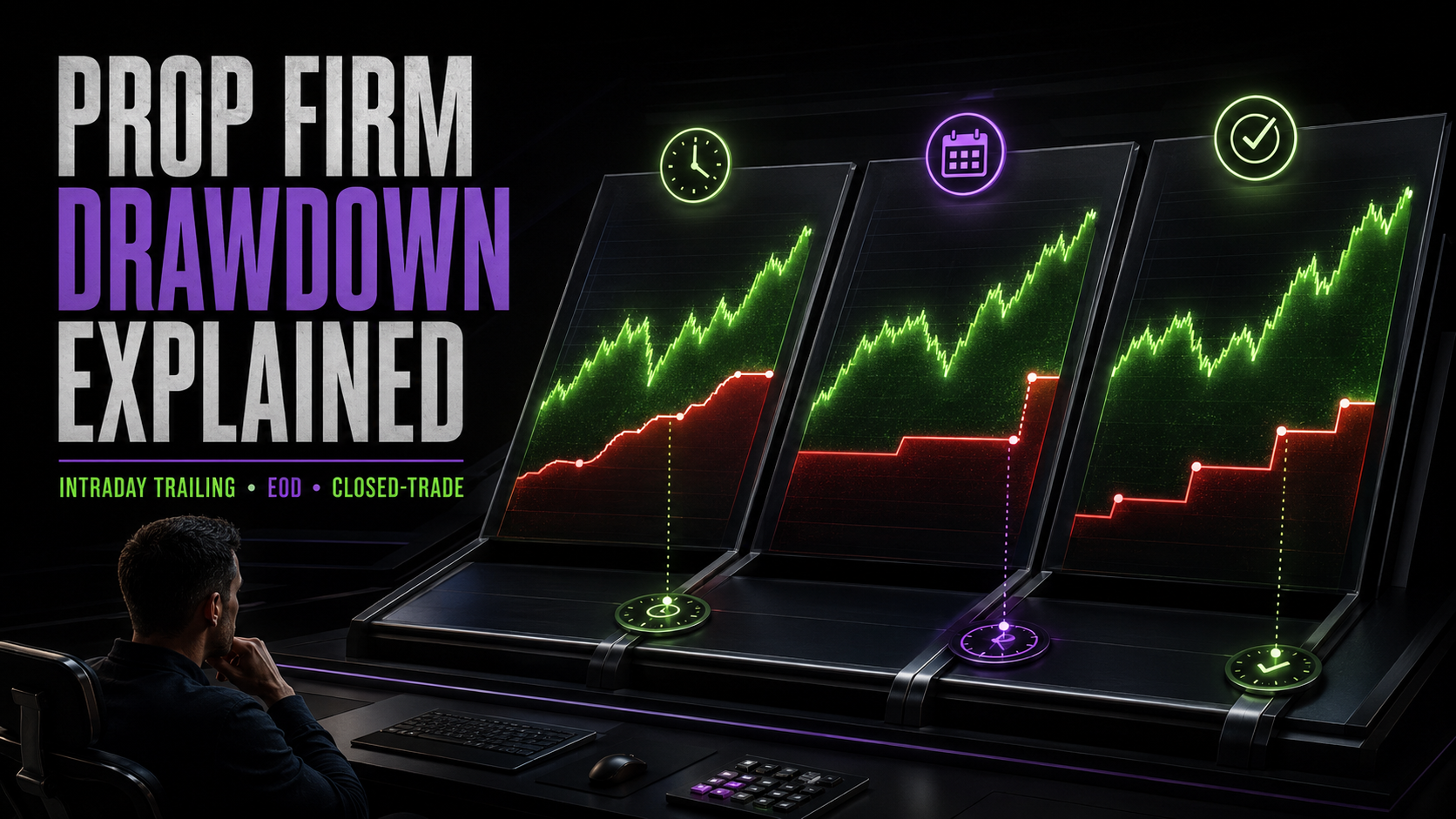
Here is the statistic that should reorganize how you think about evaluations: industry analyses attribute roughly 70 percent of failures to hitting the loss limit, not missing the profit target, and a large share of those happen in the first week. The profit target is not what kills accounts. The drawdown does, and most of the time it kills accounts whose owners did not fully understand which drawdown model they were trading under. This guide explains all four models, walks the exact same trade sequence through each one so you can watch it survive in one and die in another, and lists which futures firms use which model as of mid-2026.
Drawdown Basics in 60 Seconds
Your drawdown (firms also call it Maximum Loss Limit, trailing threshold, or auto-liquidation level) is the account value at which the firm closes your positions and fails or suspends the account. On a $50,000 account with a $2,000 drawdown, that level starts at $48,000. In a trailing model, the level follows your equity upward as you profit and never retreats: make $1,000 and your floor becomes $49,000; give the $1,000 back and you are breached, even though you are back at your starting balance. In a static model, the floor stays at $48,000 forever. Nearly all futures firms use trailing models, and many lock the floor at (or just above) your starting balance once you are far enough in profit, which converts the account into "can no longer lose the firm money" mode.
Everything that matters lives in one question: what moves the floor up? There are four answers, and they create four completely different trading experiences.
The Four Models
| Model | What Moves the Floor | Forgiveness Level | Typical Users |
|---|---|---|---|
| Intraday (real-time) trailing | Your highest unrealized equity, tick by tick, including open positions | Least forgiving | Apex classic accounts, many Rithmic-based evals |
| End-of-day (EOD) trailing | Your closing balance at session end; intraday swings do not move it | Forgiving | Topstep (set EOD), Tradeify, FundedSeat, Apex EOD option, Taurus Arena add-on |
| Closed-trade trailing | Only closed winning trades that set a new equity high | Most forgiving of trailing models | NexGen ProTrader |
| Static | Nothing; fixed floor below starting balance | Most forgiving overall, and rare | Occasional promo account types |
The Same Trade Under All Four Models
Watch one realistic sequence destroy an account under one model and pass unharmed under the others. Setup: $50,000 account, $2,000 trailing drawdown, floor starting at $48,000, flat account, day one.
The trade: you go long two contracts. The trade works: your open profit runs to +$1,500. You hold for your target. The market retraces hard, your open profit collapses to -$600, and you exit for a $600 realized loss. Painful, but a normal day for a trend trader. Your balance: $49,400.
Intraday Trailing: BREACHED
The floor trailed your open profit in real time. At +$1,500 unrealized, your peak equity was $51,500, so the floor rose to $49,500. When the retrace pulled your equity down through $49,500, the platform liquidated you and failed the account. You never banked a dollar, and a trade you managed reasonably ended your evaluation. This is the single most common way traders lose intraday-trailing accounts.
EOD Trailing: SAFE
The floor only updates at session close from your closing balance. All day it stayed at $48,000; your worst equity was $49,400, never close to it. At tonight's close, the floor recalculates from your $49,400 balance... and since you are below your starting high, at most firms it simply stays at $48,000. You live to trade tomorrow with $1,400 of room intact.
Closed-Trade Trailing: SAFE
The floor moves only when you close a winning trade at a new equity high. You closed a losing trade, so the floor never moved from $48,000. Even better: tomorrow, if you close a winner at +$700 (balance $50,100, a new high), the floor rises only then, and only to $48,100. Open-trade excursions can never hurt you in this model, in either direction.
Static: SAFE
The floor is $48,000 forever regardless of your equity path. You have $1,400 of room and nothing to recalculate. Static drawdowns are the simplest model and the rarest, because they give the firm the least protection.
Same trader, same trade, same risk management. One failed account, three healthy ones. The drawdown model is not fine print; it is arguably the single most important rule you are buying.
Which Firms Use Which (mid-2026)
| Firm | Model | Notes Worth Knowing |
|---|---|---|
| Topstep | EOD-set trailing, monitored in real time | The Maximum Loss Limit is set from end-of-day balances, but it is enforced live including open positions: an open trade dipping into the limit liquidates you. After your first funded payout, the MLL resets to $0 permanently |
| Apex Trader Funding | Intraday trailing classic; EOD option since 2026 | The classic intraday model is the one in our worked example's breach scenario; the newer EOD option changes the math entirely. Know which account type you are buying |
| Tradeify | EOD trailing | Floor recalculates at session close only |
| FundedSeat | EOD trailing, all models | Floor locks permanently once profits exceed the drawdown amount by $100 |
| Taurus Arena | Trailing; $19 EOD conversion add-on | The add-on converts real-time trailing to session-close trailing, arguably the best-value structural upgrade in futures prop |
| NexGen ProTrader | Closed-trade trailing | Floor moves only on closed winning trades at new highs; no daily loss limit, with a session halt at 50% of remaining drawdown |
Firms revise these rules regularly, and several changed models within the past year. Treat this table as a map, and each firm's current help-center documentation as the territory. Our firm reviews track rule changes with dated changelogs.
Strategy Implications
- If you let winners run and tolerate retracement, intraday trailing actively fights your strategy. Pay for EOD or closed-trade models; the fee difference is cheaper than the resets.
- If you scalp with tight stops, intraday trailing costs you little, since you rarely carry large open profit; the cheaper intraday accounts can be rational for you.
- Size from the drawdown, not the balance. On a $50K account with a $2,000 drawdown, you are really trading a $2,000 account with $50K of buying power. Passers in industry data risk roughly 0.5 to 1 percent of the drawdown-adjusted account per trade; failers risk 2 to 3 percent.
- Know your lock level. Where the floor stops rising (starting balance, or $100 above) is your account's "safe" milestone; managing toward it changes your risk math meaningfully.
- Mind the daily loss limit interaction. Where offered, a daily loss limit is a lockout, not a breach, and at some firms adding one unlocks discounts or higher payout caps. It is a seatbelt, not a threat.
Drawdown FAQ
What is a trailing drawdown?
A loss limit that follows your account upward as you profit and never retreats. The defining question is what moves it: real-time open equity (intraday model), end-of-day closing balance (EOD model), or closed winning trades only (closed-trade model).
What is the difference between EOD and intraday trailing?
Intraday trailing counts your open unrealized profit tick by tick, so a winner that retraces can breach you. EOD trailing recalculates only at session close, so intraday swings cannot move the floor against you during the day. EOD is far more forgiving for trend and swing-style intraday trading.
Which model is best?
For most traders: closed-trade, then EOD, then static (where available), with intraday trailing last. The exception is tight-stop scalpers, who rarely carry open profit and can rationally take cheaper intraday accounts.
Why do most traders fail on drawdown instead of the profit target?
Roughly 70 percent of failures hit the loss limit rather than missing the target, mostly from oversizing relative to the drawdown and from misunderstanding how intraday trailing counts unrealized profit. Size from the drawdown, not the headline balance.
Firm rules cited were current at the time of writing and change frequently; always verify the drawdown model in the firm's own current documentation before purchasing. Educational content only, never personalized financial advice. Prop trading involves risk of losing evaluation fees; most participants do not reach a payout.