
Lucid Trading
 QuantTower
 NinjaTrader
 Tradovate
 TradingView
 ATAS
ATAS
 Sierra Charts
 WealthCharts
 MotiveWave
 Rithmic
Tradovate
Rithmic
Tradovate
 Rise
Rise
 Wire
Wire
 ACH
ACH
| Date | Overall Score | |
|---|---|---|
| 2026-09-17 | 2.5 | |
| 2026-09-15 | 4.8 | |
| 2026-09-14 | 5.1 | |
| 2026-09-13 | 5.1 |







Last updated: July 8, 2026
Lucid Trading Review: Rules, Accounts, Payouts, Discounts & Trader Details
Lucid Trading is a fast-rising, futures-only prop firm that launched in early 2025 and made its name on one thing: speed of payment. Approved payouts often land in under 15 minutes, and the firm crossed a $100 million lifetime payout milestone in under a year. Lucid runs three publicly available programs — LucidFlex, LucidPro, and LucidDirect — plus an invite-only LucidMaxx tier, all built on a trader-friendly end-of-day trailing drawdown and a 90/10 profit split.
Quick verdict: Lucid suits active futures day traders who want fast payouts, gentle end-of-day drawdown, and the freedom to news-trade and scalp. Before you buy, know that each program hides its complexity in a different place: LucidFlex has a tough 50% evaluation consistency rule but nothing once funded, LucidPro passes in a day but applies a 40% payout consistency rule, and LucidDirect skips the eval but enforces a strict 20% rule. Lucid also restructures often, so always confirm the current rules before committing.
Lucid Trading Quick Facts
| Category | Details |
|---|---|
| Firm Name | Lucid Trading (Lucid Prop Ltd) |
| Website | lucidtrading.com |
| Help Center | Lucid Trading Help Center |
| Company / Founder | Lucid Prop Ltd; founded 2025 by a trader known publicly as AJ |
| Support | Help center and ticket-based support (fast on payouts; slower on edge-case tickets) |
| Markets | CME futures only (ES, NQ, YM, CL, GC, and others). No forex, stocks, or crypto. |
| Account Sizes | $25K, $50K, $100K, and $150K |
| Trading Environment | Simulated evaluation and sim-funded accounts, transitioning to a real-capital LucidLive account |
| Profit Split | 90/10 across all programs (some pre-Nov 2025 accounts grandfathered at 100% on first $10K) |
| Max Funded Accounts | Up to 5 sim-funded accounts at once (up to ~10 accounts total including evaluations) |
| Payout Timing | Approved in minutes; funds often within 15 minutes, up to ~2 business days |
How We Reviewed Lucid Trading
This review is built from Lucid's own materials: the homepage and pricing configurator, the support-center payout policies for LucidFlex, LucidPro, and LucidDirect, and the firm's published rule and drawdown explanations. Pricing, rules, payout caps, and the current promo were checked in early July 2026.
One honest caveat drives how we wrote this page: Lucid has restructured its products several times in under a year. LucidBlack was discontinued in February 2026, LucidLive was rebuilt with its old escrow system removed, the split moved from 80/20 to 90/10 in March 2026, and Lucid began testing the removal of the daily loss limit on new LucidPro accounts in July 2026. Where a rule is new or in flux, we flag it — and we'd urge you to confirm the current terms on Lucid's site before buying, because this is a firm that changes fast.
Lucid Trading Account Types
Lucid sells four products, three of them public. All share the same account sizes, the same EOD trailing drawdown, and the same 90/10 split — what changes is where each one puts its friction.
LucidFlex is the most-marketed and most forgiving once funded: no daily loss limit and no funded consistency rule, but a stricter 50% consistency rule during the evaluation and a scaling plan that ties your contract size to profit. LucidPro is the fast, structured route: a one-day pass, no evaluation consistency rule, full contract size immediately, and 3-day payout cycles — with a 40% consistency rule at each payout. LucidDirect skips the evaluation entirely for a higher upfront fee (instant funding), but enforces the strictest 20% payout consistency rule. Above all three sits LucidMaxx, an invite-only, daily-payout tier you earn through a proven withdrawal track record rather than buy.
Lucid Trading Account Comparison
| Size | Profit Target (Flex/Pro) | Max Loss Limit (EOD) | Flex Eval Consistency | Pro Funded Consistency | Direct Consistency | Listed One-Time Fee (from) |
|---|---|---|---|---|---|---|
| $25K | $1,250 | $1,000 | 50% (eval only) | 40% (per payout) | 20% (per payout) | Advertised from ~$60–$90 |
| $50K | $3,000 | $2,000 | 50% (eval only) | 40% (per payout) | 20% (per payout) | Advertised from ~$130–$175 |
| $100K | $6,000 | $3,000 (Direct: $3,500) | 50% (eval only) | 40% (per payout) | 20% (per payout) | Advertised at checkout |
| $150K | $9,000 | $4,500 (Direct: $5,000) | 50% (eval only) | 40% (per payout) | 20% (per payout) | Up to ~$370 (Pro $150K) |
A few notes that don't fit neatly in a table. LucidFlex and LucidPro share identical profit targets and max loss limits; the difference is contract sizing (Flex scales with profit, Pro gives full size immediately) and where the consistency rule lands. LucidDirect carries a higher max loss limit than the Pro equivalent on the $100K and $150K. Pricing shifts often and Pro has recently been cheaper than Flex at larger sizes, so treat the figures above as a guide and confirm the live price for your chosen plan and size.
Lucid Trading Cost to First Payout
Lucid keeps the fee structure clean — a one-time purchase, no monthly subscription, and no separate activation fee when you pass an evaluation. The real variable in your time-to-cash is the consistency rule and the winning-day requirement on your chosen program, not hidden charges.
| Program | Entry | Activation Fee | Days to First Payout | Min. Payout | Buffer | Practical Takeaway |
|---|---|---|---|---|---|---|
| LucidFlex | One-time fee | $0 | 5 profitable days per cycle | $500 | No buffer | Most forgiving funded rules, but you can only withdraw up to a per-size cap and must log 5 green days. |
| LucidPro | One-time fee (often cheapest) | $0 | ~3-day cycle | $500 | Max loss + $100 | Fast 1-day pass and quick cycles, but a 40% payout consistency rule and a buffer apply. |
| LucidDirect | Higher upfront (instant funding) | N/A (no eval) | 8 trading days to first payout | $500 | Buffer applies | Skip the eval, but the 20% consistency rule is strict and the day requirement is longer. |
Two cost realities worth internalizing. First, the "profit split" is only part of what you actually pocket — on LucidFlex, each request is also capped by account size and (on some cycles) limited to a share of your balance, so a big week may take more than one cycle to fully withdraw. Second, the consistency rule is effectively a second challenge: on LucidDirect's 20% rule, a single $1,000 day means you need at least $5,000 of cycle profit before that cycle can pay out.
Lucid Trading Rules Explained
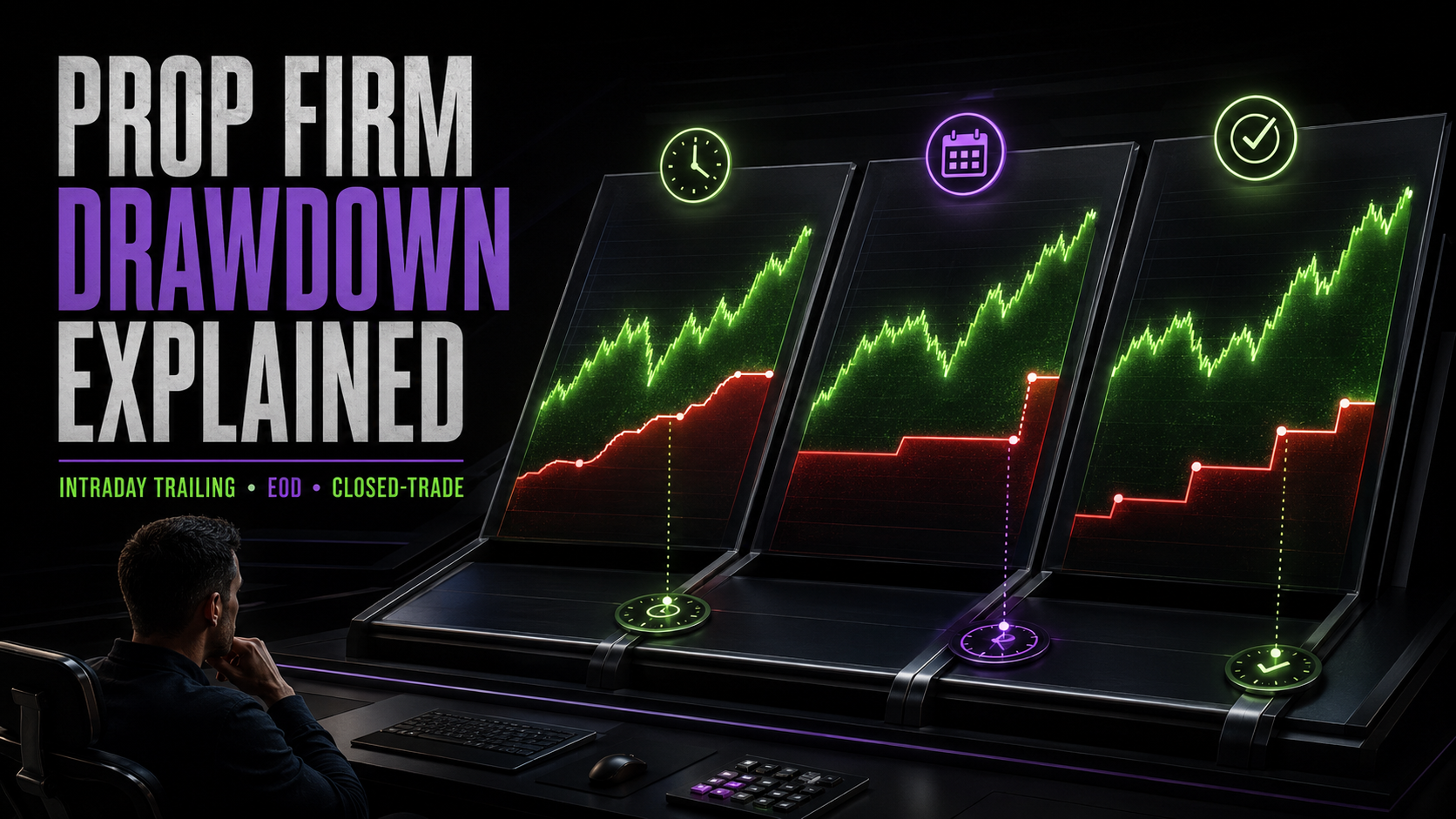
End-of-Day Trailing Drawdown
Every Lucid account uses an EOD trailing Max Loss Limit — arguably its most trader-friendly feature. The MLL only recalculates at the market close (4:45 PM EST) based on your closing balance, not your intraday high. A profitable morning you give back by the bell doesn't move your floor, so intraday swings that would breach you at an intraday-trailing firm are survivable here as long as you recover by close. The MLL trails up as your closing balance grows and then locks permanently once it reaches your starting balance.
Daily Loss Limit
This is an area in motion. Historically, the $50K, $100K, and $150K accounts carried a fixed daily loss limit (the $25K had none), and on funded Pro/Direct accounts that DLL scales to 60% of your highest end-of-day profit once you're in profit. As of early July 2026, Lucid began testing the removal of the DLL on new LucidPro evaluation and funded accounts. Because this is a live test that may change, confirm whether your specific account has a DLL before you trade.
Consistency Rule
Consistency is the single biggest differentiator between Lucid's programs. LucidPro's evaluation has none; LucidFlex's evaluation requires 50% (your biggest day can't exceed half your total eval profit). Once funded, LucidFlex has no consistency rule at all, LucidPro applies 40% per payout cycle, and LucidDirect applies a strict 20% per cycle. The formula is simple: largest single day ÷ cycle profit = your consistency percentage.
Winning Days & Buffers
LucidFlex requires 5 profitable days per payout cycle (each meeting a size-based minimum) and has no buffer. LucidPro uses a buffer of "max loss + $100" that you must stay above when withdrawing. LucidDirect requires 8 trading days before the first payout and between subsequent ones. All three reset their profit goal to $0 after each approved payout.
Hours & News
Lucid built its reputation on allowing normal trading behavior. News trading is permitted on all accounts, including through NFP, FOMC, and CPI; scalping is fine (though microscalping under five seconds that generates over 50% of profits gets flagged for review); and there's no minimum hold time. Positions must be flat by 4:45 PM EST on sim accounts — swing/overnight holds only become available on the real-capital LucidLive stage.
Lucid Trading Consistency Rule Example
Take a funded LucidPro account with its 40% payout consistency rule. Say your cycle profit since the last payout is $4,000 — no single day may account for 40% or more of that, so your biggest day must stay under $1,600. Bank $2,000 in one session and you're at 50%, over the line, and the payout is held until you add smaller green days that dilute your best day back under 40%. On LucidDirect the same math bites much harder at 20%: a $1,000 best day requires at least $5,000 of cycle profit before you can withdraw. On LucidFlex, this rule only exists during the evaluation (at 50%), then disappears once you're funded.
Lucid Trading Rule Traps to Watch
Important Rule Risks
- The 50% LucidFlex evaluation cap trips up aggressive traders — one oversized day on the session you hit target can fail the eval.
- LucidDirect's 20% payout rule is strict; big single days push your required cycle profit sharply higher.
- LucidFlex per-request payout caps don't scale up with more payouts, unlike Pro/Direct.
- Lucid restructures often — rules you read months ago (DLL, splits, escrow) may already have changed.
Before You Buy
- Pick Flex for forgiving funded rules, Pro for a fast pass and quick cycles, Direct only if you truly want instant funding.
- Pick your data feed carefully — switching later requires a support ticket.
- On Flex, plan around the scaling plan; your contract size shrinks if your balance draws down.
- Budget for support lag on non-payout tickets, which is the most common complaint.
Payout Rules
Payouts are where Lucid shines. All programs pay a 90/10 split (some accounts bought or reset before late November 2025 keep 100% on the first $10K), with a $500 minimum request. Approvals typically come in minutes, and US traders on Plaid ACH often see funds the same day — frequently inside 15 minutes. The eligibility gate differs by program.
| Program | Winning-Day Requirement | Consistency at Payout | Buffer | Payouts Before Live |
|---|---|---|---|---|
| LucidFlex | 5 profitable days per cycle | None (funded) | No buffer | 5, then live review |
| LucidPro | ~3-day cycle | 40% per cycle | Max loss + $100 | 5, then live review |
| LucidDirect | 8 trading days | 20% per cycle | Buffer applies | Scales over cycles; live review after ~6 |
| LucidLive (real capital) | 8 profitable days | Varies | MLL locks to $100 on early payout | Daily payouts, swing allowed |
Per-request payout maximums are set by account size and program, and on LucidFlex those caps do not scale up with additional payouts. After your fifth payout (on the public programs), Lucid's risk team reviews you for transition to a real-capital LucidLive account — where swing and overnight holds become available, payouts can go daily, and every funded account that has taken at least one payout transitions with you. Funded accounts with zero payouts don't transition, and Lucid refunds those evaluation fees.
Platforms & Data
Lucid supports a wide platform lineup on two data feeds — CQG and Rithmic. Listed front ends include NinjaTrader, Tradovate, TradingView, Tradesea, MotiveWave, and Quantower, giving active traders far more choice than the two-platform firms. Real-time data comes with your connection, and you pick one feed at setup.
Listed Platforms
- NinjaTrader
- Tradovate
- TradingView
- Tradesea, MotiveWave, and Quantower
- CQG and Rithmic data feeds
Platform Notes
- You choose one data feed at setup; switching later requires a support ticket.
- ProjectX compatibility was dropped from LucidFlex in late 2025 — relevant for some algo stacks.
- Automated bots and DCA strategies are generally allowed; check current policy for your setup.
- Microscalping under five seconds that drives over 50% of profits is flagged for review.
Fees, Resets & Refund Policy
Every Lucid account is a one-time purchase — no monthly rebills and no activation fee to move from a passed evaluation to a funded account. If you fail an evaluation, you can buy a reset from the dashboard rather than repurchasing the full account. Fees generally scale with account size, running from around the low-double-digits on a $25K up to roughly $370 for a $150K LucidPro.
Because purchases are one-time, there's no subscription to cancel. Reset pricing varies by program and size, and Lucid stopped offering resets for the discontinued LucidBlack program in early March 2026. As with most firms, fees are generally non-refundable — with one notable exception: if you transition to live, Lucid refunds the evaluation cost of any funded account that never took a payout.
| Fee Type | Lucid Trading Policy / Details |
|---|---|
| Evaluation Fee | One-time purchase by program and size; no monthly subscription |
| Activation Fee | $0 — no fee to upgrade a passed evaluation to a funded account |
| Reset Fee | Available from the dashboard after a failed evaluation; varies by program and size |
| Data / Platform Fees | Real-time data included with the connection; one feed (CQG or Rithmic) chosen at setup |
| Refunds | Generally non-refundable; eval cost refunded for zero-payout accounts at live transition |
Lucid Trading Discount Code
Lucid runs frequent promotions through its site and affiliate network, commonly in the 35–50% off range. The current code featured on Lucid's own pricing page is VAULT, and the firm has also run limited-time offers such as up to 40% off LucidPro. Because the exact code and percentage rotate often, treat any specific code as time-limited and confirm it at checkout.
| Promotion | Details |
|---|---|
| Current Code | VAULT (featured on Lucid's pricing page) |
| Typical Discount | Advertised promotions commonly run 35–50% off |
| Applies To | Evaluation and Direct plans; some offers are program-specific (e.g. LucidPro) |
| Limitation | Codes rotate and can change without notice; typically one code per purchase |
| Best Practice | Enter the code on the pricing page and verify the final price before purchasing |
Pros & Cons
Pros
- Extremely fast payouts, often within 15 minutes of approval
- Trader-friendly end-of-day trailing drawdown on every account
- Competitive 90/10 split across all programs
- LucidFlex has no daily loss limit and no funded consistency rule
- News trading and scalping allowed; broad platform and data-feed choice
- One-time fees with no monthly subscription and free funded upgrades
Cons
- Frequent restructures make rule stability a real question
- LucidFlex's 50% evaluation consistency rule catches aggressive traders
- LucidDirect's 20% payout rule is strict
- LucidFlex payout caps don't scale up with more payouts
- Support can lag on non-payout tickets
- Young firm — roughly a year of operating history
Who Lucid Trading Is Best For
- Active futures day traders who prioritize fast, frequent payouts
- Scalpers and news traders who want EOD drawdown and no time-in-trade rules
- Traders who want no funded consistency rule (LucidFlex) or a fast 1-day pass (LucidPro)
- Traders who value platform choice across CQG and Rithmic feeds
- Traders comfortable re-checking rules on a firm that iterates quickly
Who Lucid Trading May Not Be Ideal For
- Traders who prize long-term rule stability and a long track record
- Traders who make most of their profit in single large days (consistency rules bite)
- Swing traders who need overnight holds before reaching the live stage
- Traders who need fast help on complex, non-payout support issues
- Traders who want forex, stocks, or crypto (Lucid is CME futures only)
Best Alternatives to Lucid Trading
Traders comparing Lucid may also want to look at firms with a longer track record, a simpler single rule set, or a different funded structure.
| Alternative | Why Compare It |
|---|---|
| Take Profit Trader | Worth comparing for day-one, uncapped withdrawals and zero funded consistency rule (though it uses intraday trailing). |
| Apex Trader Funding | Useful for a longer track record, a larger multi-account ecosystem, and a choice of drawdown models. |
| Topstep | A long-running futures firm with strong rule stability and one clear trailing-drawdown rule. |
Lucid Trading FAQ
Is Lucid Trading legit?
Yes. Lucid Trading is an operational US-based futures prop firm under Lucid Prop Ltd, with thousands of Trustpilot reviews, verified fast payouts, and a $100M+ lifetime payout milestone. Its main caveat is youth — it launched in 2025 and has limited operating history.
What's the difference between LucidFlex, LucidPro, and LucidDirect?
LucidFlex has no daily loss limit and no funded consistency rule, but a 50% eval consistency rule and a scaling plan. LucidPro passes in one day with full size and 3-day cycles, but a 40% payout consistency rule. LucidDirect skips the evaluation (instant funding) but enforces a strict 20% payout consistency rule.
What drawdown does Lucid use?
End-of-day trailing on every account. Your Max Loss Limit only updates at the 4:45 PM EST close based on your closing balance — intraday spikes you recover from don't move it. Once it reaches your starting balance, it locks.
How fast are Lucid payouts?
Very fast. Requests are usually approved in minutes, and US traders on Plaid ACH often receive funds the same day, frequently within about 15 minutes. The minimum payout is $500 with a 90/10 split.
Does Lucid have an activation fee?
No. Accounts are a one-time purchase with no monthly subscription, and there's no activation fee to upgrade a passed evaluation to a funded account.
Can I trade news and scalp on Lucid?
Yes. News trading is allowed on all accounts, including NFP, FOMC, and CPI, and scalping is permitted. Microscalping under five seconds that generates over 50% of profits can be flagged for review.
What is LucidMaxx?
LucidMaxx is an invite-only tier for Lucid's most proven traders, offering daily, uncapped payouts and instant live capital. You can't buy it — you earn it through a documented payout track record on the other programs.
What is the Lucid Trading discount code?
The code currently featured on Lucid's pricing page is VAULT, with promotions commonly in the 35–50% off range. Codes rotate frequently, so confirm the current offer and final price at checkout.
Recent Updates
- July 8, 2026: Refreshed the full page across LucidFlex, LucidPro, LucidDirect, and LucidMaxx — current rules, pricing, payout mechanics, platforms, and the VAULT promo, using official sources.
- Daily loss limit test (July 2026): Lucid began removing the DLL on new LucidPro evaluation and funded accounts as a limited test — confirm whether your account has a DLL.
- Profit split raised (March 2026): The split moved to 90/10 across programs, and LucidLive was rebuilt with the old escrow system removed.
- Lineup streamlined (Feb 2026): LucidBlack was discontinued and merged into LucidPro; LucidMaxx launched as the invite-only daily-payout tier.
Final Verdict
Lucid Trading earned its reputation the hard way — by paying traders fast and often, on a genuinely trader-friendly end-of-day drawdown, with a competitive 90/10 split and real platform choice. For an active day trader or scalper who wants to news-trade freely and get paid in minutes, it's one of the most compelling firms to emerge in the last couple of years, and LucidFlex in particular removes the two rules traders hate most once funded.
The trade-offs are real, though. Each program hides its difficulty in a different place — Flex's 50% eval cap, Pro's 40% payout rule, Direct's strict 20% rule — and Lucid has restructured its products repeatedly in under a year, so the rules you buy today may not be the rules next quarter. Add a young track record and occasional support lag, and the takeaway is clear: Lucid rewards disciplined traders who read the fine print for their specific program and don't rely on one big day. For that trader — especially with the current discount — it's a strong, fast-paying option well worth comparing against the more established firms in the field.