
Trade Day
 QuantTower
 NinjaTrader
 Tradovate
 TradingView
Tradovate
TradingView
Tradovate
 Rise
Rise
 Wire
Wire
 Crypto
| Date | Overall Score | |
|---|---|---|
| 2026-09-17 | 9.1 | |
| 2026-09-15 | 7.5 | |
| 2026-09-14 | 7.5 | |
| 2026-09-13 | 7.5 |






Last updated: July 8, 2026
TradeDay Review: Rules, Accounts, Payouts, Discounts & Trader Details
TradeDay is a Chicago-based futures prop firm that has funded traders since 2020 and paid out more than $10 million along the way. In May 2026 it relaunched as "TradeDay 2.0," retiring its old nine-account grid and replacing it with two clean routes: Quick Pay (day-one payouts, your choice of intraday or end-of-day drawdown) and Fast Pass (a 3-day pass with a better starting split). Both are monthly-subscription evaluations across $50K, $100K, and $150K sizes, and both carry no activation fee.
Quick verdict: TradeDay suits futures day traders who want fast payouts, a single main rule to respect (the trailing drawdown), and a clear path to real capital. Before you buy, understand the difference between the two routes, the 30% vs 45% consistency targets during evaluation, and the payout split — Quick Pay pays 50/50 on your first $4,000 of profit before improving, while Fast Pass starts at 80/20 but gates your first payout behind five profitable days.
TradeDay Quick Facts
| Category | Details |
|---|---|
| Firm Name | TradeDay (TradeDay LLC) |
| Website | tradeday.com |
| Help Center | TradeDay Support Center |
| Company / Base | TradeDay LLC, Chicago, Illinois — operating since 2020 |
| Support | 24/7 support via email and the Freshdesk help center |
| Markets | Futures only, on permitted CME-group products. No stocks, options, forex, or crypto. |
| Account Sizes | $50K, $100K, and $150K |
| Trading Environment | Simulated evaluation and Funded Sim accounts, with a real-capital Funded Live progression |
| Profit Split | Up to 90% in Funded Live (route-specific in Funded Sim — see below) |
| Max Funded Accounts | Up to 6 accounts total, with a maximum of 3 concurrent Funded Sim accounts |
| Payout Methods | US bank wire, international wire, and crypto, processed through Riseworks |
How We Reviewed TradeDay
This review is built from TradeDay's own materials: the homepage and pricing grid, the "TradeDay 2.0" relaunch notes, and the Freshdesk help-center articles covering evaluation rules, the Quick Pay and Fast Pass payout policies, drawdown mechanics, and withdrawal methods. Pricing, account rules, payout terms, and the current promo were checked in early July 2026.
TradeDay overhauled its entire lineup in the May 2026 relaunch, so any older review that mentions Static drawdown accounts or a $139 activation fee is out of date. This page reflects the current two-route structure only, and flags the spots where the funded experience differs from the marketing headline.
TradeDay Account Types
TradeDay 2.0 runs a single one-step evaluation in one of two flavors. Quick Pay is the long-running model: a 5-day minimum evaluation, your choice of intraday or end-of-day trailing drawdown, and day-one payout access once you reach Funded Sim, with no buffer and no funded consistency rule. Its trade-off lives in the split — your first $4,000 of net profit pays 50/50 before improving to 80/20.
Fast Pass is built for speed: a 3-day pass with no formal minimum-days requirement and end-of-day drawdown only. It starts you at a flat 80/20 split in Funded Sim, but it uses a stricter 45% consistency target during evaluation, starts funded accounts with fewer contracts that scale up as you profit, and gates your first payout behind five profitable days. Both routes progress from Funded Sim to a real-capital Funded Live account at a 90/10 split, reached by consistent Funded Sim performance rather than by purchase.
TradeDay Account Comparison
| Route | Size | Profit Target | Trailing Drawdown | Eval Consistency | Min Days | Contracts | Promo Price / Reset |
|---|---|---|---|---|---|---|---|
| Quick Pay (Intraday) | $50K | $3,000 | $2,000 intraday | 30% | 5 | 5 (50 micros) | $62/mo · reset $60 |
| Quick Pay (Intraday) | $100K | $6,000 | $3,000 intraday | 30% | 5 | 10 (50 micros) | $115/mo · reset $110 |
| Quick Pay (Intraday) | $150K | $9,000 | $4,500 intraday | 30% | 5 | 15 (50 micros) | $175/mo · reset $165 |
| Quick Pay (EOD eval) | $50K | $3,000 | $2,000 EOD (funded trails intraday) | 30% | 5 | 5 (50 micros) | $87/mo · reset $85 |
| Quick Pay (EOD eval) | $100K | $6,000 | $3,000 EOD (funded trails intraday) | 30% | 5 | 10 (50 micros) | $142/mo · reset $135 |
| Quick Pay (EOD eval) | $150K | $9,000 | $4,500 EOD (funded trails intraday) | 30% | 5 | 15 (50 micros) | $197/mo · reset $195 |
| Fast Pass (EOD) | $50K | $3,000 | $2,000 EOD | 45% | 3 | 2, scales +1 per $2K | $90/mo · reset $89 |
| Fast Pass (EOD) | $100K | $6,000 | $3,000 EOD | 45% | 3 | 3, scales +1 per $2K | $160/mo · reset $140 |
| Fast Pass (EOD) | $150K | $9,000 | $4,500 EOD | 45% | 3 | 4, scales +1 per $2K | $240/mo · reset $225 |
Prices above reflect the current 50%-off promo. Note the important structural quirk: all Quick Pay funded accounts trail intraday once funded, even if you passed the end-of-day version — only Fast Pass keeps end-of-day drawdown after funding. Micros count against minis at a 10:1 ratio, and there's no daily loss limit on any account.
TradeDay Cost to First Payout
Because the evaluation is a monthly subscription, your true cost depends on how fast you pass and whether you need any resets. There's no activation fee on any TradeDay 2.0 plan, which is a real saving versus the retired program. The bigger variable is the payout structure once you're funded — the two routes get you paid very differently.
| Route / Size | Promo Price | Activation Fee | Min. Days to First Payout | Min. Payout | Funded Sim Split | Practical Takeaway |
|---|---|---|---|---|---|---|
| Quick Pay $50K | From $62/mo | $0 | 1 (day-one, no buffer) | $250 | 50/50 to $4K, then 80/20 | Fastest access, but your first $4,000 of profit is split evenly. |
| Quick Pay $100K | From $115/mo | $0 | 1 (day-one, no buffer) | $250 | 50/50 to $4K, then 80/20 | More contracts and target headroom; same 50/50 first tier. |
| Fast Pass $50K | From $90/mo | $0 | 5 profitable days ($150+ each) | $250 | Flat 80/20 | Better split from dollar one, but you wait five green days to withdraw. |
| Fast Pass $100K | From $160/mo | $0 | 5 profitable days ($200+ each) | $250 | Flat 80/20 | Passes in 3 days; contracts start small and scale +1 per $2K profit. |
| Fast Pass $150K | From $240/mo | $0 | 5 profitable days ($250+ each) | $250 | Flat 80/20 | Largest size; strongest split but the slowest contract ramp. |
The honest way to read this: Quick Pay gets cash in your hands sooner but takes half of your first $4,000; Fast Pass pays a friendlier 80/20 immediately but makes you earn five qualifying days first. Neither is universally better — it depends on whether you value speed of access or a stronger early split.
TradeDay Rules Explained
Trailing Maximum Drawdown
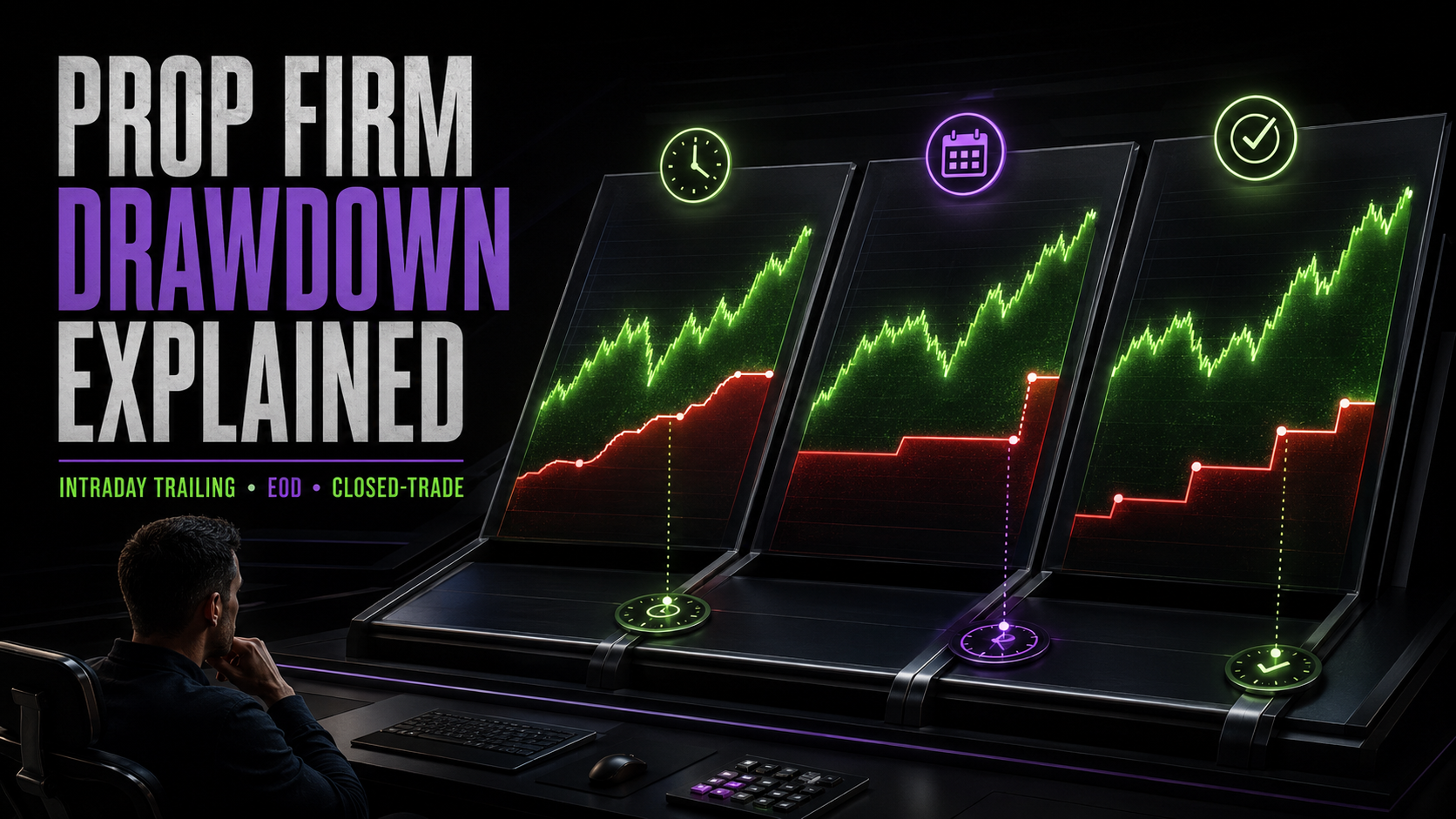
This is TradeDay's one hard rule. The trailing maximum drawdown follows your account's high-water mark and then freezes once it reaches your starting balance — after that, it stops trailing entirely. It's $2,000 on the $50K, $3,000 on the $100K, and $4,500 on the $150K. Touch or fall below the floor at any point and the account is done. There's no daily loss limit layered on top, which keeps the rule set refreshingly simple.
Intraday vs End-of-Day
Quick Pay lets you pick how the drawdown is calculated during the evaluation: intraday (trails in real time on your peak, including open profit) or end-of-day (only ratchets at the close, which is more forgiving during the session). Fast Pass is end-of-day only. The catch worth repeating: Quick Pay funded accounts switch to intraday trailing after funding regardless of which evaluation you passed, while Fast Pass keeps end-of-day into the funded stage.
Consistency Rule
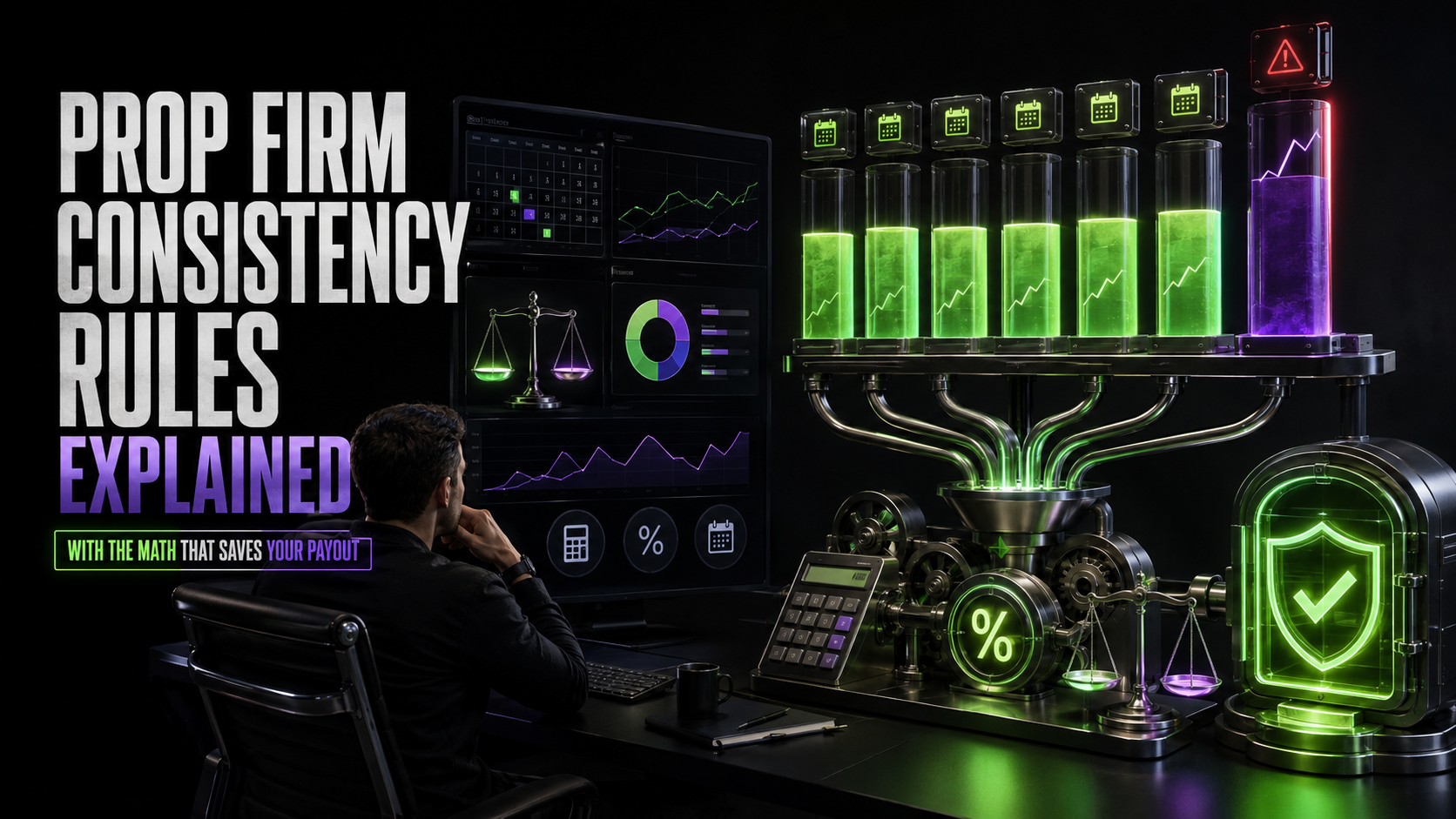
Both routes apply a consistency target during the evaluation only — 30% on Quick Pay, 45% on Fast Pass. No single winning day may exceed that share of your profit target. It won't fail you, but a lopsided big day pushes your effective target higher until your day distribution evens out. Once you're funded, there is no consistency rule at all.
Contracts & Scaling
Quick Pay uses a fixed contract limit by size (5, 10, or 15 minis, or the micro equivalent at 10:1). Fast Pass funded accounts start smaller — 2, 3, or 4 contracts — and scale up by one contract per $2,000 of end-of-day profit, rewarding steady growth over big swings.
Hours & News
TradeDay is a day-trading firm: no overnight or weekend holds, and all positions must be flat before the daily close. Around Tier 1 economic releases (such as FOMC, CPI, and NFP), the platform auto-liquidates positions roughly two minutes before and reopens about two minutes after, so plan entries around those windows to avoid forced exits.
TradeDay Consistency Rule Example
Say you're on a Quick Pay $50K with a $3,000 profit target and the 30% consistency target. No single day should carry more than $900 (30% of $3,000) of your profit. If you bank $1,400 in one session, you've crossed the line — even if you've reached the target — and TradeDay effectively raises the bar, requiring more balanced days until your biggest day falls back under 30% of the total. On Fast Pass the same logic applies at a looser 45%, so on the $50K your best day can run up to $1,350 of the target before it becomes a problem.
TradeDay Rule Traps to Watch
Important Rule Risks
- Quick Pay funded accounts trail intraday even if you passed the end-of-day evaluation — only Fast Pass stays end-of-day.
- The trailing drawdown follows unrealized profit intraday, so giving back an open gain can breach you before you close.
- The evaluation consistency rule quietly raises your target when one day is too large a share of profit.
- News auto-liquidation around Tier 1 releases can exit you at slippage-heavy prices.
Before You Buy
- Cancel the monthly subscription if you stop — it keeps billing until you pass or cancel.
- Pick Quick Pay for day-one access, or Fast Pass for a stronger 80/20 split and a 3-day pass.
- On Quick Pay, plan to push each account past $4,000 of profit to leave the 50/50 tier.
- Keep all your accounts on the same platform — TradeDay requires it.
Payout Rules
TradeDay's payout reputation is strong — it advertises day-one access on Quick Pay and processes requests fast through Riseworks. The mechanics differ by route. On Quick Pay, you can request from any positive balance on day one (no buffer, minimum $250), but the split runs 50/50 on your first $4,000 of net profit, then 80/20 above that, then 90/10 in Funded Live. On Fast Pass, you first need five profitable days (at least $150/$200/$250 per day by size), then withdraw at a flat 80/20, capped at 50% of your balance per request.
| Route | First Payout Gate | Funded Sim Split | Funded Live Split | Min. Request | Per-Request Cap |
|---|---|---|---|---|---|
| Quick Pay | Day one, any positive balance | 50/50 to $4K, then 80/20 | 90/10 | $250 | No stated cap above buffer; buffer draws split 50/50 |
| Fast Pass | 5 profitable days ($150–$250/day by size) | Flat 80/20 | 90/10 | $250 | 50% of account balance per request (tier-capped) |
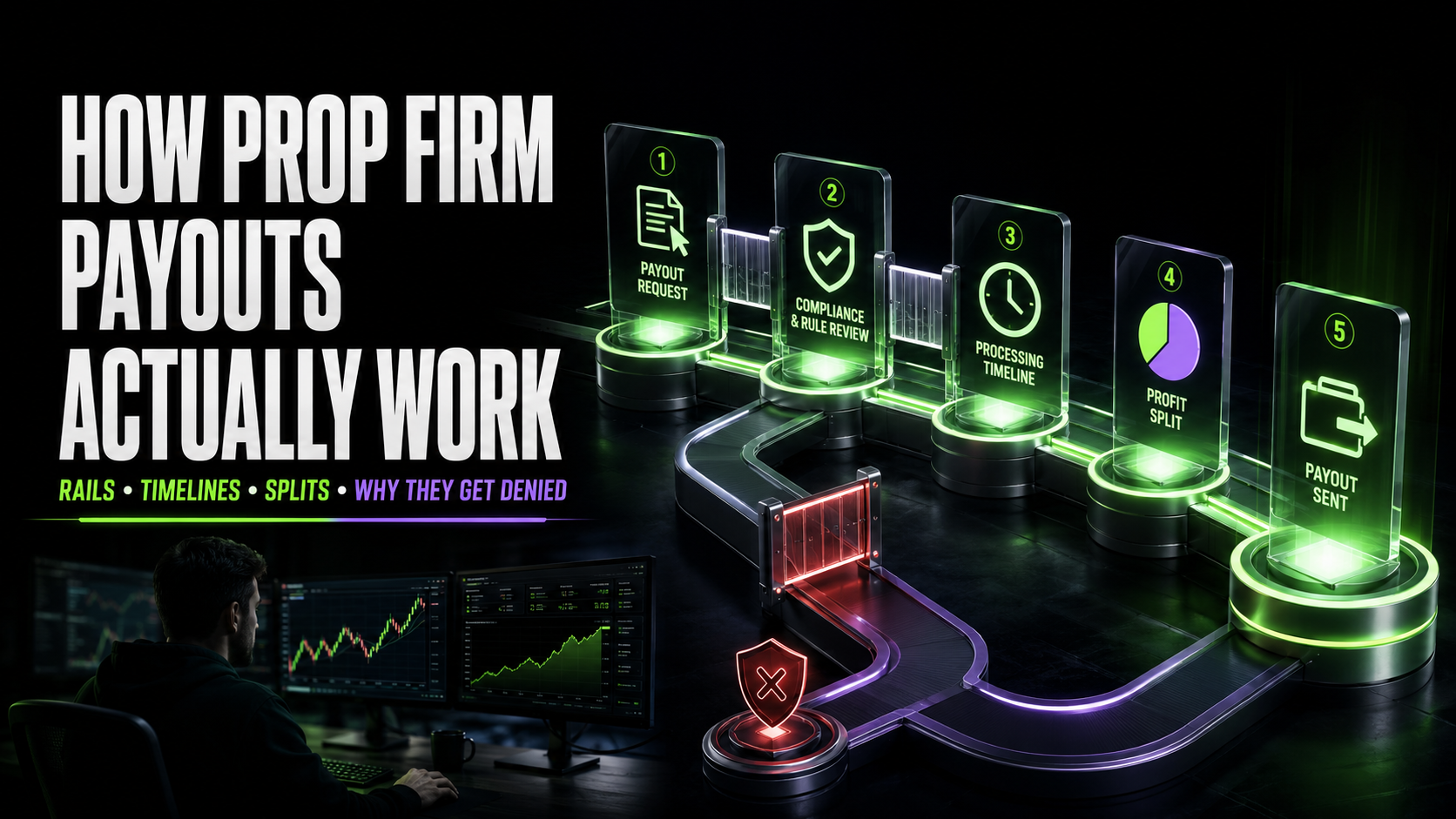
A couple of practical notes. On the first Fast Pass payout, if your trailing drawdown hasn't yet reached your starting balance, it moves up to that level and locks there. Requests submitted before 5:30 PM CT are processed within 24 business hours. Payout rails run through Riseworks: US bank wires are free, international wires cost $15, Layer 2 crypto withdrawals are free, and Layer 1 crypto carries a small fee plus gas. Funded Sim payouts are requested in the dashboard; Funded Live withdrawals are handled by email.
Platforms & Data
TradeDay runs on the Tradovate infrastructure and supports a focused set of front ends. The core platforms are Tradovate, NinjaTrader, and TradingView, with Jigsaw also featured for order-flow traders. Real-time CME data comes with your platform connection, and all of your accounts must sit on the same platform.
Listed Platforms
- Tradovate
- NinjaTrader
- TradingView
- Jigsaw (order-flow tools)
- Real-time CME data included with the connection
Platform Notes
- All your TradeDay accounts must be on the same platform.
- Custom strategies built and run inside the supported platforms are allowed.
- Third-party purchased bots and external API automation are not permitted.
- An optional CoPilot members' area (resources only, no funding) is offered separately from about $24/month.
Fees, Resets & Refund Policy
Every TradeDay 2.0 evaluation is a monthly subscription that rebills until you pass or cancel, so a slow path can add up. The good news is there's no activation fee on any plan — passing moves you straight into a funded account at no extra cost. If you breach or want a fresh start, resets are available at a flat per-size fee (roughly $60–$225 depending on route and size), cheaper than buying a brand-new evaluation.
Subscription fees are non-refundable except where required by law, and the subscription won't cancel itself — you need to cancel manually to stop billing after a fail. There's no daily data fee to worry about; real-time data comes with the platform connection.
| Fee Type | TradeDay Policy / Details |
|---|---|
| Evaluation Fee | Monthly subscription by route and size (currently 50% off with code TDNEW); rebills until you pass or cancel |
| Activation Fee | $0 on all TradeDay 2.0 plans — the old $139 fee applied only to the retired program |
| Reset Fee | Flat per-size fee (about $60–$225 depending on route and account size) |
| Data / Platform Fees | Real-time data included with the platform connection; no separate daily data fee |
| Withdrawal Fees | Free US bank wire and Layer 2 crypto; $15 international wire; small fee on Layer 1 crypto |
| Refunds | Subscription fees are non-refundable except where required by law; cancel manually to stop billing |
TradeDay Discount Code
TradeDay's current sitewide offer is a 50% discount applied with code TDNEW, which is what brings the entry price down to around $62/month on the smallest Quick Pay account. TradeDay rotates promotions periodically, so the exact code and percentage can change, but a discount of this size has been the standard headline since the 2.0 relaunch.
| Promotion | Details |
|---|---|
| Current Code | TDNEW |
| Discount | Advertised as 50% off evaluation subscriptions |
| Applies To | Quick Pay and Fast Pass evaluations across all sizes |
| Limitation | One code per purchase; codes rotate and can change without notice |
| Best Practice | Enter the code on the membership plans page and verify the final price at checkout |
Pros & Cons
Pros
- Operating since 2020 with over $10 million in verified payouts
- Two clear routes: day-one Quick Pay or fast-passing, better-split Fast Pass
- One main rule (trailing drawdown) and no daily loss limit
- No activation fee on any plan; cheap flat resets
- No funded consistency rule once you're funded
- Fast payouts through Riseworks, often next business day
Cons
- Quick Pay funded accounts trail intraday even after an EOD evaluation
- Quick Pay takes 50% of your first $4,000 of profit
- Fast Pass gates the first payout behind five profitable days
- Monthly subscription means a slow pass adds up
- No overnight/weekend holds and forced news auto-liquidation
- Only four supported platforms and three account sizes
Who TradeDay Is Best For
- Futures day traders who want fast, frequent payouts with a simple rule set
- Traders who value a choice between day-one access (Quick Pay) and a stronger early split (Fast Pass)
- Traders who bank steady green days rather than one big session
- Traders who want a genuine path from simulated funding to real capital
- Tradovate, NinjaTrader, or TradingView users
Who TradeDay May Not Be Ideal For
- Traders who want the same drawdown model from evaluation through funded (Quick Pay changes it)
- Traders who prefer a one-time evaluation fee over a monthly subscription
- Swing traders who need to hold overnight or over the weekend
- Traders who want to trade freely through major news releases
- Traders who want stocks, options, forex, or crypto (TradeDay is futures-only)
Best Alternatives to TradeDay
Traders comparing TradeDay may also want to look at firms with a one-time fee structure, a consistent drawdown model across stages, or a larger multi-account ecosystem.
| Alternative | Why Compare It |
|---|---|
| Apex Trader Funding | Worth comparing for one-time evaluation fees, a large multi-account ecosystem, and a choice of drawdown models. |
| Topstep | A long-running futures firm with a single trailing-drawdown rule that stays consistent into the funded stage. |
| Take Profit Trader | Useful for traders who want day-one, uncapped withdrawals and a simple one-step evaluation. |
TradeDay FAQ
Is TradeDay a legit futures prop firm?
Yes. TradeDay has operated from Chicago since 2020, publishes verified payouts totaling over $10 million, and discloses its evaluation pass rate (36% for January–June 2026). It funds futures traders through a one-step evaluation and a Funded Sim to Funded Live progression.
What is the difference between Quick Pay and Fast Pass?
Quick Pay is a 5-day evaluation with your choice of intraday or end-of-day drawdown and day-one payout access, but the split is 50/50 on your first $4,000 of profit before improving. Fast Pass passes in 3 days at a stricter 45% consistency, starts at a flat 80/20 split, and gates the first payout behind five profitable days.
Does TradeDay have an activation fee?
No. Every TradeDay 2.0 plan — Quick Pay and Fast Pass, all sizes — activates the funded account for $0. The $139 fee quoted in older reviews applied only to the retired pre-2.0 program.
How do TradeDay payouts work?
On Quick Pay you can request from any positive balance on day one (minimum $250), with a 50/50 split on the first $4,000, then 80/20, then 90/10 in Funded Live. On Fast Pass you withdraw at a flat 80/20 after five profitable days, capped at 50% of your balance per request. Payouts run through Riseworks, usually next business day.
What is the trailing drawdown?
It's TradeDay's one hard rule — a trailing maximum drawdown of $2,000 / $3,000 / $4,500 by size that follows your account high and then freezes at your starting balance. Touch it and the account closes. There is no separate daily loss limit.
Does the drawdown change after I pass?
On Quick Pay, yes — funded accounts trail intraday even if you passed the end-of-day evaluation. Fast Pass keeps end-of-day drawdown into the funded stage. It's the most important nuance to plan for.
How many accounts can I have?
Up to 6 accounts total, with a maximum of 3 concurrent Funded Sim accounts. Additional passed evaluations queue until a Funded Sim slot opens, and all accounts must be on the same platform.
What is the TradeDay discount code?
The current sitewide code is TDNEW, advertised as 50% off evaluation subscriptions. Codes rotate, so confirm the current offer and final price at checkout.
Recent Updates
- July 8, 2026: Refreshed the full page for the TradeDay 2.0 relaunch — new Quick Pay and Fast Pass routes, pricing, drawdown rules, payout splits, platforms, and the TDNEW promo, using current official sources.
- TradeDay 2.0 relaunch (May 2026): The old nine-account grid, including Static drawdown, was retired and replaced with two cleaner routes.
- Activation fee removed: All current plans fund for $0, replacing the retired program's setup fee.
- Split structure overhauled: Funded Sim splits are now calculated per account (Quick Pay 50/50 to $4K then 80/20; Fast Pass flat 80/20), both reaching 90/10 in Funded Live.
Final Verdict
TradeDay 2.0 is one of the more thoughtfully simplified firms in the futures space. A single hard rule, no daily loss limit, no activation fee, no funded consistency rule, and a genuine path to live capital make it easy to understand and forgiving to trade. The two-route choice is smart: Quick Pay for traders who want cash in hand on day one, Fast Pass for those who want a stronger 80/20 split and a three-day pass.
The things to weigh are the payout trade-offs and the drawdown switch. Quick Pay's day-one access comes at a 50/50 split on your first $4,000, Fast Pass's better split comes with a five-day payout gate, and Quick Pay funded accounts trail intraday even after an end-of-day evaluation. Factor in the monthly subscription and the day-trading-only rules (no overnight holds, news auto-liquidation), and the takeaway is clear: TradeDay rewards disciplined, consistent day traders. For that trader — especially with the current 50%-off pricing — it's a strong, transparent option worth comparing against the rest of the field.