How Prop Firms Actually Make Money: Revenue Streams, A-Book vs B-Book, and Where Your Payout Comes From
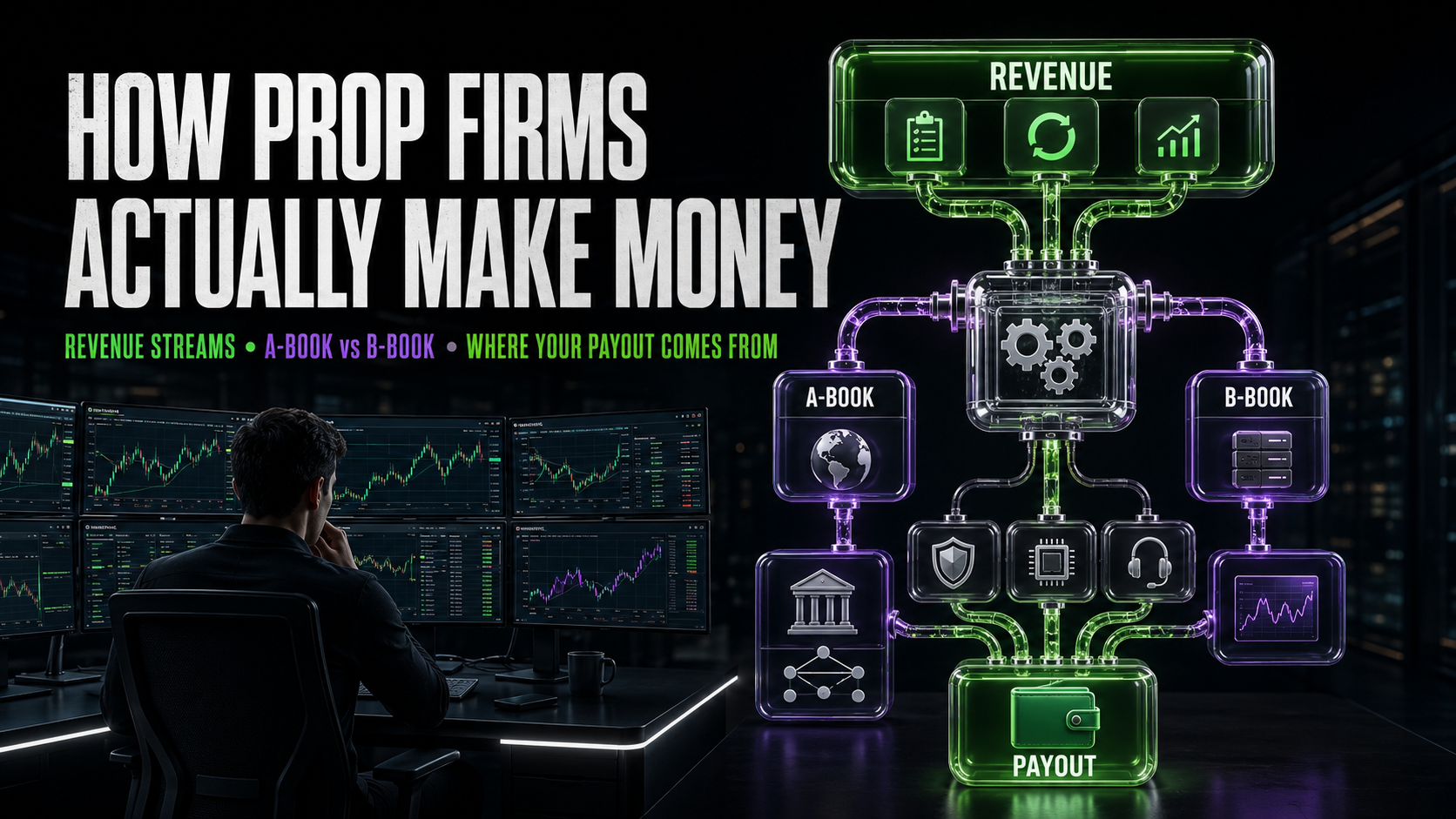
If the firm gives you $50,000 and keeps only 10 percent of your profits, who pays for all this? The five revenue streams ranked, what is simulated and what is real, the A-book versus B-book hybrid explained without euphemism, a worked unit-economics model, and a sustainability checklist for telling durable operators from fee mills.
 Tradeify
 My Funded Futures
 Top One Futures
 Alpha Futures
 Apex Trader Funding
 Lucid Trading
 BlueSky Funded
 Topstep
 Take Profit Trader
 Trade Day
 Phidias
 Earn2Trade
 Bulenox
 Funded Next Futures
 Blue Guardian Futures
 The Trading Pit
 Funded Futures Family
 E8 Markets
 Elite Trader Funding
 Funded Futures Network
 Hola Prime
 Blueberry Futures
 Taurus Arena
 Humble Futures
 Legends Trading
 Savius
 Futures Elite
 NexGen Protrader
 Funded Seat
 YRM Prop
Last updated: July 28, 2026
Every trader eventually asks the uncomfortable question: if the firm gives me $50,000 and keeps only 10 percent of my profits, who is paying for all this? The answer decides everything you should think about prop firms: which ones can survive, which rules exist for real risk reasons versus revenue reasons, whether the firm is rooting for you or against you, and why some firms collapse owing millions while others pay out for a decade. This guide opens the machine: the five revenue streams and how much each matters, what is actually simulated and what is real, the A-book versus B-book question answered without euphemism, a worked unit-economics model showing where your payout really comes from, and a sustainability checklist for telling durable operators from fee mills. None of this is cynicism; it is the owner's manual the industry never ships, and understanding it is genuinely protective.
Sourcing note: the mechanics below are assembled from industry disclosures, backend-provider data covering 300,000+ accounts, regulatory filings from past enforcement actions, and firms' own published materials. Where a practice varies by firm, we say so. Nothing here accuses any specific firm of anything; it describes how the model works in general, so you can ask the right questions about any firm in particular.
Start With the Number That Explains Everything
From the largest independent dataset in the industry (roughly 300,000 accounts across 10 firms, analyzed by backend provider FPFX Technologies): about 14 percent of evaluation buyers pass, about 7 percent ever receive a payout, and the average payout runs around 4 percent of the nominal account size. The full numbers live in our pass-rate statistics guide; what matters here is what they imply about the business. A firm selling evaluations is not primarily in the trading business. It is in the assessment business, with a payout obligation attached to a small tail of its customers. Once you see that, every other feature of the model follows logically.
The Five Revenue Streams, Ranked
| # | Stream | What It Is | How Much It Matters |
|---|---|---|---|
| 1 | Evaluation fees | The challenge purchase itself, one-time or monthly subscription while you attempt | The dominant stream at nearly every retail firm; at 5 to 14 percent pass rates, fees from unsuccessful attempts carry the entire operation |
| 2 | Repeat attempts, resets, and renewals | Failed traders buying again: monthly renewals while stuck in the evaluation, reset fees, or full-price repurchases where resets were abolished | The silent multiplier; most traders take 2 to 4 attempts, so the average customer pays the headline price several times over |
| 3 | Activation, funded-stage, and add-on fees | One-time activation after passing (typically $85 to $200 where charged), monthly funded-account fees at some firms, plus paid upgrades like end-of-day drawdown conversions or higher payout tiers | Meaningful and growing; this stream monetizes the winners too, and per-account fees compound for multi-account traders |
| 4 | Data, platform, and markup revenue | Exchange data fee pass-throughs with margin, platform licensing bundles, and (on the CFD side) spread and commission markups; futures firms lean on this stream more than forex firms | A stabilizer: recurring, outcome-independent income that makes futures firms structurally steadier than pure challenge mills |
| 5 | The profit split | The firm's 10 to 15 percent share of funded traders' withdrawals | The smallest stream at most retail firms, despite being the one the marketing talks about; a minority of firms genuinely build here via live replication of their best traders |
Read stream 2 again, because it is the one traders systematically underestimate. A trader who fails and retries has not generated one sale; they have generated a customer lifecycle, and firms price for it. This is also the correct lens on discounting: near-permanent 50 to 90 percent promotions are rational precisely because the marginal cost of another simulated evaluation is close to zero, and the expected revenue per buyer includes their future attempts. Our true-cost guide runs the buyer's side of this exact math.
What Is Actually Simulated, and What Is Real
Here is the part of the model that surprises people most, stated plainly: at the large majority of retail prop firms, the evaluation is simulated, and the funded account is usually simulated too. Your orders on a typical "funded" account do not route to the CME; they fill against market data in the firm's environment. What is real is the payout: when you withdraw, actual money arrives, sourced from the firm's revenue rather than from closed positions in a live market. Reputable firms increasingly disclose this in their terms (US regulatory pressure after the industry's enforcement cases pushed disclosure forward), and it is not inherently a problem. The payout spends the same regardless of what infrastructure sat behind it.
But it has two consequences you must internalize. First, the firm's ability to pay is a function of its fee flow, not of a pool of segregated trading capital. A firm running a mostly simulated model needs a steady stream of evaluation purchases to fund payouts, which is exactly why payout friction appears when growth slows, and why 80 to 100 firms exited the market in the 2024 to 2025 wave once a platform shock interrupted their revenue. Our red flags guide is, in business-model terms, a guide to detecting fee-flow stress from the outside. Second, since your counterparty is the firm itself, the firm's solvency and integrity are your real risk, which is why "a firm is only as trustworthy as its latest payout" is not a slogan on this site but a description of the mechanism.
A-Book, B-Book, and the Hybrid Everyone Actually Runs
The vocabulary comes from brokerage. B-booking means internalizing the risk: the firm is your counterparty, your losses are its gains, your wins are its liability, and no trade touches a live market. A-booking means hedging or replicating your positions into real liquidity, so the firm earns from the split and the flow rather than from your failure. Almost no serious firm runs a pure version of either. The standard structure, described openly in industry analyses, is a hybrid: B-book the broad population of funded traders, who statistically revert to losing, and A-book (or copy into live markets) the small cohort of consistent winners whose edge has proven durable. That is rational risk management rather than inherent villainy: a firm that A-booked every newly funded trader would bleed hedging costs on a population that mostly fails within 90 days.
The hybrid produces the industry's most misunderstood truth: a genuinely profitable trader is not a cost to a well-run firm; they are an asset. Their withdrawals are marketing. Their consistency, once identified, can be replicated live, so the firm earns the market's side of the trade alongside its split. One large futures firm's own published material describes exactly this: the signals of its most consistent traders mirrored into live positions, the trader functioning as an alpha generator. The cynical framing writes itself, but the incentive alignment is the point: firms structured this way have a real financial reason to want you to succeed and stay, which is precisely the alignment you should be shopping for. The dark side sits in the pure B-book funded stage: a firm that profits directly and only when funded traders fail has an incentive problem, and history's worst actors (the frozen firms, the retroactive rule-enforcers in our payout-denial casework) lived at that end of the spectrum.
Where Your Payout Actually Comes From: A Worked Model
Numbers make the machine concrete. An illustrative cohort, using the industry's published rates and deliberately round figures: 1,000 traders buy a $50K evaluation. With repeat attempts and add-ons, assume the average buyer spends $150 over their lifecycle: $150,000 of revenue. At the dataset's rates, roughly 140 pass, and roughly 70 ever reach a payout. Those 70 average about 4x their own fees back over their funded life, call it $600 each: $42,000 of total payout obligation, or about 28 percent of revenue, before the firm's costs (platforms, data, staff, support, affiliate commissions, payment processing) consume much of the rest.
Three things fall out of this model. First, it works: a competently run firm paying its winners promptly is entirely sustainable at real-world pass rates, which is why the "all prop firms are Ponzis" take is wrong; a Ponzi requires obligations that structurally outgrow revenue, and this model's obligations are a bounded fraction of it. Second, it is fragile in one specific way: the model above assumes the fee flow continues. Freeze sales for a quarter (a platform termination, a reputational collapse, a processor loss) while the payout tail keeps arriving, and the 28 percent becomes unpayable, which is the collapse mechanism of 2024 in one sentence. Third, it explains the rules: consistency requirements, payout caps, and qualification gates are, among their stated risk purposes, cash-flow management tools that smooth the obligation curve. That does not make them illegitimate; it means you should read them as seriously as the firm does, which is what our consistency and payout pipeline guides are for.
So Does the Firm Want You to Fail?
The honest answer has two halves. During the evaluation phase: the firm is outcome-neutral. Your fee is booked either way; the firm does not need you to fail, and the widely believed image of firms rigging evaluations misreads the economics, since at 5 to 14 percent pass rates no rigging is required. The evaluation's difficulty is the product working as designed, and the failure causes are overwhelmingly on the trader's side of the screen: oversizing and overtrading, per the behavioral data. During the funded phase: it depends entirely on the firm's model. A hybrid firm that replicates winners wants you to win. A pure B-book operator with no replication earns your drawdown when you fail, and while most such firms still behave honestly (reputation is their acquisition engine), the incentive gradient is real, and it is the phase where the industry's ugliest disputes concentrate. You cannot always see a firm's book from the outside, but you can see its behavior, which is the entire logic of scoring firms on their most recent payout conduct rather than their marketing.
The Sustainability Checklist
Signs of a Durable Model
- Payout transparency: published totals, verifiable proofs, on-chain or processor-verified histories, and a long uninterrupted record.
- Diversified revenue: data, platform, and funded-stage income alongside evaluations; futures firms structurally benefit here.
- Stable pricing: promotions that follow a calendar rather than a panic; prices that have not one-way ratcheted toward free.
- Winner alignment: live-replication programs, scaling plans, and long-tenured funded traders publicly visible.
- Boring rule changes: revisions announced ahead of time, applied prospectively, with grandfathering.
Signs of a Fee Mill Under Stress
- Discount escalation: deeper and more frequent promos, urgency marketing, referral bonus spikes: the fee flow is being force-fed.
- Payout friction rising while sales messaging accelerates: obligations outrunning revenue in real time.
- Retroactive rule enforcement and vague prohibited-conduct clauses doing payout-denial work.
- Opaque structure: unclear operating entity, jurisdiction hopping, disappearing payout proof.
- Everything discounted except withdrawals: when the only thing a firm makes hard is leaving with money, believe the structure over the branding.
How to Use All This as a Trader
- Withdraw early and often. Your balance is an unsecured claim on a fee-flow business. The model above is exactly why the traders who came out of past collapses whole were the relentless withdrawers.
- Prefer firms whose incentives point at your success: replication programs, scaling, funded-stage revenue, published payout records. Alignment beats promises.
- Read rule changes as cash-flow news. A tightened payout cap or a new consistency rule on existing funded traders is the balance sheet talking; our red flags guide ranks these signals by lead time.
- Diversify across firms like the unsecured creditor you are, and keep your net position (fees paid minus payouts received) negative at every firm you use.
- Stop moralizing the model and start pricing it. Simulated accounts, hybrid books, and fee-funded payouts are how this industry works everywhere; the variable worth your attention is execution and conduct, firm by firm, month by month, which is what the daily scores on this site exist to measure.
Business Model FAQ
Do prop firms make money when traders lose?
During evaluations, no beyond the fee itself: the fee is booked regardless of outcome. During the funded stage, it depends on the book: a B-booked funded trader's losses are the firm's gains, while replicated winners earn the firm money by succeeding. Most firms run a hybrid: B-book the majority, replicate the proven winners.
Are funded accounts real money?
Usually the account is simulated and the payout is real. Your withdrawals are paid from firm revenue rather than from live positions. That is standard, disclosed by reputable firms, and fine in itself; its consequence is that the firm's fee flow and integrity are your real counterparty risk.
Where do payouts come from?
Primarily from evaluation-fee revenue, supplemented at some firms by returns from replicating their best traders live. At realistic pass and payout rates, obligations are a bounded fraction of revenue, which is sustainable while sales flow and dangerous the moment they stop.
Is the prop firm model a Ponzi scheme?
Structurally, no: a Ponzi's obligations grow faster than its revenue by design, while a prop firm's payout obligations are a fraction of fee revenue at real-world pass rates. The legitimate concern is fee-flow dependency: a firm whose sales stall can fail to pay obligations it could previously meet, which is a solvency risk, not a Ponzi, and it is detectable through the red flags this site tracks.
Why do firms sell evaluations at 80 or 90 percent off?
Because the marginal cost of a simulated evaluation is near zero and the expected revenue per buyer includes future attempts, discounting is rational customer acquisition. Steady promotional calendars are normal; an accelerating one-way slide toward free, combined with payout friction, is the distress version.
Which firms have the most sustainable model?
As a category: firms with diversified revenue (data, platform, funded-stage income), published payout histories, prospective rule changes, and visible winner-alignment programs. As specific names: that changes with conduct, which is why we score firms on recent trader treatment rather than issuing permanent endorsements. Check the live rankings and the checklist above.
Educational content only, never personalized financial advice. Descriptions of business practices are general and drawn from public sources; individual firms vary, and nothing here alleges misconduct by any named firm. Prop trading involves risk of losing evaluation fees; most participants do not reach a payout.