
Humble Futures
 QuantTower
 ATAS
ATAS
 Sierra Charts
 Onyx
Onyx
 Rithmic
| Date | Overall Score | |
|---|---|---|
| 2026-09-17 | 7.5 | |
| 2026-09-15 | 7.5 | |
| 2026-09-14 | 7.5 | |
| 2026-09-13 | 7.5 |

Last updated: July 9, 2026
Humble Futures Funding Review: Rules, Accounts, Payouts, Discounts & Trader Details
Humble Futures Funding (HFF) is a newer, community-driven futures prop firm that has built a following on flexible rules and generous payout messaging. Its headline hook is a 100% profit split on your first $25,000 in payouts — double the $10K most rivals cap that benefit at — plus same-day payout options, free Tier 1 market data, and up to four different funding paths. The firm is US-based, futures-only, runs largely on Rithmic-connected platforms, and leans heavily on its Discord and live support. It's genuinely trader-friendly on paper, but it's also young and mostly manually operated, so it pays to go in with eyes open.
Quick verdict: Humble Funding may appeal to traders who want flexible rules, a low barrier to entry, and an unusually generous first-$25K split. The things to understand before buying are that the four paths have very different mechanics (subscription vs. one-time, activation fee vs. none), the path-specific consistency rules and minimum days, the trailing drawdown on most accounts, the HFT/DCA-abuse rules that can push a payout onto a monthly spread, and the reality that this is a small, hands-on firm still maturing its systems.
Humble Futures Funding Quick Facts
| Category | Details |
|---|---|
| Firm Name | Humble Futures Funding (HFF) |
| Website | humblefunding.co |
| Help Center | Humble Funding FAQ |
| Support Email | support@humblefunding.co (plus 24/7 Discord and live support) |
| Markets | CME, CBOT, NYMEX, and COMEX futures — minis and micros |
| Account Sizes | $10K to $300K depending on path |
| Profit Split | 100% on the first $25,000 of payouts, then a favorable split thereafter |
| Max Funded Accounts | Up to 25 via the merit-based scaling system |
| Payout Methods | Wise, Plane, and ACH (Rise being added) |
| Payout Timing | Same-day option once a request is approved; windows vary by path |
How We Reviewed Humble Futures Funding
We reviewed Humble Funding using its official homepage, FAQ, and payout-guidelines pages, alongside its published community updates and trader feedback across independent review platforms. Because HFF frequently adjusts its lineup and runs rotating promotions, pricing and rule details here reflect what is advertised at the time of writing; always confirm the current figures on the checkout page for your specific path. Details were last checked on July 9, 2026.
A note on structure: Humble Funding is best understood as a multi-product ecosystem rather than a single challenge. The four paths differ in how you get funded, what you pay, and which rules apply once funded — so choose the path first, then read the funded mechanics attached to it.
Humble Futures Funding Account Types
HFF offers four funding paths aimed at different styles and budgets.
Standard Path is the classic evaluation — a low-target, affordable monthly subscription with a trailing drawdown, a 4-trading-day minimum, and a one-time activation fee after you pass to unlock your Performance Account. Static Drawdown Accounts swap the trailing drawdown for a fixed floor that doesn't move with your equity, offered on $100K and $150K sizes with a 5-day minimum, a 30% consistency rule, and a same-day payout option. Express Path is a one-time fee with no monthly subscription, no activation fee, and a free monthly reset — the fastest low-friction route. Instant Path skips the evaluation entirely for a one-time fee, funding you immediately with an 8-trading-day minimum before payout.
Across all paths, funded traders can scale up to 25 accounts through HFF's merit-based system, and every account includes free Tier 1 CME/CBOT/NYMEX/COMEX data.
Humble Futures Funding Account Comparison
Here's how the four paths line up. Prices are advertised figures that move with HFF's frequent promotions, and some path details vary by size, so verify the final price and rules at checkout.
| Path | Funding Model | Drawdown | Min. Trading Days | Consistency | Activation Fee | Account Sizes | Advertised Price |
|---|---|---|---|---|---|---|---|
| Standard Path | Evaluation (monthly) | Trailing | 4 | Flexible / lower targets | Yes (after passing) | $25K–$300K | $159–$654 / month |
| Static Drawdown | Evaluation | Static (fixed floor) | 5 | 30% | Verify at checkout | $100K & $150K | Advertised — verify at checkout |
| Express Path | One-time fee | Trailing | Path-specific | Flexible | None | $25K–$150K | One-time — verify at checkout |
| Instant Path | Instant funding (one-time) | Trailing | 8 | Applies | None | $10K, $25K, $50K, $150K | One-time — verify at checkout |
HFF doesn't publish a single clean target-and-drawdown ladder across every size the way some larger firms do, and its own site loads pricing dynamically. Treat the size ranges above as the advertised span, and confirm the exact profit target, drawdown, and contract limit for your chosen size and path on the live checkout page.
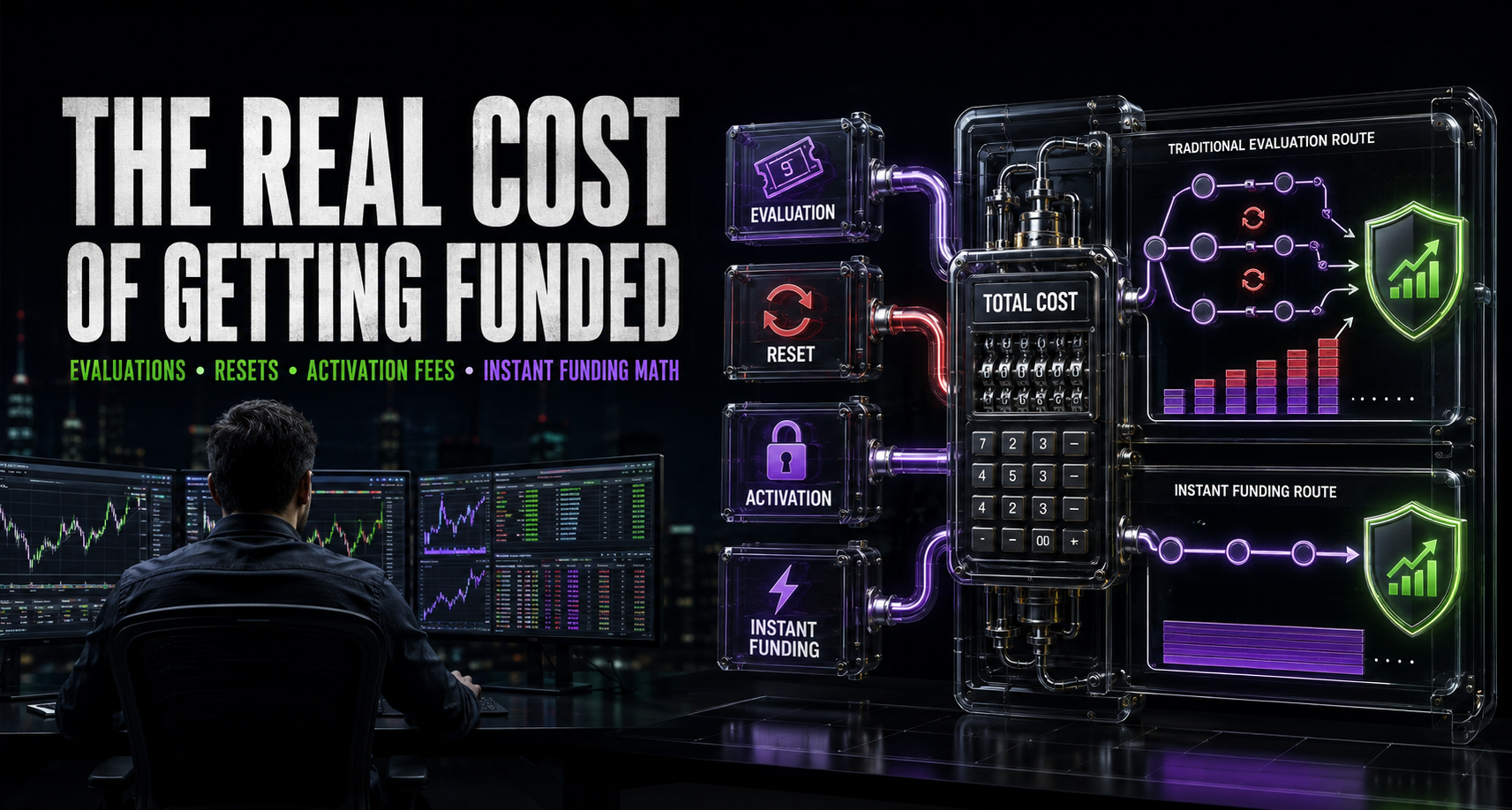
Humble Futures Funding Cost to First Payout
The headline price rarely tells the whole story. On the Standard Path, budget for the monthly subscription plus the one-time activation fee you pay after passing to receive your Performance Account. On Express and Instant, you pay once with no activation fee, which can work out cheaper if you pass quickly. Every path then has a minimum-trading-days requirement before you can withdraw, and the fastest same-day payouts are reserved for accounts in good standing.
| Path | Entry Cost | Activation / Data Fees | Min. Trading Days | Reset | Practical Takeaway |
|---|---|---|---|---|---|
| Standard Path | $159–$654 / month by size | Activation fee after passing; Tier 1 data free | 4 | Paid | Cheapest monthly entry, but the activation fee is a real add-on to budget for. |
| Static Drawdown | One evaluation fee (verify at checkout) | Tier 1 data free | 5 | Verify at checkout | Fixed drawdown suits traders who dislike a trailing floor; 30% consistency applies. |
| Express Path | One-time fee, no subscription | No activation fee; Tier 1 data free | Path-specific | One free reset per month | Best value if you pass fast — the free monthly reset softens a failed attempt. |
| Instant Path | One-time fee | No activation fee; Tier 1 data free | 8 | Verify at checkout | Skip the eval, but you must log 8 trading days before your first withdrawal. |
Humble Futures Funding Rules Explained
Drawdown
Most HFF paths use a trailing drawdown that follows your account's peak, which is stricter than an end-of-day model and can catch traders coming from EOD or static-drawdown firms. The Static Drawdown accounts are the exception: the loss limit is a fixed floor that doesn't move up as you profit, which many traders find easier to manage. HFF has publicly said it's considering adding EOD and static options more broadly in response to trader requests.
Daily Loss Limit
A standout feature traders highlight is that HFF's evaluations generally run with no daily loss limit — your main guardrail is the drawdown. That gives more intraday freedom than firms that pair a trailing drawdown with a hard daily cap, but it also puts the onus on you to manage a bad day yourself.
Consistency Rule
Consistency is path-specific. A 30% consistency rule is tied to the Static Drawdown product (and applies during evaluation on some paths), meaning no single day should exceed 30% of your total profit. Other paths advertise more flexible conditions. Because it varies, confirm the exact rule for the path you buy before you start trading.
Max Contracts & Scaling
Contract limits scale with account size and are tighter on Performance Accounts than some traders expect, so micro-focused and scaling strategies should check the cap for their size. Funded traders can grow across up to 25 accounts through the merit-based scaling system rather than a single large account.
News, Overnight, Hedging & Prohibited Activity
HFF is one of the more permissive firms on style: traders report news trading allowed, no overnight-hold restriction on some paths, and hedging permitted — and the firm removed an earlier grid-trading restriction. What it does police is abuse: no copying or mirrored trading across accounts, and DCA abuse (rapid repeated entries/exits used to sidestep the scalping/HFT rules) can flag an account. Notably, HFF says it doesn't ban DCA as a strategy — only the abusive pattern.
Humble Futures Funding Consistency Rule Example
Take a $100K Static Drawdown account, where the 30% consistency rule applies. If you've built $6,000 in total profit toward a payout, your single best day should stay at or below $1,800 (30% of $6,000). If one big session banked $3,000, that day is 50% of your profit and the payout would be held back until further trading brings that day's share under 30% — here, your total profit would need to climb past roughly $10,000 for a $3,000 day to sit at 30%. As with most firms, the fix is to distribute your gains across several days rather than lean on one outsized session.
Humble Futures Funding Rule Traps to Watch
Where Traders Slip
- The four paths have different rules — minimum days, consistency, and fees aren't universal, so read your path's terms.
- Standard Path adds an activation fee after you pass, on top of the monthly subscription.
- Fast in-and-out trading can trip the HFT/DCA-abuse checks and push a payout onto a monthly spread.
- Most paths use a trailing drawdown, which is stricter than EOD or static models.
Before You Buy
- Screenshot the rules page and any Discord rule announcements on day one, and keep your own records.
- Confirm whether your path bills monthly and how to cancel from the client portal.
- Complete KYC and set up your payout method early so your first withdrawal isn't delayed.
- Because HFF is small and largely manual, expect the occasional processing hiccup — and use support/Discord to resolve it.
Payout Rules
HFF's payout pitch is its biggest draw: 100% of profits on your first $25,000 in withdrawals, then a favorable split beyond that — more generous than the common $10K cap elsewhere. A same-day payout option is available once a request is approved, and traders report flexible windows rather than rigid locked dates (some paths use twice-monthly windows, for example the 1st–4th and 16th–18th). Payouts are sent via Wise, Plane, or ACH, with Rise being added.
Two practical caveats. First, payout requirements are path-specific — the minimum trading days differ (4 on Standard, 5 on Static, 8 on Instant), and Performance/Premium accounts unlock larger payout limits. Second, if the firm's analysis team flags HFT or DCA-abuse patterns, a payout can be moved onto a monthly spread rather than paid in one same-day lump — you still get paid, but more slowly. Payout certifications are published monthly.
| Path | Min. Trading Days | First $25K Split | Same-Day Option | Payout Methods |
|---|---|---|---|---|
| Standard Path | 4 | 100% | Yes (in good standing) | Wise / Plane / ACH |
| Static Drawdown | 5 | 100% | Yes | Wise / Plane / ACH |
| Express Path | Path-specific | 100% | Yes (in good standing) | Wise / Plane / ACH |
| Instant Path | 8 | 100% | Same-day or multi-month spread | Wise / Plane / ACH |
Platforms & Data
Humble Funding runs on the Rithmic ecosystem. Quantower has full integration, NinjaTrader connects via Rithmic, and R | Trader Pro plus other Rithmic-compatible platforms are supported. Real-time Tier 1 data for CME, CBOT, NYMEX, and COMEX is included free on every evaluation and funded account, with optional market depth available on request. Execution runs through Rithmic's low-latency infrastructure, which suits active and scalping styles.
Supported Platforms
- Quantower (full integration)
- NinjaTrader (via Rithmic)
- R | Trader Pro
- Other Rithmic-compatible platforms
Data & Notes
- Free Tier 1 CME/CBOT/NYMEX/COMEX data on all accounts.
- Optional market depth (Level 2) on request.
- Rithmic execution — stable, low-latency, scalping-friendly.
Fees, Resets & Refund Policy
Fees depend heavily on the path. Standard Path is a monthly subscription ($159–$654 by size) plus a one-time activation fee after passing. Express and Instant are one-time purchases with no activation fee, and Express includes one free reset per month. Market data is included, so there's no separate data fee. Because Standard is a subscription, remember to cancel from the client portal if you stop trading, so you aren't billed for another month.
HFF hasn't published a broad money-back guarantee, and — like most prop firms — purchases should be treated as final once your account is issued. That said, the firm has a public reputation for leniency: free resets, continued trading after some violations, and a willingness to re-analyze accounts if a trader believes an error was made. If you're unsure about a charge or a flagged payout, its support and Discord are the fastest routes to a resolution, and it's wise to keep your own screenshots of the rules in case of a dispute.
| Fee Type | Humble Funding Policy / Details |
|---|---|
| Account Fee | Standard: monthly subscription; Express/Instant/Static: one-time |
| Activation Fee | Required on Standard Path after passing; none on Express/Instant |
| Reset | Express includes one free reset per month; other paths vary |
| Data / Platform Fees | Free Tier 1 CME/CBOT/NYMEX/COMEX data; market depth optional on request |
| Refunds | No broad money-back policy published; treat purchases as final and verify current terms |
Humble Futures Funding Discount Code
Humble Funding runs frequent, rotating promotions — often steep — and regularly gives away free accounts through its Discord community and giveaways. Because the codes change often and the firm sometimes swaps in a bigger site-wide discount, the surest move is to check the live banner and confirm the discounted price at checkout before you pay. If you're using an affiliate link or coupon, enter [INSERT YOUR HUMBLE FUNDING CODE] at checkout so your discount applies.
| Promotion | Details |
|---|---|
| Standing Offer | Frequent large discounts across evaluation, Express, and Instant paths |
| Coupon Code | [INSERT YOUR HUMBLE FUNDING CODE] — enter at checkout if using an affiliate code |
| Community Perks | Free-account giveaways and deals via the HFF Discord |
| Note | Apply your code at checkout — discounts generally aren't added retroactively |
| Best Practice | Verify the final discounted price at checkout before purchasing |
Pros & Cons
Pros
- 100% profit split on the first $25,000 — double the usual cap
- Four flexible paths, including Express and Instant one-time options
- Permissive style rules: news allowed, hedging allowed, often no daily loss limit
- Free Tier 1 CME/CBOT/NYMEX/COMEX data on every account
- Same-day payout option and scaling to 25 accounts
- Responsive, community-focused support via Discord
Cons
- Young firm with largely manual operations and evolving systems
- Four overlapping paths make the lineup harder to compare
- Standard Path adds an activation fee on top of a subscription
- Trailing drawdown on most paths; static only on select sizes
- HFT/DCA-abuse flags can move a payout to a monthly spread
- Smaller public track record than established leaders
Who Humble Futures Funding Is Best For
- Traders who want an unusually generous first-$25K payout split
- Traders who value flexible rules (news, hedging, no daily loss limit on some paths)
- Budget-minded traders who want a low barrier to entry or a one-time Express fee
- Quantower and Rithmic users who want free Tier 1 data
- Community-oriented traders who like active Discord support and giveaways
Who Humble Futures Funding May Not Be Ideal For
- Traders who want a large, long-established firm with fully automated systems
- Traders who prefer EOD or static drawdown across all sizes
- High-frequency scalpers whose style may trip the HFT/DCA-abuse checks
- Traders who want one simple account model rather than four paths
- Anyone who won't keep their own records in case of a payout dispute
Best Alternatives to Humble Futures Funding
If you want to compare Humble Funding against other futures firms — for a longer track record, more automated systems, or different drawdown models — these are worth a look:
| Alternative | Why Compare It |
|---|---|
| Apex Trader Funding | Large, established firm with one-time fees, EOD or intraday drawdown, and frequent discounts. |
| Funded Futures Network | Fast-payout futures firm with same-day withdrawals and multiple account paths. |
| My Funded Futures | Modern rule set with no daily loss limit on most plans and several evaluation styles. |
| Take Profit Trader | Straightforward EOD-drawdown evaluation with a clean payout structure for comparison. |
Humble Futures Funding FAQ
Is Humble Futures Funding a futures prop firm?
Yes. HFF funds futures traders through evaluation, Express, Static Drawdown, and Instant funding paths, trading CME/CBOT/NYMEX/COMEX products on Rithmic-connected platforms.
What account paths and sizes are available?
Four paths: Standard ($25K–$300K), Static Drawdown ($100K & $150K), Express ($25K–$150K), and Instant ($10K, $25K, $50K, $150K). Each has its own rules, so match the path to your style.
How much does Humble Funding cost?
Standard Path runs about $159–$654 per month by size plus a one-time activation fee after passing. Express and Instant are one-time fees with no activation fee. Prices move with frequent promos, so confirm at checkout.
What is the profit split?
You keep 100% of your first $25,000 in payouts — higher than the $10K cap at many firms — then continue on a favorable split. A same-day payout option is available once approved.
What is the drawdown and is there a daily loss limit?
Most paths use a trailing drawdown; Static Drawdown accounts use a fixed floor. Many HFF evaluations run with no daily loss limit, leaving the drawdown as your main guardrail.
Are there consistency rules and minimum trading days?
Both are path-specific. A 30% consistency rule is tied to the Static Drawdown product, and minimum days run from 4 (Standard) and 5 (Static) to 8 (Instant). Check your path's terms before trading.
Does HFF allow news trading, hedging, and DCA?
News trading and hedging are allowed, and the firm removed an earlier grid-trading rule. DCA is allowed as a strategy — only DCA "abuse" used to bypass scalping/HFT rules is flagged, which can move a payout to a monthly spread.
What platforms and payout methods are supported?
Quantower (full integration), NinjaTrader via Rithmic, R | Trader Pro, and other Rithmic-compatible platforms. Payouts are sent via Wise, Plane, or ACH, with Rise being added.
Recent Updates
- July 9, 2026: Built the review for Humble Futures Funding, covering the four funding paths (Standard, Static Drawdown, Express, Instant), advertised sizes and pricing, trailing vs. static drawdown, path-specific consistency and minimum-day rules, the 100%-to-first-$25K split, same-day and monthly-spread payouts, the activation-fee and free-reset structure, Quantower/Rithmic platforms with free Tier 1 data, and current promo guidance.
Final Verdict
Humble Futures Funding punches above its weight on the things active traders care about: a genuinely generous 100%-to-first-$25K split, flexible rules (news and hedging allowed, often no daily loss limit), free Tier 1 data, one-time Express and Instant options, and a support team with a strong community reputation. For traders who want a low barrier to entry and room to trade their own way, it's an appealing package.
The caveats are real, though. This is a young, largely manual firm with four overlapping paths, a trailing drawdown on most accounts, a Standard-Path activation fee, and HFT/DCA-abuse checks that can slow a payout to a monthly spread. Keep your own records, read your specific path's rules carefully, and start small. For traders who do that and value flexibility and payout generosity, Humble Funding is worth a look — and it's worth comparing directly against Apex, Funded Futures Network, and Take Profit Trader before you commit.