
Funded Futures Network
 QuantTower
 NinjaTrader
 ATAS
ATAS
 Sierra Charts
 MotiveWave
 Onyx
Onyx
 Rithmic
 Wire
Wire
 ACH
ACH
| Date | Overall Score | |
|---|---|---|
| 2026-09-17 | 2.5 | |
| 2026-09-15 | 2.5 | |
| 2026-09-14 | 2.5 | |
| 2026-09-13 | 2.5 |

Last updated: July 9, 2026
Funded Futures Network Review: Rules, Accounts, Payouts, Discounts & Trader Details
Funded Futures Network (FFN) is a futures-only prop firm founded in 2022 and based in New York. It runs a one-step evaluation on a monthly subscription, with account sizes from $25K up to $250K and an end-of-day style trailing drawdown that most traders find more forgiving than tick-by-tick intraday models. FFN is best known for same-day payouts, live onboarding calls, and famously fast support. It splits its lineup into two routes — OG accounts that pass through an Exhibition stage, and MAX accounts that skip Exhibition and fund you faster.
Quick verdict: FFN suits futures traders who want fast funding, quick withdrawals, and responsive support without the punishing intraday drawdown some competitors use. The things to understand before buying are the monthly subscription model (you keep paying until you pass), the $120 activation fee after passing, the difference between the four account paths, the buffer you must build before your first payout, the 40%/25% consistency rules, and the payout caps that apply until you reach Live Funded status.
Funded Futures Network Quick Facts
| Category | Details |
|---|---|
| Firm Name | Funded Futures Network (FFN) |
| Website | fundedfuturesnetwork.com |
| Help Center | Funded Futures Network Help Center |
| Founded / Location | 2022, New York, United States |
| Support | Live chat and Discord, with an advertised ~10-second average response time and live onboarding calls for new traders |
| Markets | CME futures across equity indexes, currencies, energy, metals, agriculture, and micros |
| Account Sizes | $25K, $50K, $100K, $150K, $250K |
| Profit Split | 80/20 on Sim Funded Pro, upgrading to 90/10 on Live Funded Pro after $5,000 in cumulative payouts |
| Max Accounts | Up to 10 total; up to 5 funded / copy-traded at once |
| Payout Methods | ACH (default), PayPal, and bank wire |
| Payout Speed | Same-day processing once eligible; Live Funded accounts can withdraw daily |
How We Reviewed Funded Futures Network
We built this review from FFN's own homepage and account pages, its published help-center rules on drawdown, consistency, payouts and fees, its FAQ, and its account-specification articles. Where a number tends to move with promotions — evaluation pricing, activation-fee waivers, discount offers — we describe what is advertised and tell you to confirm the final figure at checkout. Pricing, drawdown, payout, and discount details were last checked on July 9, 2026.
FFN sells four evaluation products across two paths, and they are easy to mix up. This review keeps the paths separate so you can see exactly what changes between them: how you pass, how the drawdown behaves, and what you must do before each withdrawal.
Funded Futures Network Account Types
Every FFN funding journey runs through the same pipeline: Evaluation → (Exhibition) → Sim Funded Pro → Live Funded Pro. What differs is whether you pass through an Exhibition stage and how the drawdown is calculated. There are two families.
OG accounts keep the classic structure. After you pass the evaluation you enter an Exhibition stage, where you build a buffer equal to your trailing drawdown before the funded account goes live. OG accounts use a realized trailing drawdown that updates when you close a trade. The two OG variants are Standard OG (7 trading-day minimum, 40% consistency) and Express OG (4 trading-day minimum, tighter 25% consistency for a faster pass).
MAX accounts skip the Exhibition stage entirely. You pass the evaluation and go straight to a funded account, building the buffer inside it. Standard MAX passes on 5 winning days, uses an end-of-day (EOD) drawdown plus a soft daily loss limit, and keeps a 40% consistency rule with no per-payout winning-day requirement. Express MAX is the fastest route — as few as 2 winning days — but uses an unrealized trailing drawdown while the buffer builds (open losses count in real time), tightens funded consistency to 25%, and requires 5 winning days before every payout.
Funded Futures Network Account Comparison
Below is how the sizes line up. Profit targets sit at roughly 6% of account size, and the trailing max drawdown and contract cap are fixed per size. Prices shown are the current advertised monthly figures with the site's standing 50%-off promotion; the crossed-comparison in parentheses is the regular listed price. Standard MAX runs a few dollars above Standard OG for the no-Exhibition path. Express OG and Express MAX sit slightly higher again in exchange for the faster pass — verify the exact Express price at checkout.
| Account Size | Profit Target | Trailing Max Drawdown | Max Contracts (minis / micros) | Standard OG — Advertised (Regular) | Standard MAX — Advertised (Regular) |
|---|---|---|---|---|---|
| $25,000 | $1,500 | $1,500 | 3 / 30 | $63 ($125) | $68 ($135) |
| $50,000 | $3,000 | $2,000 | 4 / 40 | $75 ($150) | $80 ($160) |
| $100,000 | $6,000 | $3,600 | 10 / 100 | $153 ($305) | $158 ($315) |
| $150,000 | $9,000 | $5,000 | 15 / 150 | $175 ($350) | $183 ($365) |
| $250,000 | $15,000 | $6,000 | 20 / 200 | $290 ($580) | $295 ($590) |
And here is how the four paths differ in structure, using the $50K account as a reference point:
| Path | How You Pass | Drawdown Type | Exhibition Stage? | Eval Consistency | Funded Consistency | Winning Days Before Each Payout |
|---|---|---|---|---|---|---|
| Standard OG | 7 trading-day minimum + hit target | Realized trailing (updates on trade close) | Yes | 40% | 40% | No |
| Express OG | 4 trading-day minimum + hit target | Realized trailing (updates on trade close) | Yes | 25% | 40% | No |
| Standard MAX | 5 winning days + hit target | End-of-day (EOD) + soft daily loss limit | No | 40% | 40% | No |
| Express MAX | 2 winning days + hit target | Unrealized trailing while buffer builds, then static | No | Looser in eval (about 50%) | 25% | Yes — 5 winning days |
Funded Futures Network Cost to First Payout
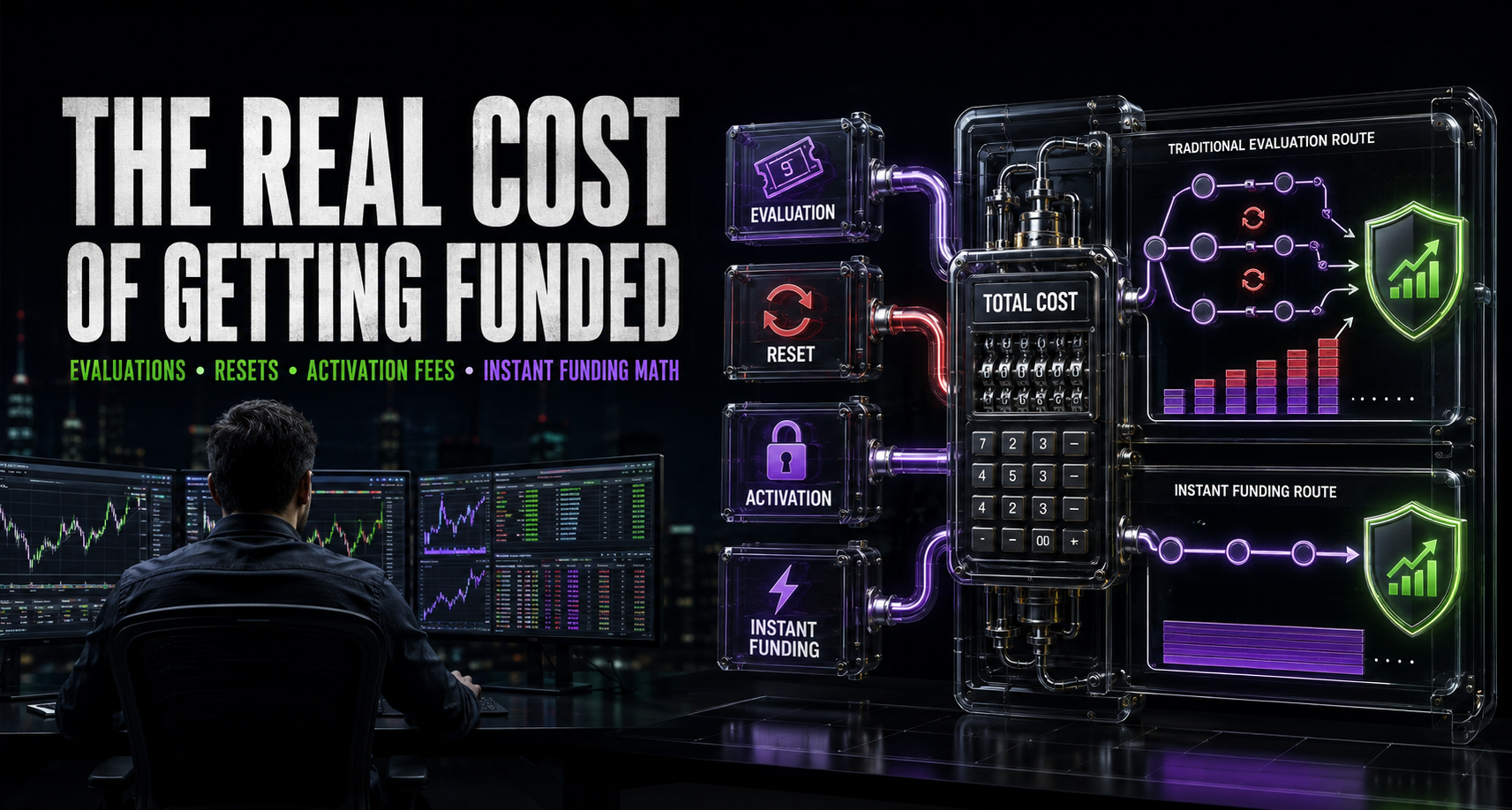
The headline evaluation price is only the entry ticket. Because evaluations bill monthly, the real cost depends on how quickly you pass, whether you reset, the $120 activation fee, and the buffer you must build before any money comes out. Here is the practical math for a few common accounts, using current advertised promo pricing.
| Account | Eval Price (Advertised) | Activation Fee | To Pass | Buffer Before First Payout | Min Payout | Practical Takeaway |
|---|---|---|---|---|---|---|
| $50K Standard MAX | ~$80 / month | $120 (currently waived under the no-activation promo) | 5 winning days, $3,000 target, $2,000 EOD drawdown | Reach $52,000, then $500 above the buffer to withdraw | $500 | Fastest clean path with EOD drawdown room. Budget for the activation fee if the promo ends. |
| $50K Standard OG | ~$75 / month | $120 (activates your Exhibition account; currently promo-waived) | 7 trading days, $3,000 target, $2,000 realized trailing | Build a $2,000 buffer in Exhibition, then $500 above buffer once funded | $500 | A few dollars cheaper up front, but the extra Exhibition stage is one more place to slip. |
| $50K Express MAX | Slightly above Standard MAX — verify at checkout | $120 (currently promo-waived) | 2 winning days, $3,000 target, unrealized trailing while buffer builds | Build $2,000 buffer, plus 5 winning days before each payout | $500 | Quickest to fund, but the unrealized drawdown and per-payout winning-day rule demand tight risk control. |
| $25K Standard MAX | ~$68 / month | $120 (currently promo-waived) | 5 winning days, $1,500 target, $1,500 EOD drawdown | Reach $26,500, then $500 above the buffer to withdraw | $500 | Cheapest entry. Small drawdown room means tight sizing; winning days need ~$100 net each. |
One more real-cost note: if you fail an evaluation, you can reset for $100 from the dashboard instead of paying another full month of subscription. On the cheaper accounts a reset may cost more than simply re-subscribing, so do the arithmetic before you click.
Funded Futures Network Rules Explained
Trailing Drawdown
OG accounts use a realized trailing drawdown: the floor only rises when you close a profitable trade, and an open, unrealized dip does not count against you. Standard MAX uses an end-of-day (EOD) drawdown that recalculates once at session close, giving you the most intraday breathing room. Express MAX is the strictest — while you are building your buffer, the drawdown is unrealized, so open losses hit your floor in real time. Once your buffer is built on any funded account, the drawdown turns static and stops trailing, freezing your risk line so profits above it are truly yours.
Daily Loss Limit
OG and Express accounts do not carry a separate daily loss limit — the trailing drawdown is the main guardrail. Standard MAX adds a soft daily loss limit that locks you out of trading for the rest of the session rather than failing the account (for example, around $1,250 on a $50K Standard MAX). It is a safety net, not a hard breach.
Consistency Rule
Standard accounts (OG and MAX) apply a 40% rule: no single day should account for more than 40% of your profit. Express OG tightens this to 25% during the evaluation. Express MAX is looser in the evaluation but tightens to 25% once funded. Importantly, funded consistency is measured against your best day ever, and that record does not reset after a payout — so one outsized day can hold up withdrawals until your total profit grows enough to bring the percentage back in line.
Max Contracts & Scaling
Contract caps are fixed per size: 3 minis (30 micros) on $25K, 4 (40) on $50K, 10 (100) on $100K, 15 (150) on $150K, and 20 (200) on $250K. Funded accounts scale up toward those caps as realized profit grows, but larger tiers require risk-manager approval — there is no automatic scaling, and trading above your current tier can fail the account.
News, Flat Times & Hedging
News trading is allowed during the evaluation. In Exhibition and funded stages you must be flat one minute before, during, and after Tier 1 events (FOMC, CPI, employment reports and similar). All positions must be flat by 4:50 PM EST each day and can reopen at 6:00 PM EST; on weekends, flat by Friday 4:50 PM and reopen Sunday 6:00 PM. Hedging is prohibited — you cannot be long one product and short a correlated one, and FFN treats a mini and its micro as different products (going long NQ while short MNQ counts as a hedging violation).
Funded Futures Network Consistency Rule Example
Take a $50K Standard account with a $3,000 profit target and a 40% consistency rule. Your best single day should stay at or below $1,200 (40% of $3,000). If you bank $1,500 in one session, that day now represents more than 40% of the target, so FFN effectively raises the bar — you would need to grow total profit to about $3,750 for that $1,500 day to land back at 40%. On the Express side (25%), the same $3,000 target caps your best day at $750, which forces several medium winners instead of one big spike. The lesson is the same on both: spread your gains across days rather than relying on a single home run.
Funded Futures Network Rule Traps to Watch
Where Traders Slip
- Evaluations bill monthly. There is no time limit to pass, but the meter keeps running — a $100 reset is often cheaper than another month.
- A $120 activation fee applies per account after passing (currently promo-waived). Five accounts means five activation fees if the waiver ends.
- A "winning day" is your net at session close, not an intraday peak. Up $200 midday but flat at $80 close does not count.
- Express MAX's unrealized drawdown while building the buffer can fail you on open losses before you ever close a trade.
Before You Buy
- Match the path to your style: OG realized drawdown and Standard MAX EOD suit swing-in-the-day traders; Express MAX rewards fast, disciplined scalpers.
- Remember the hedging rule counts mini vs. micro as different products.
- Plan around the $10,000 per-user payout cap and per-account sim caps until you reach Live Funded.
- Copy-trading more than 5 accounts makes you ineligible for funding and forces resets.
Payout Rules
On Sim Funded Pro accounts you keep 80% of profits. Three things must be true at once to withdraw: your buffer is fully built (reach the account's minimum threshold below), your balance sits at least $500 above the buffer, and you are inside your consistency limit. Standard accounts have no per-payout winning-day requirement; Express MAX requires 5 winning days before each payout, and that counter resets after every withdrawal. The minimum withdrawal is $500, and the maximum any single user can take in one payout event is $10,000, counted across all of your accounts.
Sim-funded accounts also carry per-account payout caps that scale with size and rise after your first few payouts (for example, a $50K account is capped around $1,500 for early payouts and $2,000 later). Payouts are processed same-day once you are eligible, with no fixed payout day. Once you reach $5,000 in cumulative payouts, you can move to Live Funded Pro, which lifts the split to 90/10, removes the per-account caps and the consistency rule, and allows daily withdrawals.
| Account Size | Buffer / Minimum Threshold to Withdraw | Min Payout | Per-User Cap (Sim) | Split (Sim → Live) |
|---|---|---|---|---|
| $25K | $26,500 | $500 | $10,000 across all accounts | 80% → 90% |
| $50K | $52,000 | $500 | $10,000 across all accounts | 80% → 90% |
| $100K | $103,600 | $500 | $10,000 across all accounts | 80% → 90% |
| $150K | $155,000 | $500 | $10,000 across all accounts | 80% → 90% |
| $250K | $256,000 | $500 | $10,000 across all accounts | 80% → 90% |
Platforms & Data
FFN includes a trading-platform license with your subscription at no extra cost. Its current in-house platforms are FundX (a Quantower-based platform) and EdgeProX (a MotiveWave-based platform), both powered by Rithmic data, with a newer Onyx option appearing in recent materials. Because everything runs on Rithmic, you can also connect other Rithmic-compatible platforms if you hold a valid license. FFN has updated its platform lineup over time, so confirm the current options at signup.
Included Platforms
- FundX (Quantower-based)
- EdgeProX (MotiveWave-based)
- Onyx (newer option)
- Rithmic-compatible platforms with your own valid license
Data & Notes
- Rithmic data feed included — no separate data fee to trade the evaluation.
- Copy trading is supported across up to 5 accounts.
- Fully automated bots and high-frequency trading are restricted; confirm your setup complies before running anything automated.
Fees, Resets & Refund Policy
FFN evaluations are monthly subscriptions, so you continue to be billed until you pass or cancel. After passing there is a one-time $120 activation fee per account (the current promotion waives it). On OG accounts, activation opens your Exhibition account; on MAX accounts it releases your funded account. Failed evaluations can be reset for $100 from the dashboard. Platform and Rithmic data are included, so there is no separate data fee.
Evaluation fees are generally non-refundable once a subscription starts — you cancel to stop future monthly billing rather than requesting money back. Activation fees follow the usual prop-firm pattern of being non-refundable once charged. Because promotions change these amounts often, confirm the current fee and refund terms at checkout before you buy.
| Fee Type | Funded Futures Network Policy / Details |
|---|---|
| Evaluation Fee | Monthly subscription; billed until you pass or cancel |
| Activation Fee | $120 per account after passing (currently waived under the no-activation promo) |
| Reset Fee | $100 per reset from the dashboard on a failed evaluation |
| Data / Platform Fees | Included — FundX / EdgeProX license and Rithmic data at no extra cost |
| Refunds | Evaluation fees generally non-refundable; cancel to stop future billing. Activation fees non-refundable once charged. |
Funded Futures Network Discount Code
At the time of writing, FFN is running a standing promotion of 50% off all evaluation accounts, plus a Buy One, Get One free account and no activation fee. The 50%-off pricing is applied site-wide, so you see it directly in the account prices. To claim the free BOGO account, email your receipt to support@fundedfuturesnetwork.com with your username; FFN emails back a free account code, usually within 24 hours, and a no-activation code when you pass. If you are using an affiliate link or coupon, enter [INSERT YOUR FFN CODE] at checkout to make sure your discount tracks.
| Promotion | Details |
|---|---|
| Current Offer | 50% off all evaluations + Buy One Get One free + no activation fee |
| Coupon Code | [INSERT YOUR FFN CODE] — enter at checkout if using an affiliate code |
| Free Account | Email your receipt to support@fundedfuturesnetwork.com to receive a free BOGO account code (usually within 24 hours) |
| Sale Pricing | Varies by account size, path (OG vs. MAX), and Standard vs. Express |
| Best Practice | Verify the final price and any code at checkout before purchasing |
Pros & Cons
Pros
- Same-day payouts and daily withdrawals once you reach Live Funded
- Trader-friendly drawdown — realized on OG, EOD on Standard MAX
- Fast funding paths: MAX accounts skip Exhibition entirely (Express MAX in as few as 2 winning days)
- Standing 50% off, BOGO, and no-activation-fee promotion
- Platform license and Rithmic data included at no extra cost
- Standout support: ~10-second responses and live onboarding calls
Cons
- Monthly subscription keeps billing until you pass or cancel
- $120 activation fee per account once the promo ends
- Four account paths can be confusing for newcomers
- Express MAX's unrealized drawdown is unforgiving of open losses
- Per-account sim payout caps and a $10,000 per-user cap until Live Funded
- No traditional single-account scaling — you scale mainly by running multiple accounts
Who Funded Futures Network Is Best For
- Futures traders who want fast funding and same-day payouts
- Traders who prefer realized or EOD drawdown over tick-by-tick intraday models
- Scalpers and active day traders who can rack up winning days quickly (Express MAX)
- Traders who value responsive support and a live onboarding walkthrough
- Traders who want to scale by running and copy-trading several funded accounts
Who Funded Futures Network May Not Be Ideal For
- Traders who want a single one-time fee rather than a monthly subscription
- Beginners who prefer one simple account model over four paths
- Traders who dislike buffer requirements and per-account payout caps
- Anyone who wants automated or high-frequency strategies without restriction
- Traders who want a large single-account scaling plan rather than multiple accounts
Best Alternatives to Funded Futures Network
If you want to compare FFN against other futures prop firms — especially for one-time-fee pricing, different drawdown models, or larger single-account scaling — these are worth a look:
| Alternative | Why Compare It |
|---|---|
| Apex Trader Funding | Large, established firm with one-time evaluation fees, EOD or intraday drawdown, and frequent deep discounts. |
| My Funded Futures | Modern rule set with no daily loss limit on most plans and multiple evaluation styles to match your pace. |
| Take Profit Trader | Platform-first evaluation with a straightforward payout structure for traders who want simplicity. |
| Topstep | Long-running futures firm with a well-known evaluation and a different funded-account structure. |
Funded Futures Network FAQ
Is Funded Futures Network legit?
FFN is a real, US-based futures prop firm founded in 2022 with a public presence, published rules, an active community, and a documented history of paying traders. As with any prop firm, "legit" does not mean risk-free — you still face evaluation risk and rule-change risk — so treat it as one option among several.
Are FFN evaluations a one-time fee or a subscription?
Evaluations are billed as a monthly subscription. There is no time limit to pass, but you keep paying month to month until you do. If you fail, you can reset for $100 from the dashboard instead of restarting the subscription.
What is the difference between OG and MAX accounts?
OG accounts pass through an Exhibition stage to build a buffer before funding and use a realized trailing drawdown. MAX accounts skip Exhibition — you go straight to a funded account and build the buffer there. Standard MAX uses an EOD drawdown; Express MAX uses an unrealized drawdown while the buffer builds.
How much does FFN cost?
With the current 50%-off promotion, advertised Standard pricing runs from about $63 (25K) to $290 (250K) per month, with MAX a few dollars higher. There is also a $120 activation fee per account after passing, currently waived by the promo. Confirm the exact figure at checkout.
How do FFN payouts work?
On Sim Funded Pro you keep 80% of profits. You must build your buffer, sit at least $500 above it, and stay within your consistency limit. The minimum withdrawal is $500 and the maximum is $10,000 per user per payout across all accounts. After $5,000 in cumulative payouts you can move to Live Funded Pro for a 90% split, no caps, and daily withdrawals.
What is the FFN discount code?
FFN runs a standing 50%-off promotion with a Buy One Get One free account and no activation fee. The 50% off shows in site pricing automatically; email your receipt to support@fundedfuturesnetwork.com to claim the free account. Enter your affiliate code at checkout if you have one.
Does FFN allow news trading?
News trading is allowed during the evaluation. In Exhibition and funded stages you must be flat one minute before, during, and after Tier 1 events such as FOMC, CPI, and employment reports.
What platforms and payout methods does FFN support?
FFN includes FundX (Quantower-based) and EdgeProX (MotiveWave-based) on Rithmic, with a newer Onyx option, plus other Rithmic-compatible platforms via your own license. Payouts go out by ACH (default), PayPal, or bank wire.
Recent Updates
- July 9, 2026: Rebuilt the review for Funded Futures Network with current account paths (Standard/Express OG and MAX), profit targets and drawdowns by size, monthly subscription pricing, the 50%-off + BOGO + no-activation promotion, payout rules and caps, platform and data details, and the $120 activation and $100 reset fees.
Final Verdict
Funded Futures Network is one of the more trader-friendly futures firms on the payout and support side. The realized and EOD drawdown models give you room to breathe, the MAX accounts get you funded quickly, withdrawals are fast, and the standing promotion keeps entry cheap. Its live onboarding and rapid support are genuinely unusual in this space.
The trade-offs are the monthly subscription that bills until you pass, the $120 activation fee waiting behind the promo, four account paths that take a moment to learn, and payout caps that persist until you cross $5,000 in cumulative withdrawals and reach Live Funded. If you understand those mechanics and want fast funding with quick, reliable payouts, FFN earns a spot on your shortlist — and it is worth comparing directly against Apex, My Funded Futures, and Take Profit Trader before you commit.