
Funded Futures Family
 NinjaTrader
 Tradovate
 TradingView
 WealthCharts
Tradovate
WealthCharts
Tradovate
 Rise
Rise
 Crypto
| Date | Overall Score | |
|---|---|---|
| 2026-09-17 | 10.0 | |
| 2026-09-15 | 9.5 | |
| 2026-09-14 | 8.3 | |
| 2026-09-13 | 7.2 |









Last updated: July 8, 2026
Funded Futures Family Review: Rules, Accounts, Payouts, Discounts & Trader Details
Funded Futures Family (FFF) is a US-based, futures-only prop firm founded by Manuel Meraz and run out of Dallas, Texas. It has paid out several million dollars to traders and leans hard into one idea: a community-driven path from a monthly-subscription evaluation, to a simulated funded account, to a live proprietary desk with one-on-one risk calls. Where most firms give you one or two account models, FFF gives you a whole menu — Prime, Premier (and Premier+), Classic, Elite, Velocity, and Straight-to-Funded — each with its own drawdown style, pass speed, and payout rules.
Quick verdict: FFF suits experienced futures traders who want to pick the exact rule set that fits their style and who value a real route to a live desk. Before you buy, understand that the plans differ a lot — on drawdown type, minimum days, consistency rules, and buffers — and that funded resets are expensive. The 90% split (with your first $10K at 100%) is competitive, but the complexity and the intraday-trailing plans are where less-organized traders get caught.
Funded Futures Family Quick Facts
| Category | Details |
|---|---|
| Firm Name | Funded Futures Family (FFF) |
| Website | fundedfuturesfamily.com |
| Help Center | Funded Futures Family Help Center |
| Company / Base | US-registered LLC based in Dallas, Texas; founded and led by Manuel Meraz |
| Support | 24/5 support via the help center, live chat, and an active Discord community |
| Markets | Futures only, on CME-group products (ES, NQ, CL, GC, and the rest of the CME suite). No forex, stocks, or crypto. |
| Account Sizes | $25K, $50K, $100K, and $150K (range varies by plan) |
| Trading Environment | Simulated evaluation and simulated funded accounts, with a live proprietary desk stage for proven traders |
| Profit Split | 100% on your first $10,000, then 90/10 in your favor |
| Max Funded Accounts | Advertised up to 4 funded accounts (verify current limit at checkout) |
| Payout Method | Processed through Rise; approved requests typically paid within 24 hours |
How We Reviewed Funded Futures Family
This review is built from FFF's own materials: the homepage, the plan and pricing details, the Intercom help-center articles covering each program and the payout policy, and the firm's published rule explanations. Pricing, rules, payout stages, and the current promo were checked in early July 2026.
A note on the moving target: FFF runs an unusually large plan lineup, and it revised several rules in 2026 (notably a set of changes around April 7, 2026, including the Premier+ variant and adjusted qualifying-day counts). Where the plans genuinely differ, we've laid them out side by side, and where a figure varies by plan or wasn't clearly published for every size, we've said so rather than guessing. One common mix-up worth clearing up: FFF is not the same company as MyFundedFutures (MFFU).
Funded Futures Family Account Types
All of FFF's programs are one-step: pass a profit target without breaching the max loss, then trade a simulated funded account. What separates them is the trade-off between pass speed, drawdown style, and payout flexibility.
Classic is the conservative flagship — end-of-day drawdown, a 2-day minimum to pass, and a 50% evaluation consistency rule. Prime and Premier keep the gentler end-of-day drawdown but pass in as little as one day, with Premier offering a $0-activation version. Elite is the cheapest entry but uses a stricter intraday trailing drawdown. Velocity is the cash-flow plan — intraday trailing, a fast qualifying cadence, and an optional Daily Payout add-on. Straight-to-Funded (S2F) skips the evaluation entirely for a higher upfront fee. Above all of these sits the Evaluation-to-Live path, FFF's route to a real proprietary desk with custom risk parameters.
Funded Futures Family Account Comparison
| Plan | Drawdown Type | Min. Days to Pass | Eval Consistency | Activation Fee | Sizes | Notes |
|---|---|---|---|---|---|---|
| Classic | EOD trailing | 2 | 50% | ~$100–$150 by size | $25K–$150K | Most conservative; gentle intraday, structured pass |
| Prime | EOD trailing | 1 | Applied at payout (40%) | $0 | $25K–$150K | Fast pass, EOD flexibility, 3 qualifying days per payout |
| Premier / Premier+ | EOD (and intraday variant) | 1 | Premier+ removes it | $0 (Premier) | $25K–$150K | Premier+ (after Apr 7, 2026) drops the consistency rule and buffer |
| Elite | Intraday trailing | 1 | None on eval | ~$100 | $25K–$150K | Cheapest monthly entry; harsher real-time drawdown |
| Velocity | Intraday trailing | 3 | 40% | Listed at checkout | $25K–$150K | Cash-flow focused; optional Daily Payout add-on |
| Straight-to-Funded | Trailing (per size) | None (skips eval) | 25% | Built into price | $25K–$150K | Higher upfront fee; funded from day one |
Profit targets scale with size across the core plans — roughly $1,500 on the $25K, $3,000 on the $50K, $6,000 on the $100K, and $9,000 on the $150K — with trailing max drawdowns in the range of about $1,500 to $4,500 depending on plan and size. Contract limits run to 5, 10, or 15 minis (or 50/100/150 micros) by account size. Because the exact target and drawdown pairing shifts by plan, confirm the numbers for your specific plan and size before buying.
Funded Futures Family Cost to First Payout
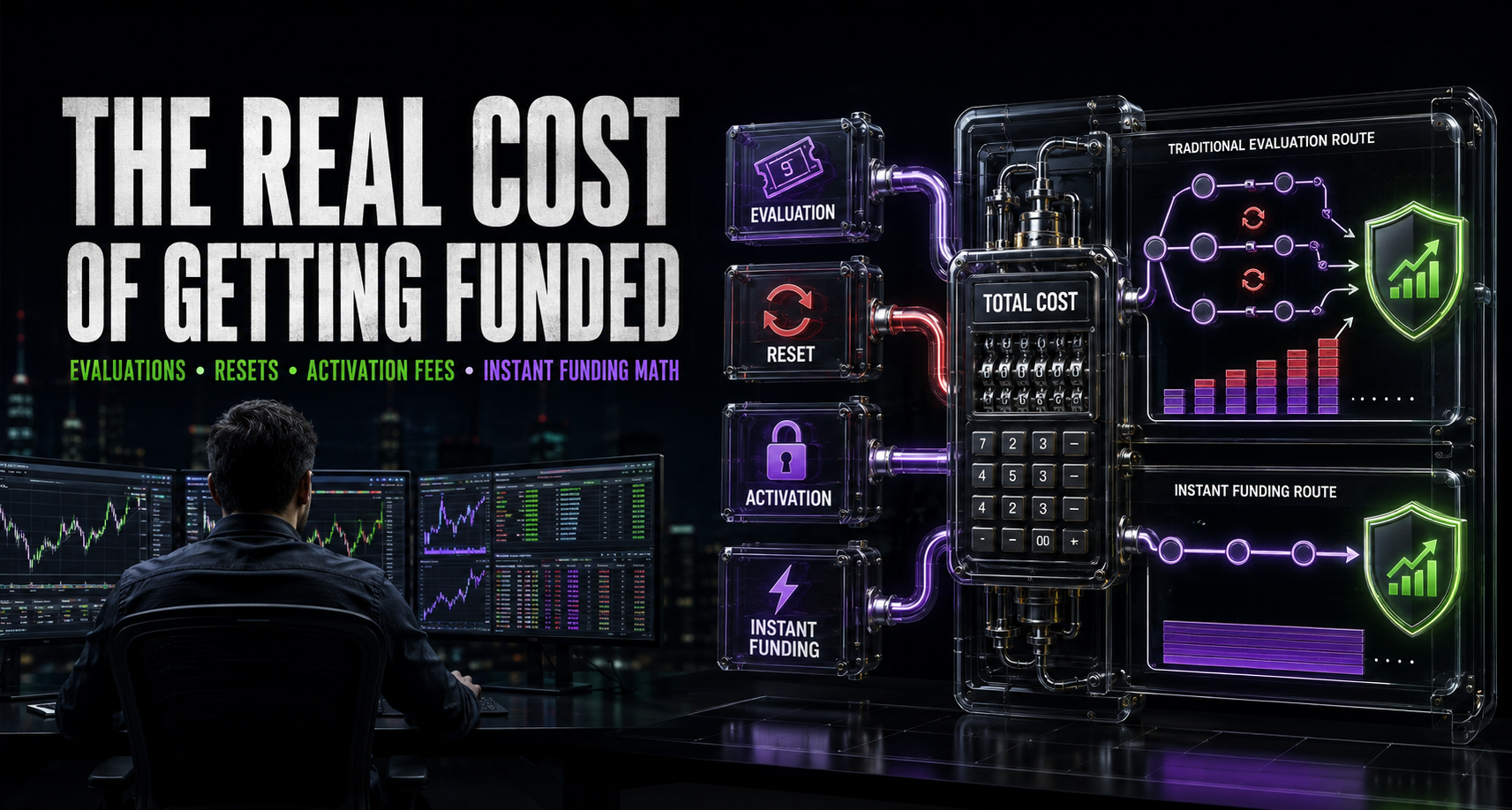
FFF is a monthly subscription, not a one-time fee, so a slow or repeated path to passing adds up. The headline monthly price is only part of the story — you also want to weigh the activation fee (waived on some plans), the buffer you must clear before withdrawing, and the qualifying-day count on your plan. Here's a practical view of the entry points.
| Plan / Size | Monthly (advertised) | Activation Fee | Qualifying Days to First Payout | Min. Daily Profit | Practical Takeaway |
|---|---|---|---|---|---|
| Elite $50K | From ~$64/mo | ~$100 | 7 | $200/day | Cheapest monthly entry, but intraday drawdown and an activation fee raise the true cost. |
| Premier $50K | From ~$135/mo | $0 | 7 (5 on Premier+) | $200/day | Predictable all-in cost thanks to the waived activation fee; gentler EOD drawdown. |
| Prime $50K | Listed at checkout | $0 | 3 | $200/day | Fastest to a first payout — only 3 qualifying days per cycle. |
| Velocity $50K | Discounted on landing pages | Listed at checkout | 3 (or daily with add-on) | $200/day | Built for cash flow, but the 40% consistency rule and intraday drawdown demand discipline. |
| Straight-to-Funded $150K | Up to ~$699 one-time | Built in | 7 | $200/day | Skips the evaluation, but you pay for it upfront and still face a 25% consistency cap. |
Two things shape the real cost more than the sticker price. First, most plans gate your first withdrawal behind a buffer (you can't withdraw an amount that would drop your balance below the required buffer line). Second, the qualifying-day requirement means even a fast, profitable trader needs several $200+ days before the first payout — so budget time as well as money.
Funded Futures Family Rules Explained
Drawdown Types
FFF runs two very different drawdown models, and picking the wrong one is the most expensive mistake here. End-of-day (EOD) trailing — used on Classic, Prime, and the EOD Premier — updates once per day at the close based on realized gains, giving you room to breathe intraday. Intraday trailing — used on Elite, Velocity, and the intraday Premier — moves in real time with your peak balance and includes unrealized profit, which tightens fast and is much harsher on scalpers and volatile sessions. In both cases the drawdown trails up and then locks once it reaches a floor near your starting balance.
Daily Loss Limit
FFF's core evaluation plans do not use a separate daily loss limit — the trailing drawdown is the rule that governs the account. That's a plus for traders who've been burned by intraday loss caps elsewhere, but it also means the trailing line is the only thing standing between you and a breach, so it deserves your full attention.
Consistency Rule
Consistency at FFF varies more by plan than almost anything else. Classic applies a 50% rule during the evaluation. Velocity and Prime apply a 40% cap, S2F a 25% cap, and Premier+ removes the consistency rule entirely. On the funded side, FFF's published payout policy also uses staged caps that loosen as you take more payouts (commonly around 40% for early payouts, rising toward 50% for later ones). The takeaway: check your specific plan's consistency number before you size up on a big day.
Qualifying (Winning) Days
A qualifying day is any day with at least $200 in realized profit. The number you need before a payout depends on the plan: 3 on Prime and Velocity, 5 on Premier+, and 7 on Classic, Premier, Elite, and S2F. Velocity's optional Daily Payout add-on removes the qualifying-day gap between requests entirely.
Hours & News
FFF is day-trading only — positions must be flat before the daily settlement, with no overnight or weekend holds. News trading is generally allowed, but the firm warns that slippage and gaps during high-impact events are your responsibility, and trading is suspended when a product trades within about 2% of its CME price limit. Automated bots and EAs are restricted, and martingale, grid, arbitrage, and HFT-style strategies are prohibited.
Funded Futures Family Consistency Rule Example
Say you're funded on a plan with a 40% consistency cap and you've earned $5,000 in total realized profit since your last payout. No single day may account for 40% or more of that — so your biggest day should stay under $2,000. Bank $2,500 on one session and you're at 50%, over the line, and the payout is held until you add more qualifying days at smaller size to dilute that percentage. On the staged funded schedule, the cap is more forgiving early (around 40%) and tightens toward 50% on later payouts, which rewards traders who spread profit across many days rather than chasing one windfall.
Funded Futures Family Rule Traps to Watch
Important Rule Risks
- Intraday trailing drawdown on Elite and Velocity moves with unrealized profit and can breach you before you close a trade.
- Payouts can be denied if the requested amount would drop your balance below the required buffer.
- Funded resets are expensive — up to roughly $1,499 on the largest accounts, capped at 3 per funded account.
- The plan lineup is complex; consistency, minimum days, and drawdown all differ, so it's easy to break a rule you didn't realize applied.
Before You Buy
- Choose EOD (Classic/Prime/Premier) if you hold through intraday swings; intraday only if you scalp tight.
- Match the qualifying-day count to how quickly you need cash (Prime/Velocity are fastest at 3).
- Cancel the monthly subscription manually if you stop — it keeps billing until you pass or cancel.
- Read your exact plan's consistency and buffer rules before your first big day.
Payout Rules
FFF pays 100% on your first $10,000 in profits, then moves to a 90/10 split in your favor — competitive positioning versus the 80/20 standard at many firms. Payouts are request-based and processed through Rise. Requests are reviewed Monday through Friday; submit before 5 PM EST and it's reviewed the same day, with funds typically sent within 24 hours of you signing the payout contract.
Eligibility depends on your plan's qualifying-day count (3, 5, or 7 days of $200+ profit), the consistency cap for your payout stage, and the buffer. The count resets after each payout, so every cycle starts fresh. On Premier+, the buffer is replaced by a simpler net-profit rule: your balance just needs to be at least $1 above your previously requested level.
| Plan | Qualifying Days | Consistency at Payout | Buffer Rule | Split |
|---|---|---|---|---|
| Prime | 3 | 40% lifetime cap | Buffer applies | 100% first $10K, then 90/10 |
| Velocity | 3 (or daily with add-on) | 40% (removed with Daily Payout add-on) | Buffer applies | 100% first $10K, then 90/10 |
| Premier+ | 5 | None | Net-profit rule ($1 above prior) | 100% first $10K, then 90/10 |
| Classic / Elite / S2F | 7 | Staged (≈40% → 45% → 50%) | Buffer applies | 100% first $10K, then 90/10 |
Payout caps and buffer amounts vary by plan and account size, and FFF adjusts them to support account longevity, so confirm your plan's specific limits in the help center. The pattern to internalize: FFF rewards steady $200–$500 days that stack qualifying days, not one heroic session that trips the consistency cap or empties the buffer.
Platforms & Data
FFF supports a broad set of futures platforms and connections. The commonly listed options include NinjaTrader, Tradovate, Rithmic, and WealthCharts, covering both the popular execution front ends and Rithmic-compatible tools. Real-time data comes with the platform connection, and the subscription covers your evaluation account and feed.
Listed Platforms
- NinjaTrader
- Tradovate
- Rithmic (and Rithmic-compatible tools)
- WealthCharts
- Real-time CME data included with the connection
Platform Notes
- Plan families differ by platform (some plans are tied to specific platform/data setups).
- One profile per user — multiple accounts under one person are allowed, but not multiple profiles.
- Third-party automated bots, martingale, grid, arbitrage, and HFT strategies are prohibited.
- Copy trading rules vary by plan — check your specific plan before relying on it.
Fees, Resets & Refund Policy
Evaluation accounts are billed monthly and rebill until you pass or cancel; some plans add a one-time activation fee when you pass (Elite around $100, Classic around $100–$150), while Prime and Premier waive it. Evaluation resets are relatively cheap — roughly $39 to $170 depending on size — and are effectively unlimited.
The expensive part is funded resets. If you breach a funded account, restarting it costs from around $649 up to roughly $1,499 depending on size, and each funded account allows a maximum of three funded resets. Fees are generally non-refundable, all payments must be made on a card in the account holder's own name, and third-party payment methods are prohibited.
| Fee Type | Funded Futures Family Policy / Details |
|---|---|
| Evaluation Fee | Monthly subscription by plan and size; rebills until you pass or cancel (S2F is a one-time fee) |
| Activation Fee | $0 on Prime and Premier; roughly $100–$150 on Elite and Classic |
| Evaluation Reset | About $39–$170 by size; effectively unlimited |
| Funded Reset | About $649–$1,499 by size; maximum of 3 per funded account |
| Data / Platform Fees | Real-time data included with the platform connection |
| Refunds | Fees are generally non-refundable; cancel the subscription manually to stop billing |
Funded Futures Family Discount Code
Funded Futures Family runs frequent promotions, and the widely circulated current code is DGT, advertised at up to 80% off evaluations (for example, a $50K plan dropping from around $179 to roughly $98). Because FFF rotates deals often and runs plan-specific landing-page discounts (Velocity in particular tends to show deep cuts), the exact code and percentage can change.
| Promotion | Details |
|---|---|
| Current Code | DGT |
| Discount | Advertised up to 80% off evaluation plans |
| Applies To | Evaluation plans; some plans also show standalone landing-page discounts |
| Limitation | Codes rotate and can change without notice; typically one code per purchase |
| Best Practice | Enter the code at checkout and verify the final price before purchasing |
Pros & Cons
Pros
- A wide menu of plans to match nearly any trading style
- Choice of gentler EOD or tighter intraday trailing drawdown
- 100% on your first $10K, then a strong 90/10 split
- No daily loss limit on the core plans
- Fast payouts through Rise, usually within 24 hours of approval
- A genuine, structured path to a live proprietary desk
Cons
- Complex lineup — easy to misread a plan's rules and breach
- Monthly subscription means a slow pass adds up
- Funded resets are very expensive (up to ~$1,499)
- Intraday trailing plans are harsh on scalpers and volatile sessions
- Buffer and staged consistency rules can delay payouts
- Automated bots and several strategy types are restricted
Who Funded Futures Family Is Best For
- Experienced futures traders who want to pick the exact rule set that fits their style
- Traders who understand the difference between EOD and intraday trailing drawdown
- Traders who can stack steady $200+ qualifying days rather than one big day
- Traders who actually plan to pursue the live proprietary-desk pathway
- NinjaTrader, Tradovate, Rithmic, or WealthCharts users
Who Funded Futures Family May Not Be Ideal For
- Beginners who want one simple account model and rule set
- Traders who prefer a one-time evaluation fee over a monthly subscription
- Scalpers who dislike intraday trailing drawdown
- Traders who make most of their profit in single large days
- Traders who rely on automated bots or want forex, stocks, or crypto
Best Alternatives to Funded Futures Family
Traders comparing FFF may also want to look at firms with a simpler single-rule structure, a one-time fee, or a larger multi-account ecosystem.
| Alternative | Why Compare It |
|---|---|
| Apex Trader Funding | Worth comparing for one-time fees, a much larger multi-account ceiling, and a choice of drawdown models. |
| Topstep | A long-running futures firm with one clear trailing-drawdown rule and a structured path to live capital. |
| Take Profit Trader | Useful for traders who want day-one, uncapped withdrawals and a simpler one-step evaluation. |
Funded Futures Family FAQ
Is Funded Futures Family a legit prop firm?
Yes. FFF is a US-registered futures prop firm based in Dallas, Texas, founded by Manuel Meraz, with a public website, help center, thousands of Trustpilot reviews, and visible trader payouts totaling several million dollars.
Is FFF the same as MyFundedFutures?
No. Funded Futures Family (FFF) and MyFundedFutures (MFFU) are different companies with different rules, plans, and ownership, despite the similar names.
What account types does FFF offer?
Several one-step programs: Classic (EOD, conservative), Prime and Premier/Premier+ (EOD, fast pass), Elite (intraday, cheapest), Velocity (intraday, cash-flow), and Straight-to-Funded (skips the evaluation), plus an Evaluation-to-Live path to a real desk.
What drawdown does FFF use?
Both types, by plan. Classic, Prime, and the EOD Premier use end-of-day trailing drawdown (gentler intraday). Elite, Velocity, and the intraday Premier use intraday trailing drawdown that moves in real time with unrealized profit.
How do FFF payouts work?
You keep 100% of your first $10,000, then 90/10 after. Eligibility needs a set number of $200+ qualifying days (3, 5, or 7 by plan), the plan's consistency cap, and the buffer. Payouts run through Rise and are usually paid within 24 hours of approval.
Does FFF have an activation fee?
It depends on the plan. Prime and Premier waive it; Elite and Classic charge roughly $100–$150 when you pass. There's no activation fee on many of the standard EOD offerings.
How much are FFF resets?
Evaluation resets are cheap (about $39–$170) and effectively unlimited. Funded resets are expensive — roughly $649 to $1,499 by size — and capped at three per funded account.
What is the FFF discount code?
The widely circulated current code is DGT, advertised at up to 80% off evaluations. Codes rotate frequently, so confirm the current offer and final price at checkout.
Recent Updates
- July 8, 2026: Refreshed the full page across FFF's plan lineup — Classic, Prime, Premier/Premier+, Elite, Velocity, and Straight-to-Funded — with current rules, pricing, payout stages, platforms, and the DGT promo, using official sources.
- Premier+ introduced (April 2026): A newer Premier variant removes the consistency rule and buffer, replacing the buffer with a simpler net-profit rule.
- Qualifying-day counts adjusted: Prime and Velocity require 3 qualifying days, Premier+ requires 5, and Classic, Premier, Elite, and S2F require 7 before a payout.
- Staged funded consistency: The funded payout consistency cap loosens early (around 40%) and tightens toward 50% on later payouts.
Final Verdict
Funded Futures Family stands out for choice and its live-desk ambition. Instead of one rigid model, it hands you a full menu — gentle EOD plans like Classic, Prime, and Premier, tighter intraday plans like Elite and Velocity, and a Straight-to-Funded shortcut — plus a genuine pathway to a proprietary desk with one-on-one risk calls. Pair that with 100% on your first $10K, a 90/10 split after, no daily loss limit on the core plans, and fast payouts, and it's a compelling firm for traders who know exactly what they want.
The flip side is complexity and cost. The lineup's differing drawdown types, consistency rules, and qualifying-day counts make it easy to breach a rule you didn't realize applied, funded resets run into four figures, and the monthly subscription rewards passing quickly. The takeaway is clear: FFF rewards organized, experienced traders who pick the right plan and grind steady qualifying days. For that trader — especially with the current discount — it's a strong, flexible option worth comparing carefully against the simpler firms in the field.