Which Prop Firm Account Size Should You Buy? The Drawdown-per-Dollar Math (25K vs 50K vs 100K vs 150K)
The account label is marketing; the drawdown is the account. The standard tiers decoded, the two ratios that compare any account at any firm in seconds, which strategies physically fit which sizes, the one-big versus several-small math experienced traders converge on, and a worked decision at the end.
 Tradeify
 My Funded Futures
 Top One Futures
 Alpha Futures
 Apex Trader Funding
 Lucid Trading
 BlueSky Funded
 Take Profit Trader
 Trade Day
 Phidias
 Bulenox
 Funded Next Futures
 Blue Guardian Futures
 The Trading Pit
 Funded Futures Family
 E8 Markets
 Daytraders
 Elite Trader Funding
 Funded Futures Network
 Hola Prime
 Blueberry Futures
 Taurus Arena
 Humble Futures
 Legends Trading
 Savius
 Futures Elite
 NexGen Protrader
 Funded Seat
 YRM Prop
 FundingPips
 FundedNext
Last updated: July 28, 2026
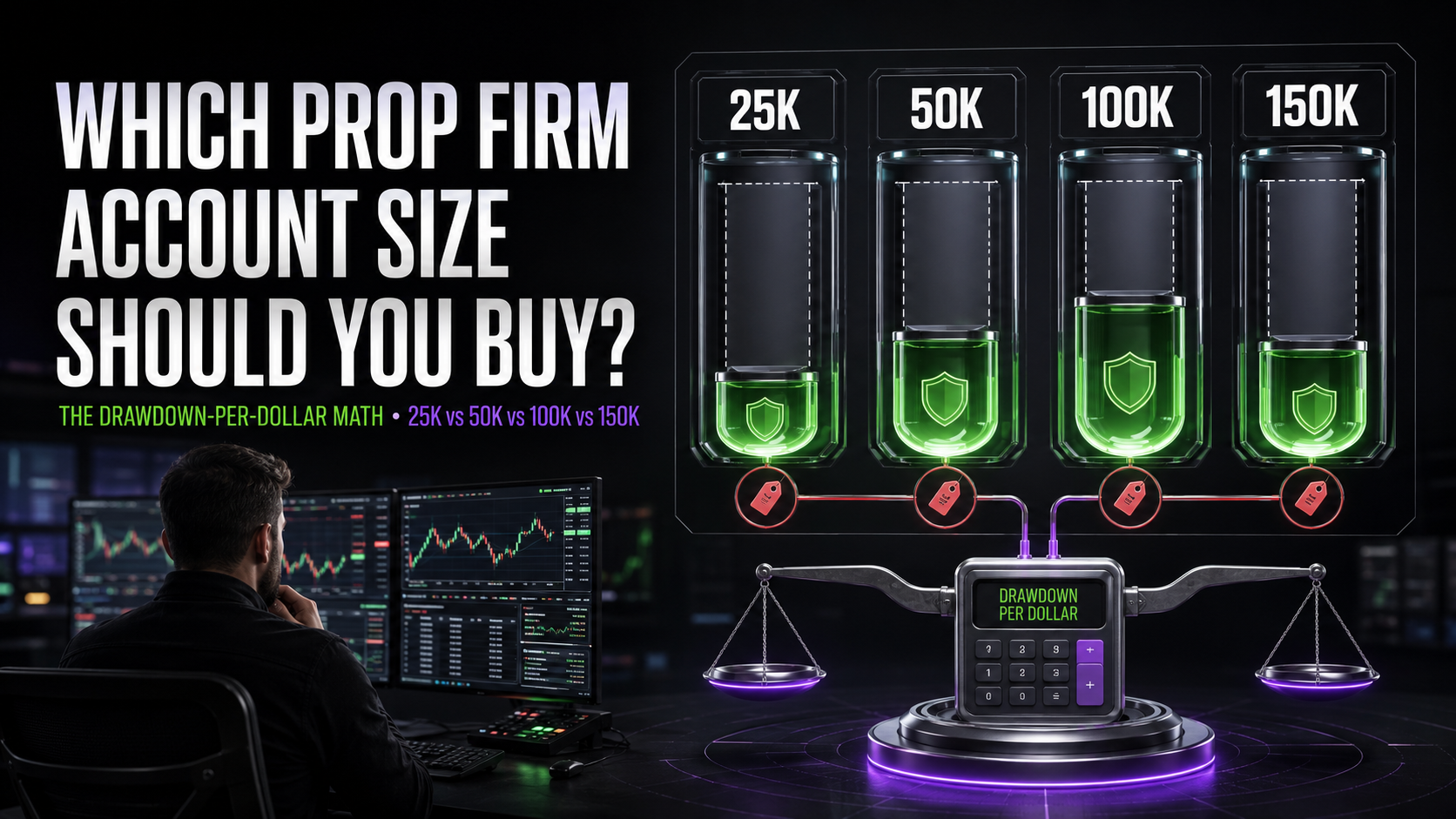
The account size on a prop firm's pricing page is the least informative number on it. A "$100,000 account" does not hand you $100,000 of risk capital; it hands you buying power wrapped around a drawdown of perhaps $3,000, and that drawdown is the account you are actually buying. Once you price accounts that way, the size question stops being about ego and becomes arithmetic: dollars of survivable risk per dollar of fee, difficulty measured as target-to-drawdown stretch, and what stop distances each size can genuinely afford at sane risk. This guide builds that arithmetic: the real structure of the standard tiers, the two ratios that let you compare any account at any firm in seconds, the strategy-fit question (which styles physically fit which sizes), the one-big versus several-small decision that experienced funded traders almost all resolve the same way, and a worked decision at the end.
Numbers note: tier structures below use the common mid-2026 shapes; exact drawdowns, targets, and prices vary by firm and change often, so verify the specific account's parameters before buying. The ratios are the durable tools.
What You Are Actually Buying: The Standard Tiers Decoded
| Nominal Size | Typical Max Drawdown | Drawdown as % of Nominal | Typical Profit Target | Target ÷ Drawdown (difficulty stretch) |
|---|---|---|---|---|
| $25,000 | $1,000 to $1,500 | 4 to 6% | $1,500 to $2,000 | roughly 1.3 to 1.5x |
| $50,000 | $2,000 to $2,500 | 4 to 5% | $3,000 | roughly 1.2 to 1.5x |
| $100,000 | $3,000 to $3,500 | 3 to 3.5% | $6,000 | roughly 1.7 to 2.0x |
| $150,000 | $4,500 to $5,000 | 3 to 3.3% | $9,000 | roughly 1.8 to 2.0x |
Two patterns hide in that table, and they are the whole argument. First, drawdowns do not scale with the label: the 100K account costs roughly twice the 50K's fee at most firms but carries only about 1.5 times the drawdown, and its drawdown is a thinner slice of its nominal size (3 percent versus 4 to 5), meaning the bigger account is relatively tighter, not looser. Second, the difficulty stretch rises with size: a 50K typically asks you to make about 1.5 times your survivable risk before you breach it, while a 100K asks for about 2 times, which is a materially harder assignment for the identical strategy. The marketing intuition (bigger account, more room, easier life) is exactly backwards on both counts. The larger tiers do buy real things (higher contract caps, larger payout caps, more scaling headroom), but room for error is not one of them.
The Two Ratios That Compare Any Account in Seconds
- Ratio 1: Drawdown dollars per fee dollar (survivability value). Divide the max drawdown by the cost per attempt. A 50K at $2,000 drawdown for a $60 promo evaluation gives you about $33 of survivable risk per fee dollar; a 100K at $3,000 for $130 gives about $23. On this metric, mid-size accounts at promo prices are almost always the best-value risk capital in the industry, and the flagship tiers are almost always the worst. Run it on any pair of accounts, same firm or across firms, and the value question answers itself, before the full cost stack refines it.
- Ratio 2: Target divided by drawdown (difficulty stretch). Already computed in the table: how many multiples of your real account you must earn before losing one of it. Every 0.25 added to this ratio demands either a higher win rate, better reward-to-risk, or more trades survived, from the same strategy. When two accounts tempt you, the one with the lower stretch is the statistically easier passage, whatever the labels say.
A third number worth checking, though it is a constraint rather than a ratio: the contract cap and scaling plan. Many firms limit contracts by tier and unlock more as the balance grows. If your strategy needs 3 MNQ and the tier caps you at levels that only matter for 10-lot traders, you are paying for headroom you will never touch, which is one more quiet argument for right-sizing downward.
Which Strategies Physically Fit Which Sizes
Risk budgets make this concrete. At 1 percent of the real account (the drawdown) per trade, the passer-profile discipline from the industry's behavioral data, each tier affords:
| Tier (typical drawdown) | 1% Risk Budget | Max Stop, 1 MNQ ($2/pt) | Max Stop, 1 MES ($5/pt) | What Fits |
|---|---|---|---|---|
| 25K ($1,000 to $1,500) | $10 to $15 | 5 to 7 points | 2 to 3 points | Tight-stop scalps and the tight-flag variant only; the sweep-anchored stops and value-area rotations of the other playbooks mostly do not fit at 1 percent |
| 50K ($2,000 to $2,500) | $20 to $25 | 10 to 12 points | 4 to 5 points | The workhorse tier: most intraday setups fit on one micro, some on two with tight structure |
| 100K ($3,000 to $3,500) | $30 to $35 | 15 to 17 points | 6 to 7 points | Wider-structure trades on micros, or one mini with genuinely tight stops; the first tier where an ES contract is ever sanely sizeable, barely |
| 150K ($4,500 to $5,000) | $45 to $50 | 22 to 25 points | 9 to 10 points | Multi-micro scaling and swing-style intraday structure; still one mini at most per position at 1 percent |
Read that table against your own backtest's median stop distance and the size question mostly answers itself: buy the smallest tier whose 1 percent budget covers your normal stop on your normal contract, and treat anything larger as paying for optionality. The table also explains a pattern every reviewer sees in the failure data: 25K accounts have the worst outcomes not because their buyers are worse traders, but because almost no popular strategy fits a $10 risk budget, so their owners run 2 to 3 percent by necessity, which is the failing-trader signature. A too-small account does not save you money; it converts your fee into a statistics lesson.
One Big Account or Several Small Ones?
Ask funded traders with a few years of payouts and the answer converges: several mid-size accounts beat one flagship account, for reasons that are structural rather than stylistic. Diversification of ruin: one bad morning that breaches a single 150K ends everything, while the same morning breaches one of three 50Ks and leaves two funded. Payout mechanics: per-request and monthly caps apply per account at most firms, so three accounts triple your extraction bandwidth, which matters enormously once you internalize the withdraw-early discipline from the payout guide. Cost per drawdown dollar: Ratio 1 almost always favors the mid tiers, so three 50Ks frequently buy more total survivable risk than one 150K at a lower combined price. And copy execution: most firms permit placing the same trade across your own accounts in parallel (through their approved copier setups), which makes managing three accounts operationally close to managing one, though two cautions are mandatory: copying across different people or households is the fastest route to a denied payout in the industry, and per-account consistency rules still bind each copy separately, so verify your firm's copier policy in writing before scaling this way. The honest costs of the multi-account route: activation and funded-stage fees multiply per account (structure 4 in the cost guide punishes this hardest), evaluation attempts multiply, and a strategy that draws down all accounts simultaneously concentrates exactly the risk you meant to spread if you copy identical entries rather than staggering them.
The Decision Framework, Worked
A concrete chooser, in order: (1) Fit: from your sim results, find your median and 80th-percentile stop distance; the smallest tier whose 1 percent budget covers the 80th percentile is your candidate size. (2) Budget: price a full campaign (2 to 4 attempts plus finish-line fees per the cost guide) at that tier; if the campaign busts your quarter's budget, drop a tier rather than cutting attempts, because attempts are the variable that predicts success. (3) Stretch: between two candidate accounts, take the lower target-to-drawdown ratio. (4) Scale later by adding accounts, not by upsizing: your second account after your first payout, funded ideally by that payout, is the low-risk growth path.
Worked: a trader whose NQ setups run 8 to 12 point stops on one MNQ ($16 to $24) is priced out of the 25K ($10 to $15 budget), fits the 50K exactly, and gains nothing structural from the 100K except a higher difficulty stretch (roughly 2.0 versus 1.5) at double the fee. The arithmetic buys the 50K, budgets three attempts, and plans the second 50K out of the first payout. Eighteen months later that trader is far more likely to be running three 50Ks with staggered entries than one 150K, which is precisely what the veterans converged on before the arithmetic existed to explain why.
Account Size FAQ
Which prop firm account size is best for beginners?
The smallest tier whose 1 percent risk budget actually covers your normal stop distance, which for most intraday futures strategies on micros is the 50K shape, not the 25K. Accounts too small for your stops force oversizing, which is the primary documented failure cause.
Is a bigger account easier to pass?
Generally the opposite: drawdowns shrink as a percentage of nominal size as tiers rise, and the target-to-drawdown stretch grows from roughly 1.2 to 1.5x at the 50K shape to roughly 2x at 100K and above, meaning the same strategy must earn more multiples of its survivable risk. Bigger buys contract caps and payout headroom, not forgiveness.
Why does everyone say the drawdown is the real account?
Because it is the amount you can lose before the account ends: a 100K account with a $3,000 trailing drawdown is $3,000 of risk capital with $100K of buying power attached. All sizing, value comparison, and difficulty math should run off the drawdown, and the drawdown's mechanics (see our drawdown model guide) matter as much as its size.
Should I buy one large account or several small ones?
Experienced funded traders overwhelmingly run several mid-size accounts: better ruin diversification, multiplied payout caps, and usually more drawdown per fee dollar. Verify your firm's self-copy policy in writing first, never copy across different people, and remember per-account fees multiply too.
Do these numbers apply at every firm?
The shapes are industry-typical for mid-2026 but every firm sets its own drawdowns, targets, caps, and prices, and they change often. The two ratios (drawdown per fee dollar, target over drawdown) transfer to any firm's current numbers in seconds, which is the point of learning them.
Educational content only, never personalized financial advice. Tier structures and figures are typical mid-2026 shapes for illustration; verify every account's current drawdown, target, caps, and pricing in the firm's own documentation before purchasing. Prop trading involves risk of losing evaluation fees; most participants do not reach a payout.