How Traders Scam Prop Firms: Reverse Hedging, Copy Rings, Pass Services, and Why It Keeps Failing
The other side of the industry's fraud story. Six documented scheme patterns from reverse hedging to identity fraud, the worked math that makes them tempting, the public case history, the detection machinery that now hunts them across firms, what getting caught actually costs, the line between aggressive play and fraud, and how honest traders keep themselves out of the enforcement net.
 Tradeify
 My Funded Futures
 Top One Futures
 Alpha Futures
 Apex Trader Funding
 Lucid Trading
 BlueSky Funded
 Topstep
 Take Profit Trader
 Trade Day
 Phidias
 Earn2Trade
 Bulenox
 Funded Next Futures
 Blue Guardian Futures
 The Trading Pit
 Funded Futures Family
 E8 Markets
 Daytraders
 Elite Trader Funding
 Funded Futures Network
 Hola Prime
 Blueberry Futures
 Taurus Arena
 Humble Futures
 Legends Trading
 Savius
 Futures Elite
 NexGen Protrader
 Funded Seat
 YRM Prop
 E8 Markets
Last updated: July 30, 2026
Most of our trader-protection coverage documents firms behaving badly. This guide reverses the camera, because the industry's story is incomplete without it: from the day the evaluation model was invented, a professionalized ecosystem of traders, rings, and service sellers has been working to extract payouts without possessing any trading edge at all, and their methods explain more about your rulebook than any FAQ does. Reverse hedging, copy rings, pass-for-hire services, simulator exploits, martingale account farms, identity fraud: every strange prohibition in your terms of service is a scar from one of these schemes, and every honest trader has, at some point, been inconvenienced, rule-tightened, or wrongly flagged because of them.
This is the documented anatomy of trader-side fraud: how each scheme works at the conceptual level, the worked math that makes them tempting, the public case history, the detection machinery that now hunts them, what getting caught actually costs, where the legal line between aggressive-but-legitimate play and fraud sits, and how honest traders keep themselves out of the enforcement net. One thing this guide deliberately is not: a manual. We describe schemes at the level already public in firms' own prohibited-conduct pages and industry documentation, because understanding them is protective; we omit the operational details that would make any of them easier to attempt, and we will spoil the ending now: the detection arms race has tilted decisively toward the firms, and the people still selling these schemes are mostly scamming the traders who buy them.
Why the Model Invites Attack: The Economics of the Exploit
Start with the structure that makes all of it possible. An evaluation is a cheap ticket to an asymmetric payoff: tens of dollars of fee against thousands of dollars of potential payout, settled inside a simulated environment, sold at unlimited scale to anonymous buyers worldwide, by firms whose pass-rate pricing assumes buyers are independent individuals trading honestly. Every scheme in this guide attacks one of those assumptions. Collusion attacks independence. Pass services attack identity. Simulator exploits attack the gap between simulation and reality. Account farming attacks the statistical pricing itself. And the same business model that makes the honest product sustainable (payouts funded from pooled fees at modeled pass rates) is exactly what makes systematic abuse existential for firms: a ring that manufactures guaranteed passes is not beating a market, it is draining the pool every honest trader's payout comes from. That is why firms treat this as survival, not policy, and why the enforcement apparatus described later has grown so sharp so fast.
The Scheme Catalog
1. Reverse hedging: the guaranteed-pass machine
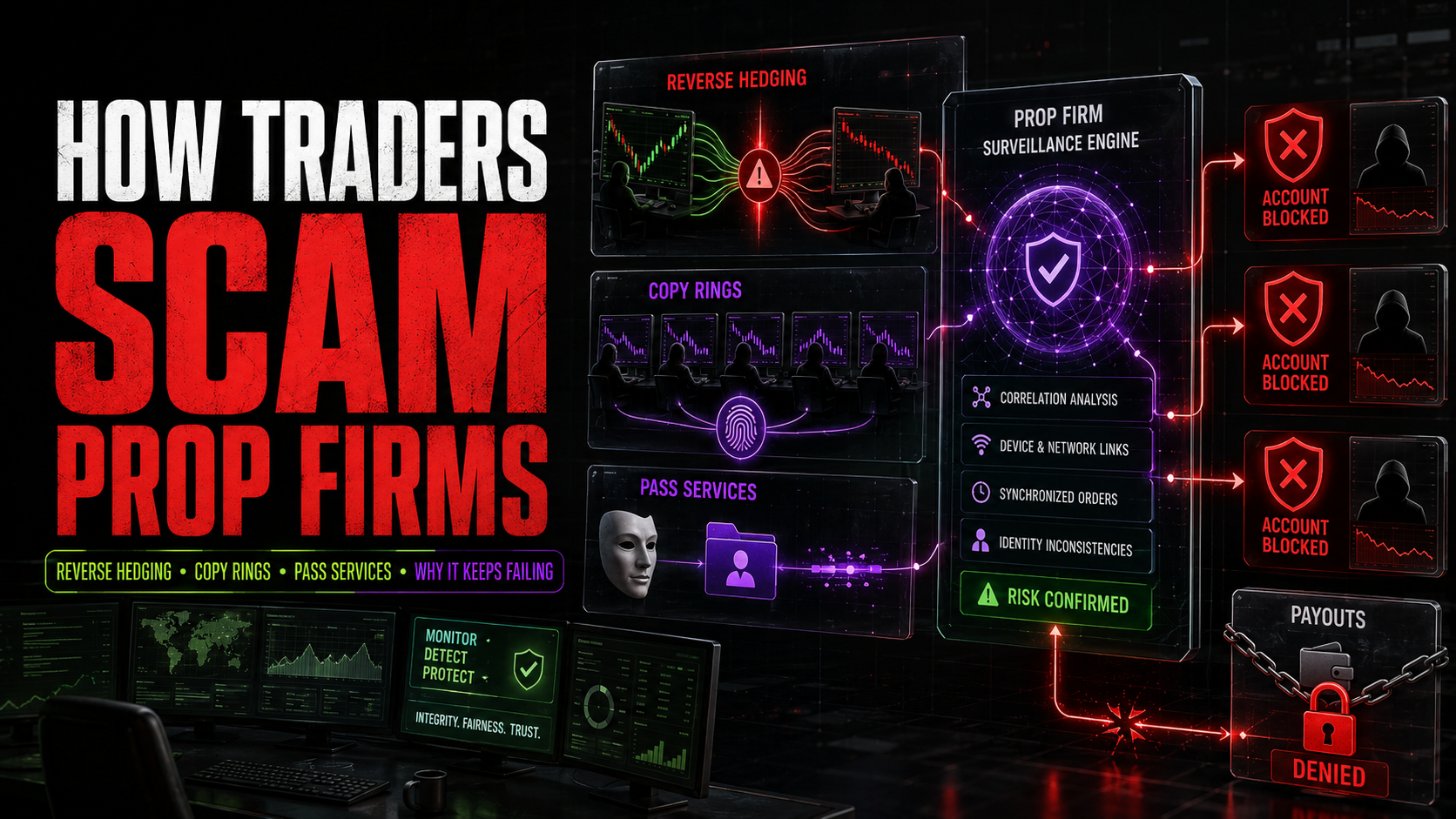
The foundational scam, banned by name in nearly every rulebook (FundedNext Futures' help center defines it precisely: opposite positions opened across different accounts so one account's guaranteed win pays for the other's guaranteed loss). The worked math shows the temptation: buy two 50K evaluations at a $50 promo price each, take maximum-size opposite positions in the same instrument, and one account passes its profit target essentially by construction while the other burns. Total cost: $100 and one dead evaluation per guaranteed funded account, versus the honest route's 2-to-4 attempts and no guarantee. Scale it across a coordinated group (different names, different households, opposite sides distributed around a ring) and you have manufactured a portfolio of funded accounts whose "edge" is arithmetic. The funded stage repeats the trick against payout thresholds. Every variant shares one signature the detection section returns to: the positions only make sense as a set, and risk desks now look at sets.
2. Copy rings and the pass-for-hire market
One skilled operator (or one bot) trading many people's accounts: the openly advertised "we pass your challenge" services that live on Telegram and Discord, account-sharing arrangements where a buyer hands over credentials, and signal rings where dozens of "independent" evaluations execute the same trades in the same sequence. The scheme monetizes twice: the service fee from the buyer, then the multiplied payouts if the funded accounts survive. It is banned essentially universally (the industry's plain statement of the principle: the evaluation exists to test your edge, and an account that is a conduit for someone else's is fraud on the product itself), and it fails two ways the sellers never advertise: the pattern-detection described below clusters identical fingerprints ruthlessly, and the buyer has handed their KYC-verified identity to a criminal enterprise, which means when the ring is caught, the buyer's name is the one on every banned account and denied payout. A large share of "pass services" skip the trading entirely and simply take the money, because who would the victim complain to?
3. The HFT-pass era: the industry's formative scandal
The historical case that reshaped the rulebooks. In the CFD prop boom's peak years, automated systems appeared that could pass certain firms' evaluations in minutes to hours, exploiting platform execution quirks and evaluation structures never designed to face machines: bought off the shelf, run at industrial scale, and openly marketed. The aftermath rewired the industry: firms banned classes of automation outright, added minimum-hold-time and strategy-conduct rules, overhauled platforms, and in some cases collapsed under funded liabilities their pricing never modeled. The era's fingerprints are all over today's futures rulebooks (EA restrictions, tick-scalping bans, minimum trade-duration rules), and its most instructive legacy is the arms race it started: evasion tooling is still openly sold today, marketed explicitly on its ability to produce equity curves that dodge known detection signatures, which tells you everything about both the persistence of the attackers and why firms' detection has had to become behavioral rather than checklist-based.
4. Simulator exploits: attacking the gap between sim and reality
Evaluations and most funded accounts are simulations, and simulations have seams. The documented families: latency arbitrage (exploiting a data feed that lags a faster source by even twenty milliseconds to "trade the past," per the example in FundedNext's own prohibited list), news-spike gambling (max size into a CPI print because the sim fills at shown prices with none of the slippage that would shred the same order live, making the sim trade far better than real), and gap-and-fill quirks unique to how a given engine handles halts, opens, and thin prints. These schemes explain the rules traders complain about most: news-window restrictions, minimum-hold rules, and the sweeping "exploitation of the simulated environment" clauses exist because the sim's generosity is an attack surface. The honest-trader translation: a strategy whose profits depend on fills you could not get in a live market is not an edge, and the firms' detection increasingly models exactly that question.
5. The account farm: gambling the promo calendar
Less cinematic, more common: no collusion, no bots, just deliberate abuse of statistics. Buy many evaluations at deep discount, trade each as a maximum-risk coin flip (all-in one-shots, martingale progressions, grid stacking), and let variance fund the survivors. Ten accounts at $25 promo pricing is a $250 lottery ticket where even coin-flip odds "pass" several accounts, whose funded stages then get the same treatment toward a first payout. It is why martingale, all-in behavior, and gambling-pattern clauses appear in prohibited lists, and it is the single biggest reason consistency rules exist at all: a consistency check is precisely a filter distinguishing a distribution of skilled days from one lucky detonation. The gray-zone honesty this category deserves: buying multiple discounted accounts is legal and normal, and firms priced the promos knowing it; what crosses the line is the max-risk pattern the terms prohibit, and what usually ends it is not detection at all but the account farmer's own funded-stage variance, since the coin that passed the evaluation keeps flipping.
6. Identity, payment, and payout fraud: where it becomes ordinary crime
The bottom of the barrel, where "gaming a challenge" stops being a terms-of-service argument and becomes textbook fraud: KYC farms (recruiting real people's verified identities to front accounts for banned operators), ban evasion through relatives' and purchased identities, evaluations bought with stolen cards (whose chargebacks then land on the firm), and the chargeback double-dip (collect a payout, then dispute the evaluation fee that produced it). None of this is trading-adjacent cleverness; it is identity fraud and payment fraud with a trading skin, it is the category most likely to produce police involvement rather than a ban, and it is a major reason every legitimate firm now runs the KYC gauntlet honest traders grumble about at their first payout.
Case Files: What the Public Record Shows
- The mass-enforcement waves. Several of the industry's largest firms have conducted sweeping enforcement actions flagging large numbers of funded accounts for prohibited conduct (coordinated activity, gambling-pattern trading, news exploitation), and these waves are the industry's most contested events: firms present them as rings caught at scale, affected traders present them as retroactive payout avoidance, and the honest reading of the record is that both phenomena are real, sometimes inside the same wave. That tension is exactly why our denied-payout playbook exists, and why enforcement quality (evidence shown, appeals honored) is one of the sharpest differentiators between firms.
- The abuse defense in collapses. Multiple failed firms have cited trader abuse among the causes of their insolvency, and the claim is simultaneously self-serving and partially credible: undetected rings genuinely do drain payout pools, and "abuse" is also the most convenient epitaph for a firm that mispriced its product. The lesson for traders evaluating firms is indirect but real: a firm with a weak risk desk is a firm whose payout pool is being farmed, and you are an unsecured creditor of that pool.
- The dueling-narratives regulatory saga. The industry's most famous enforcement case featured accusation in both directions: the regulator alleging misconduct by the firm, and the firm's defenders cataloguing abusive trader tactics it faced. Whatever one concludes, the case fixed in public record that both sides of this market have documented bad actors, which is the premise of this site's whole methodology: verify conduct, not narratives.
- The open marketplace. The most damning evidence requires no investigation: pass services advertise openly on messaging platforms, and detection-evasion software is marketed on the clearnet with feature lists describing which signatures it dodges. An abuse economy this brazen is why firms' terms read like counterintelligence manuals, and why they increasingly cooperate against it.
Why It Keeps Failing: The Detection Machine and the Bill
The modern risk desk does not read rules; it reads behavior, across every account at once. The documented stack: cross-account correlation analysis (instruments, sequence, timing, lot-size ratios, and exits clustered across accounts; one pair of similar trades proves nothing, twenty accounts entering in the same sequence with matching ratios and synchronized payout requests starts an investigation), device, session, and access fingerprinting (shared devices, sessions, and access patterns linking "unrelated" identities), execution forensics (equity curves and fill patterns matched against known exploit signatures, including the ones evasion tools advertise dodging), payout-stage review (the audit every withdrawal triggers, which is where most rings finally surface), and, increasingly, cross-firm information sharing: firms using common KYC and risk-screening vendors mean a serious violation at one firm now follows the identity to the next, an industry shift that hardened through 2025 and 2026. The mature desks also state the principle that protects the innocent: signals trigger review rather than replacing it, because shared IPs, similar strategies, and VPS use are all things honest traders legitimately have.
And the bill when it lands: forfeited fees and voided profits, denied payouts, clawback pursuit of paid ones, lifetime bans that now travel between firms, exposure of every accomplice whose KYC identity fronted an account, and, for the identity and payment categories, genuine criminal liability. Weigh that against the prize: the industry's payout data shows typical successful withdrawals of a few hundred to a couple thousand dollars. People are running felony-shaped risk for amounts a decent legitimate trader clears in a normal month, which is the most honest summary of the entire abuse economy.
The Line: Aggressive Play vs Fraud
Legitimate, however aggressive
- Accounts at multiple competing firms, traded independently: standard professional practice, stated as permitted in most firms' own terms
- Buying several discounted evaluations and trading each honestly within the rules
- Self-copying one strategy across your own verified accounts where the firm's copier policy allows it, confirmed in writing
- Exploiting a rule's design generously but within it (an easy structure honestly passed is the firm's pricing decision, not your crime)
- Promo stacking, timing discounts, choosing the most forgiving rule structures: that is shopping, and our cost guide teaches it
Fraud, whatever it calls itself
- Any structure that makes outcomes risk-free across accounts or identities: reverse hedging, ring collusion, distributed opposite-siding
- Anyone but the verified account owner placing the trades: pass services, account sharing, signal-conduit copying
- Strategies whose profit exists only in the simulator's seams: latency arb, exploiting sim-only fills
- Identity misrepresentation in any form, including "borrowed" KYC and post-ban re-entry
- Payment abuse: stolen instruments, payout-then-chargeback
The test that separates the columns is simple enough to memorize: could you show the firm your full setup, every account, every hand on the keyboard, every dependency of the strategy, and still be inside their written rules? Everything in the left column survives that disclosure. Nothing in the right column does, which is the definition of the difference.
Protecting Yourself From the Net: For Honest Traders
The uncomfortable corollary of behavioral detection is collateral damage: honest traders share households, IP addresses, Chicago VPS providers, popular strategies, and even entry times with rings they have never heard of, and every experienced trader knows someone flagged for resembling one. The defensive playbook: trade only accounts KYC-verified in your own name and let nobody else touch them, ever, including family, since account sharing is the one violation with no innocent explanation; get your firm's copier and multi-account policy in writing before running one strategy across your own accounts; if someone in your household trades the same markets at the same firm, front-run the question by disclosing it to support and keeping the answer; avoid the abuse signatures even when technically compliant (max-size news one-shots on a fresh account look like scheme five whether or not they are); and keep the records our denied-payout guide is built on: your own timestamped logs and rationale notes, which are precisely the evidence that separates an independent trader from a ring member when a review lands. Firms whose enforcement shows its evidence and honors appeals deserve weight in your firm selection for exactly this reason; that is behavior our daily scores capture when it breaks either way.
What the Abuse Economy Costs Everyone Else
End where the incentives point. Every scheme above is ultimately paid for by the honest majority: rings drain the pool payouts come from, exploit waves trigger the rule-tightening everyone then trades under (the news windows, the hold-time minimums, the consistency math, the KYC gauntlet), enforcement nets built for rings occasionally catch the innocent, and firms' defensive crouch is a tax on trust in both directions. Which yields this guide's closing symmetry, and the honest thesis of this whole site: the industry's durability depends on conduct on both sides of the glass. We track the firms' side daily; this article is the record of the other side, and the standing advice it produces is the same either way: be the counterparty whose conduct survives an audit, and do business only with counterparties whose conduct does too.
Trader-Fraud FAQ
What is reverse hedging at prop firms?
Opening opposite positions across different accounts (yours, a partner's, or a ring's) so one account is guaranteed to hit its target while the other burns, manufacturing passes and payouts without any trading edge. It is banned by name at virtually every firm, is detected through cross-account correlation analysis, and is treated as fraud on the evaluation itself.
Are challenge-passing services legit?
No. They violate every firm's terms, the resulting accounts and payouts are voided when detected, the buyer's verified identity absorbs the ban, and a substantial share of sellers simply take the money. There is no compliant version of someone else trading your evaluation.
Is it legal to have accounts at multiple prop firms?
Yes, and most firms state so in their own terms; trading several firms independently is standard professional practice. What is prohibited is coordinating those accounts into risk-free structures (opposite-siding across firms) or exceeding one firm's own multi-account and copying policies.
Why do firms ban news trading and set minimum hold times?
Largely because of documented simulator exploits: simulated fills at news spikes lack real-world slippage, and latency and tick-pattern tactics profit from the engine rather than the market. The rules honest traders find annoying are mostly scars from these schemes.
Can I get flagged without cheating?
Yes: shared households, IPs, VPS providers, and popular strategies can resemble ring signatures, which is why mature firms treat signals as triggers for review rather than proof. Protect yourself by trading only your own verified accounts, getting copier and household situations documented in advance, and keeping timestamped logs; our denied-payout guide covers the response if a flag lands anyway.
Do firms share information about banned traders?
Increasingly yes: common KYC and risk-screening vendors mean serious violations (fraud rings, identity falsification, copy networks) now follow an identity across firms, a shift that hardened through 2025 and 2026. A lifetime ban is becoming an industry-wide status, not a single-firm one.
Educational content only, describing schemes at the level already public in firms' prohibited-conduct documentation and industry sources, for the purpose of understanding rules, enforcement, and risk; nothing here is instruction, encouragement, or legal advice, and engaging in the conduct described breaches contracts and may constitute criminal fraud. Descriptions of industry events are general and allege no misconduct by any named party beyond what public records state. Prop trading involves risk of losing evaluation fees; most participants do not reach a payout.