My Prop Firm Denied My Payout: What to Do Next, Step by Step
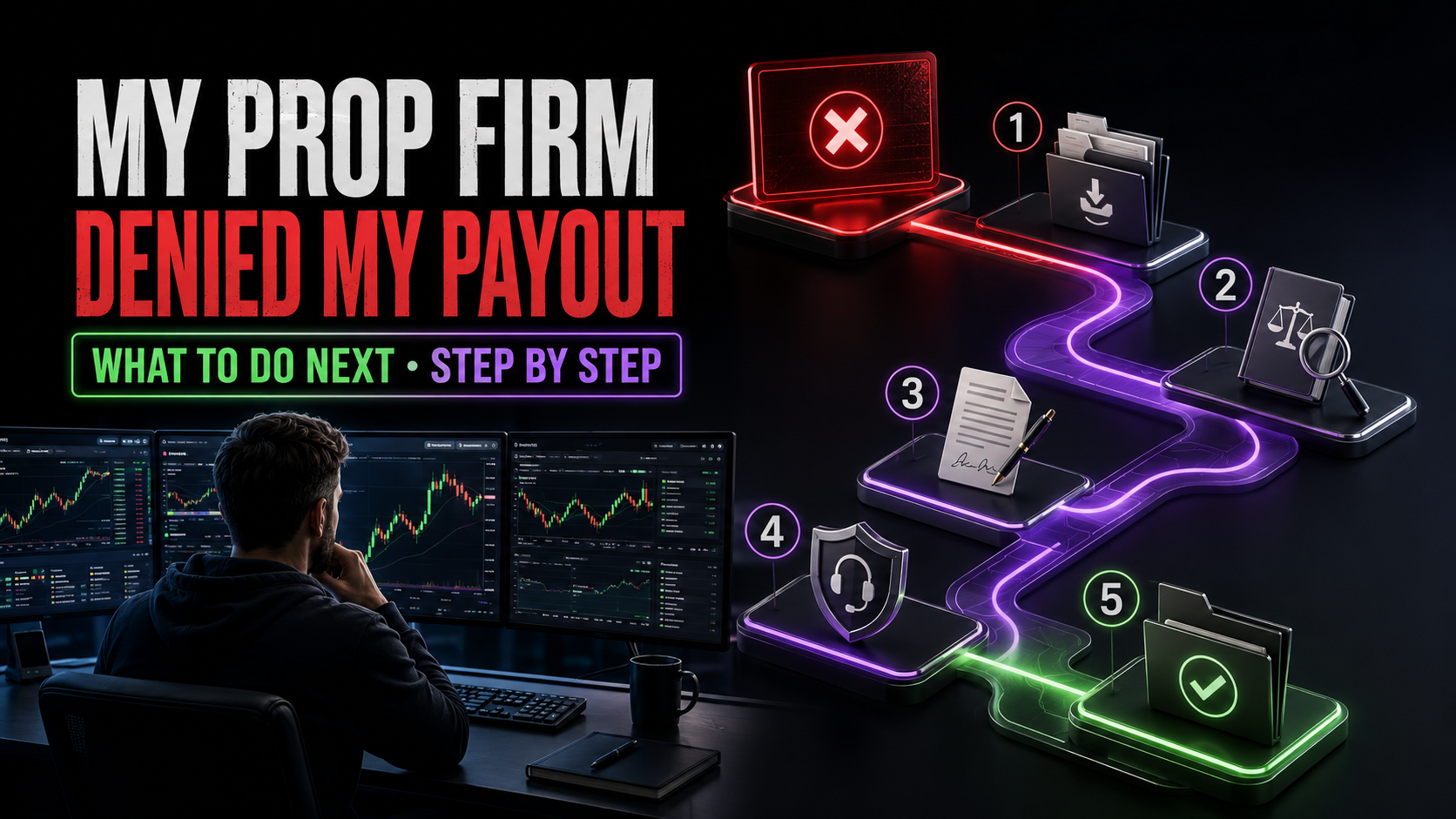
A denied payout is not always the end. Here is the exact sequence that maximizes your odds: what to document in the first hour, how to escalate so a human reviews your case, what chargebacks can and cannot recover, and where to report firms that will not pay.
 Tradeify
 My Funded Futures
 Top One Futures
 Alpha Futures
 Apex Trader Funding
 Lucid Trading
 BlueSky Funded
 Topstep
 Take Profit Trader
 Trade Day
 Phidias
 Bulenox
 Funded Next Futures
 The Trading Pit
 Funded Futures Family
 Daytraders
 Elite Trader Funding
 Funded Futures Network
 Hola Prime
 Blueberry Futures
 Taurus Arena
 Humble Futures
 Legends Trading
 Savius
 NexGen Protrader
 Funded Seat
 YRM Prop
 Instant Funding
Last updated: July 13, 2026
You passed the evaluation. You followed the rules as you understood them. You requested your payout, and the answer came back: denied. Or worse, no answer came back at all. Take a breath, because what you do in the next 48 hours matters more than anything you say in anger, and the order you do it in matters most of all. This guide walks the exact sequence: identify which kind of denial you are facing, lock down your evidence before anything can change, escalate in a way that gets a human to actually review your case, and then, if the firm still will not pay, use the leverage and reporting channels that exist. We will also be honest about the hard parts: what chargebacks can and cannot do, and what recovery realistically looks like in each scenario.
One thing before we start: nothing here is legal advice. For amounts that justify it, a consultation with a lawyer in your jurisdiction is worth more than any guide. What follows is the practical playbook that costs nothing and maximizes your position in every scenario, including the one where you eventually do talk to a lawyer.
Step 0: Identify Which Denial You Are Facing
Payout denials come in three shapes, and everything downstream depends on which one you have.
| Type | What It Looks Like | Recovery Odds | Your Play |
|---|---|---|---|
| Rule-violation denial | The firm cites a specific rule: consistency breach, prohibited strategy, news trading, copy trading, account sharing | Best of the three. Reversals happen when the evidence is on your side | Demand specifics in writing, audit the claim against your own logs, appeal with evidence |
| Delay and silence | Payout approved but never arrives, tickets unanswered, deadlines slip repeatedly | Depends entirely on whether the firm is stressed or sinking | Paper trail plus firm deadlines, and check whether other traders report the same this week |
| Account closure | Account terminated, often citing vague prohibited conduct, pending payout voided | Hardest to reverse. The firm has already decided | Full documentation, formal written appeal, then reporting and public record |
A useful diagnostic for the second type: search the firm's most recent reviews for payout complaints dated this month. One trader's delay is a dispute. Fifty traders' delays in the same three weeks is a solvency event, and in that case skip ahead to the reporting section and stop waiting politely, because in a collapse the traders who documented and pushed earliest historically fared best.
Step 1: Document Everything, Today
Do this before you send a single angry message. Dashboards change, terms pages get edited, and Discord messages get deleted. Your evidence is strongest the day of the denial and only degrades from there.
- Screenshot your dashboard: account balance, equity curve, payout request status, account status, and any violation notice, with visible dates and account numbers.
- Export your complete trade log from the platform: every fill with timestamps. If the denial cites specific trades, this is the battlefield.
- Save the denial communication itself, full headers on emails, screenshots of in-dashboard notices, and the exact wording of the rule cited.
- Capture the terms and payout rules as they exist right now, and then check the Wayback Machine (web.archive.org) for the version that existed when you signed up. If the rule you allegedly broke was added after your purchase, that is the center of your appeal.
- Gather your payment records: receipts for every evaluation fee, activation fee, and reset, with dates and the processing entity named on your card statement.
- Preserve community evidence if relevant: screenshots of staff statements in Discord, announcements, or support replies that contradict the denial.
Organize it in one folder with a one-page timeline: purchase date, pass date, payout request date, denial date, rule cited. Every subsequent step uses this package.
Step 2: Get the Denial Specified in Writing
Firms sometimes deny with a category ("consistency violation") rather than specifics. Your first reply should be calm, short, and surgical. Request, in writing: the exact rule violated, quoted from the terms; the specific trades or dates involved, with timestamps; and the calculation or evidence behind the finding. Something like: "I would like to understand this decision fully. Please provide the specific rule cited, the trades and timestamps the finding is based on, and the calculation used, so I can review it against my records."
This does three things. It forces a human review of what may have been an automated flag. It commits the firm to one story, which matters if the story later changes. And it gives you something concrete to audit. Keep every exchange in the ticket system or email, never only in Discord DMs, which can vanish and carry no weight later. Stay professional in every message; the person reading your appeal has discretion, and traders who rage in all caps get the minimum of it.
Step 3: Audit the Claim and Appeal With Evidence
Now compare their specifics against your logs. Real cases fall into three buckets: they are right (you did breach the rule, in which case the honest play is accepting it and deciding whether the firm's rules fit how you trade), they are technically right but the rule was ambiguous or added mid-relationship (arguable, and the terms archive matters here), or they are wrong on the facts, which happens more than you would think with automated consistency calculations and timezone edge cases.
If you have a case, submit one formal appeal: your timeline, the rule as written when you purchased, your trade evidence, and a specific request ("release the payout of $X requested on DATE"). One thorough appeal beats ten fragmentary complaints. Ask what the review timeline is, note it, and follow up in writing when it passes. If the firm offers a compromise (a partial payout, an account reinstatement), weigh it against the realistic alternatives below rather than against what you are owed in a perfect world.
Step 4: Apply Legitimate Leverage
If the appeal fails or goes unanswered, you move from persuasion to consequences. The legitimate ones:
- A factual public review, on Trustpilot and the review platforms the firm cares about. Stick strictly to documented facts: dates, amounts, the rule cited, the response received. Factual reviews are protected speech in most jurisdictions and they are the leverage firms respond to fastest; embellished ones get removed and hand the firm an excuse. Firms frequently resolve disputes after a detailed, verifiable negative review appears.
- Submit your documentation to review and tracking sites (including ours) that log payout disputes. Patterns across traders are what turn one denial into a visible firm problem, and firms know it.
- Post your documented case in the firm's community and trading forums, calmly, once. If moderators delete factual payout posts, screenshot that too; it is itself a red flag other traders deserve to see.
What not to do: threats, harassment, spamming staff, or public accusations of crime you cannot prove. Beyond the ethics, every unprofessional message weakens your position with the firm, with platforms, and with any regulator or court that later reads the file.
Step 5: The Chargeback Decision
Traders reach for chargebacks first. It should be nearly last, because the mechanics are widely misunderstood:
- A chargeback recovers fees, never payouts. You can dispute the evaluation and activation fees you paid by card. The profit you earned was never a card transaction and no bank can claw it back for you.
- It ends the relationship permanently. Virtually every prop firm's terms classify chargebacks as prohibited conduct: expect every account closed, pending payouts voided, and a permanent ban, sometimes shared across affiliated firms. Never file one while you still have accounts or appeals you care about.
- Time limits apply. Card networks generally allow disputes within roughly 60 to 120 days of the charge depending on network and reason code, so old fees may already be out of reach. Your bank can tell you exactly what applies.
- Success is not guaranteed: the firm will respond that you received the service (an evaluation account). Disputes stand strongest when the firm failed to deliver something concrete, went unresponsive, or shut down entirely.
The clean logic: chargeback when the relationship is already dead and unrecovered fees are all that remains, such as a firm that has gone silent or insolvent. In a live dispute over an earned payout, filing one converts a maybe into a certain zero.
Step 6: Where to Report
Reporting rarely gets your specific payout released, and it is still worth doing: complaint volume is how regulators pick targets, and your file may be the pattern-completing one. Be aware that most futures prop products are simulated accounts that fall outside direct CFTC/NFA regulation, which is exactly why consumer-protection channels are the primary route.
| Channel | Who It Is For | What It Does |
|---|---|---|
| FTC (reportfraud.ftc.gov) | US residents, any firm marketing to the US | Consumer fraud database that feeds investigations and pattern detection |
| FBI IC3 (ic3.gov) | Internet-enabled fraud, including offshore firms taking US money | Federal intake for online financial fraud; volume matters |
| State Attorney General | US residents; strongest when the firm has a US entity | Consumer protection offices that mediate and occasionally sue |
| CFTC tips (cftc.gov) | Any trader; especially firms misrepresenting live trading | Limited direct jurisdiction over sim products, but tips built the MFF and RED list actions |
| Your national consumer agency / financial regulator | Non-US traders | Several EU regulators now actively track prop firm complaints |
| The payment processor | Anyone; identify the processor from your card statement | Processors drop merchants with high complaint rates, which firms fear more than reviews |
| Small claims court | Amounts within your local limit, firm with reachable presence | Cheap and sometimes effective domestically; often impractical against offshore entities |
What Recovery Realistically Looks Like
Honesty section. Rule-violation denials with good evidence get reversed regularly; a calm, documented appeal is genuinely worth the effort. Delay situations resolve when the firm is stressed but solvent, and mostly do not when it is sinking: when The Funded Trader paused in 2024 owing more than $2 million in denied payouts, years later much of it remained unpaid, and that is the honest template for insolvency outcomes. Account closures with voided payouts are the hardest category, which is why the prevention habits below are worth more than every escalation step combined. Set yourself a decision point: if a payout dispute passes 60 to 90 days without movement, shift your energy from recovering that payout to recovering fees where possible, reporting thoroughly, and warning others with your documentation. Sunk-cost grinding against an insolvent firm costs you the thing a trader can least afford, which is focus.
Never Again: The Prevention Habits
Money Habits
- Withdraw the minimum the moment you qualify, every cycle. A balance at a prop firm is an unsecured IOU.
- Track your net position per firm: fees paid minus payouts received. Get it negative (net paid to you) as fast as possible and keep it there.
- Diversify across firms so one denial never ends your funded trading.
Rule Habits
- Read the payout rules before the first request, and screenshot them with the date. Most denials cite rules the trader never read.
- Complete KYC before money is at stake, not during your first payout request, where verification disputes concentrate.
- Avoid the gray zones firms flag most: cross-account copy trading, shared access, exploiting sim data quirks, and anything the terms call prohibited even if enforcement looks lax.
- Check the firm's current review sentiment before every purchase. Most payout disasters were visible in recent reviews before the buyer clicked checkout.
Denied Payout FAQ
Can a denied prop firm payout be reversed?
Yes, especially rule-violation denials where your trade logs contradict the finding. Get the firm to specify the rule, trades, and calculation in writing, audit it against your records, and submit one thorough evidence-based appeal. Insolvency-driven denials are rarely recoverable.
Should I do a chargeback against a prop firm?
Last resort only. It can recover card-paid fees, never earned payouts, and it triggers a permanent ban with all accounts closed and pending payouts voided. Card networks also impose time limits, commonly 60 to 120 days. File one only when the relationship is already dead.
Where do I report a prop firm that refuses to pay?
US traders: the FTC, the FBI's IC3, your state attorney general, and a CFTC tip. Non-US traders: your national consumer protection agency and financial regulator. Everyone: a factual complaint to the payment processor on your card statement, and documented reviews on the platforms the firm cares about.
Is a payout denial legal?
The terms you accepted usually give the firm broad discretion and specify arbitration or a foreign jurisdiction, so legality depends on your contract and where the firm sits. For significant amounts, a one-hour consultation with a lawyer in your jurisdiction is worth far more than forum opinions. For most traders, documentation, escalation, and prevention deliver more than litigation.
The firm went completely silent. What now?
Check whether other traders report the same in reviews dated this month. If the silence is firm-wide, treat it as a potential insolvency: document everything immediately, file your fee chargeback within the card time limits, report through every channel above, and stop purchasing. In collapses, early documenters recover the most.
Will leaving a negative review hurt my appeal?
Sequence matters. Exhaust the private appeal first, since the person reviewing it has discretion. Once the appeal is denied or ignored, a strictly factual public review is legitimate leverage and often prompts resolution. Keep it to documented facts, dates, and amounts.
Bottom Line
A denied payout is a process, not a verdict. The traders who recover money share the same profile: they documented on day one, forced the denial into specifics, appealed once with evidence instead of ten times with anger, and knew exactly when to switch from recovering the payout to recovering the fees and warning the next trader. And the traders who never face this at all share a profile too: they withdraw early, spread their risk, read the rules they trade under, and check what this month's reviews say before they buy. That last habit is the entire reason our trader scores exist and refresh every day. The best time to read a firm's recent reviews is before your money is inside it.
Educational content only, never legal or financial advice; consult a qualified lawyer in your jurisdiction for significant amounts. References to past firm events are drawn from public reporting. Trader scores are generated from each firm's most recent public reviews and refresh daily. Prop trading involves risk of losing evaluation fees; most participants do not reach a payout.