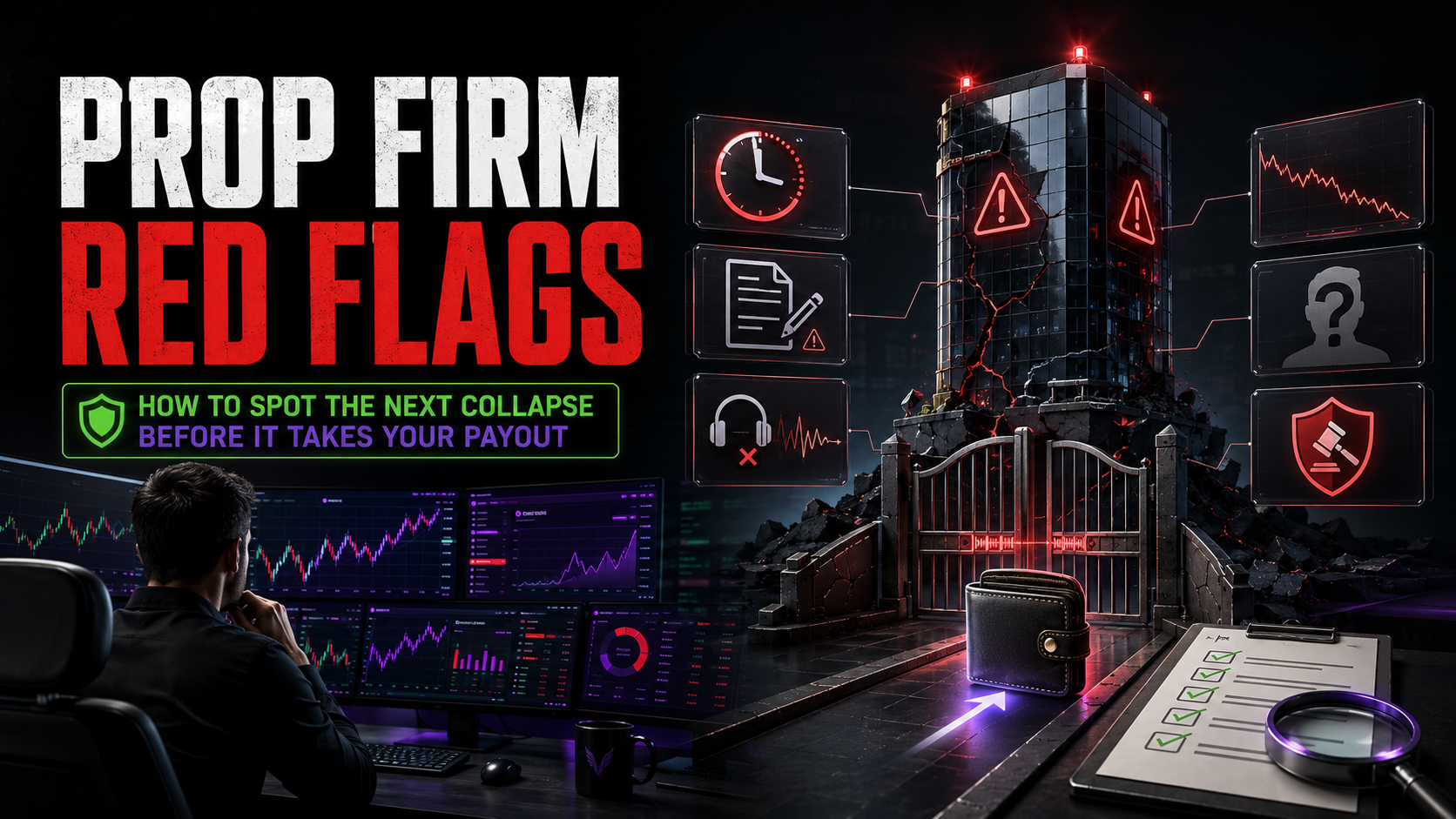
Prop Firm Red Flags: How to Spot the Next Collapse Before It Takes Your Payout
Between 2024 and 2025, an estimated 80 to 100 prop firms shut down, and almost every collapse showed warning signs first. Here are the red flags from real cases, why they appear in recent reviews before anywhere else, and a checklist to protect your payouts.
 Tradeify
 My Funded Futures
 Alpha Futures
 Apex Trader Funding
 Lucid Trading
 BlueSky Funded
 Topstep
 Take Profit Trader
 Trade Day
 Phidias
 Earn2Trade
 Bulenox
 Funded Next Futures
 Blue Guardian Futures
 The Trading Pit
 Funded Futures Family
 E8 Markets
 Daytraders
 Elite Trader Funding
 Funded Futures Network
 Hola Prime
 Blueberry Futures
 Taurus Arena
 Humble Futures
 Legends Trading
 Savius
 Futures Elite
 NexGen Protrader
 Funded Seat
 YRM Prop
Last updated: July 13, 2026
Between February 2024 and late 2025, an estimated 80 to 100 proprietary trading firms shut down, roughly one in seven firms worldwide, in the largest collapse the industry has ever seen. Traders lost evaluation fees, funded accounts, and earned payouts that will never arrive. Here is the part that matters for you: almost none of those collapses came out of nowhere. In case after documented case, the trader-facing symptoms showed up weeks or months before the shutdown announcement. This guide walks through what actually happened at the firms that failed, the specific red flags that preceded each failure, and a practical checklist for protecting your money. It is also, frankly, the argument for how we score firms: reputations describe the past, and collapses happen in the present.
What Collapse Actually Looks Like: The Documented Cases
Every red flag in this guide comes from a real failure. Four cases define the pattern.
My Forex Funds: the overnight freeze
In August 2023, My Forex Funds was by most accounts the largest retail prop firm in the world. On August 29, the US CFTC and the Ontario Securities Commission filed a complaint alleging fraudulent solicitation of more than $310 million from over 135,000 customers, and operations froze essentially overnight. The legal saga that followed is its own story: the case ultimately collapsed in 2025 after a special master recommended dismissal, citing prosecutorial misconduct, so the fraud allegations were never proven. But notice what did not depend on who was right in court: 135,000 traders lost access to their accounts and pending payouts in a single day. The lesson is not about fraud. It is that a prop firm can be a single regulatory or banking event away from a total freeze, and no amount of size protects you from that.
True Forex Funds: the flagged firm nobody watched
Hungary-based True Forex Funds was added to the CFTC's RED list, which flags foreign firms serving US customers without registration, in June 2023. Eight months later, on February 2, 2024, MetaQuotes terminated its MetaTrader licenses without warning, freezing operations. The firm scrambled to migrate platforms and even relaunched briefly, but the months of frozen accounts and zero revenue proved fatal: on May 13, 2024, it announced permanent closure due to insolvency, leaving an estimated $1.2 million unpaid to roughly 300 traders. The warning had been publicly visible for the better part of a year. Almost nobody acted on it.
The Funded Trader: the slow-motion payout failure
The Funded Trader did not get shut down by a regulator or a platform. It simply stopped being able to pay. Payout complaints accumulated publicly through early 2024, the firm paused operations on March 28, 2024, and later acknowledged more than $2 million in denied payouts. It relocated to the Cayman Islands, announced new partnerships, and by late 2024 claimed to have processed a fraction of what it owed. As of 2026, many traders from that era remain unpaid. This is the most common collapse shape: not a dramatic shutdown, but a firm quietly drowning in obligations while its marketing keeps selling evaluations.
Funded Engineer: the exit scam
At the darkest end of the spectrum, Funded Engineer appears to have never been a real business: an estimated $1 to $2 million collected from hundreds of traders, no payouts ever processed, and a bankruptcy filing that shielded the operators as they vanished. Exit scams are rarer than insolvencies, but they exist, and they are why the red flags around corporate opacity matter.
Why the wave happened at all
The structural cause is worth one paragraph, because it tells you what to watch. Most prop firms fund payouts primarily from evaluation fee revenue. Industry data from roughly 300,000 accounts suggests only about 14 percent of traders pass their evaluation and only about 7 percent ever receive a payout, which is the margin the model runs on. When anything interrupts fee revenue (a platform termination, a regulatory freeze, a reputational hit that slows new signups) while payout obligations keep arriving, the math breaks fast. The 2024 wave was concentrated in forex and CFD firms because MetaQuotes controlled their infrastructure; futures firms run on CME-connected platforms and dodged that specific bullet, but the solvency logic is identical in every asset class. A futures firm whose fees stop covering its payouts is on the same clock.
The 12 Red Flags, Ranked by How Early They Appear
These are ordered roughly by lead time: the ones at the top tend to show up earliest, often while the firm's public reputation still looks fine.
| # | Red Flag | What It Looks Like | Why It Matters |
|---|---|---|---|
| 1 | Rising payout friction | New verification steps, longer processing, more denied edge cases, payouts approved but not arriving | The single earliest symptom of cash-flow stress; appears in recent reviews weeks before anything official |
| 2 | Payout terms tightened mid-relationship | New caps, longer cycles, higher minimums, or consistency rules applied to existing funded traders | A firm changing the deal on people it already owes is managing an obligation problem |
| 3 | Discount escalation | Promos getting deeper and more frequent; 60 to 90 percent off becoming the permanent price | Fee revenue is the payout fund; an accelerating fire sale can signal revenue hunger |
| 4 | Stars and words diverging | Ratings holding steady while the actual text of recent reviews fills with payout complaints | Solicited 5-star support reviews mask trouble; the words break before the stars do |
| 5 | Support going quiet | Response times ballooning, tickets unanswered, staff departures, Discord mods deleting payout questions | Firms in trouble ration attention; censorship of complaints is a five-alarm signal |
| 6 | Sudden eligibility changes | Countries banned mid-relationship, existing traders cut off with short notice | Can reflect banking or processor trouble upstream of the firm itself |
| 7 | Regulatory flags | Appearing on the CFTC RED list or receiving warnings from regulators like Consob, FSMA, or CNMV | True Forex Funds was publicly flagged eight months before the event that killed it |
| 8 | Single-platform dependency | Entire product built on one licensed platform the firm does not control | MetaQuotes ended dozens of firms with one decision; ask what the firm's plan B is |
| 9 | Corporate opacity or jurisdiction hopping | Unclear operating entity, mismatched registration claims, relocation to lighter jurisdictions mid-crisis | The Funded Trader's mid-crisis Cayman move; opacity is also the exit-scam signature |
| 10 | Payout proof disappearing | Payout leaderboards, certificates, or totals quietly removed or frozen at old numbers | Firms showcase payouts when they are flowing; silence usually means they stopped |
| 11 | Terms edited quietly | ToS changes without announcement, retroactive rule interpretations, vague new prohibited-conduct clauses | Retroactive rule enforcement is the classic mechanism of mass payout denial |
| 12 | Affiliate push intensifying | Sudden surge in influencer promotion, referral bonus increases, urgency marketing | Alone it means growth; combined with flags 1 to 4 it means new fees are needed to pay old obligations |
One flag alone is noise. Watch for clusters and direction: a firm showing flags 1, 3, and 4 simultaneously, and getting worse month over month, is telling you something no press release will.
Why This Is Exactly What Our Scores Measure
Look back at that table and notice where the earliest flags live: in what traders are saying right now. Payout friction, support decay, retroactive rule enforcement, and the gap between star ratings and review text all surface in recent reviews long before they surface anywhere official. That is the entire reason our trader scores are computed only from each firm's most recent reviews and refreshed daily, instead of averaging years of history. A firm that paid flawlessly for a decade and is now delaying payouts should not be protected by its decade; a firm treating traders well this month should not be punished for a rough patch last year. Every documented collapse in this guide would have shown up as a falling recent-review score before it showed up as a headline. That is not a guarantee we will catch the next one, but it is the highest-probability early warning system available to a retail trader, and it is free to check.
The Trader Protection Checklist
Before You Buy
- Check the current trader score, not the reputation. Read the most recent reviews, especially the negative ones, and note what they complain about.
- Identify the operating entity and jurisdiction in the terms, and search the CFTC RED list and your local regulator's warning list for the name.
- Screenshot the terms, payout rules, and pricing you are signing up under, with dates. If rules change later, you want the before picture.
- Size your exposure like a trade. Never have more in unrecovered fees at one firm than you can write off without pain.
While You Are Funded
- Withdraw early and often. A balance sitting at a prop firm is an unsecured IOU. Take the minimum payout as soon as you qualify, every time you qualify.
- Diversify across two or three firms so no single failure ends your funded trading.
- Re-check the score monthly and before every major purchase or scale-up. Direction matters more than level.
- Treat a first payout delay as information, not an inconvenience. Slow down purchases at that firm until it resolves.
Red Flags FAQ
How many prop firms have collapsed?
Industry trackers estimate 80 to 100 firms ceased operations between February 2024 and late 2025, roughly 13 to 14 percent of all firms globally, in a wave triggered by MetaQuotes revoking MetaTrader licenses and sustained by the industry's dependence on evaluation-fee revenue.
What is the single most reliable red flag?
Rising payout friction: new verification hurdles, lengthening processing times, and denied edge cases appearing in recent reviews. It is the earliest visible symptom of cash-flow stress and preceded nearly every documented collapse.
Did collapsed firms show warning signs first?
Almost always. True Forex Funds was publicly flagged by the CFTC eight months before the platform termination that killed it. The Funded Trader's payout complaints accumulated publicly before its March 2024 pause. Collapses look sudden from outside; the trader-facing symptoms rarely are.
Are futures prop firms safer than forex prop firms?
They avoided the specific 2024 catastrophe because they do not depend on MetaTrader licenses. But the solvency model is the same everywhere: payouts funded largely by evaluation fees. Judge futures firms by the same flags, especially payout friction and discount escalation.
If a firm shows red flags, should I stop trading there immediately?
Prioritize extraction over panic: request any payout you are eligible for, stop buying new evaluations there, and let existing accounts play out without adding exposure. One flag is a caution; a worsening cluster is an exit signal.
Can a firm recover after showing red flags?
Yes. Firms have slowed payouts during growing pains and then stabilized, which is exactly why we track scores daily in both directions. A recovering score with clean recent payout reviews is as meaningful as a falling one. Judge the current month, not the worst month.
Bottom Line
The prop firm industry's defining risk is not losing a challenge. It is passing one, earning real money, and watching the firm fail before it pays you. That risk cannot be eliminated, but it can be managed the same way you manage a trade: size your exposure, take profits early, diversify, and act on the signal instead of the story. The signal, in this industry, is what traders who got paid (or did not get paid) this week are saying. That is what we track, every day, for every firm we cover. Yesterday's reputation is not today's payout, and nowhere is that more true than at a firm six weeks from insolvency that still looks fine from the outside.
All collapse details above are drawn from public reporting and regulatory filings and describe events as documented at the time of writing; allegations that were never proven in court are identified as allegations. Trader scores are generated from each firm's most recent public reviews and refresh daily. Educational content only, never personalized financial or legal advice. Prop trading involves risk of losing evaluation fees; most participants do not reach a payout.