The Real Cost of Getting Funded: Evaluations, Resets, Activation Fees, and the Instant Funding Math
The advertised fee is 40 to 60 percent of what funded traders actually pay. The complete cost stack itemized, the four pricing structures the industry uses and who each favors, worked cost-to-first-payout models with the attempt math filled in, the honest economics of instant funding, and the seven checkout questions that surface every hidden drain.
 Tradeify
 My Funded Futures
 Top One Futures
 Alpha Futures
 Apex Trader Funding
 Lucid Trading
 BlueSky Funded
 Topstep
 Take Profit Trader
 Trade Day
 Phidias
 Earn2Trade
 Bulenox
 Funded Next Futures
 Blue Guardian Futures
 The Trading Pit
 Funded Futures Family
 E8 Markets
 Daytraders
 Elite Trader Funding
 Funded Futures Network
 Hola Prime
 Blueberry Futures
 Taurus Arena
 Humble Futures
 Legends Trading
 Savius
 Futures Elite
 NexGen Protrader
 Funded Seat
 YRM Prop
 FundedNext
Last updated: July 28, 2026
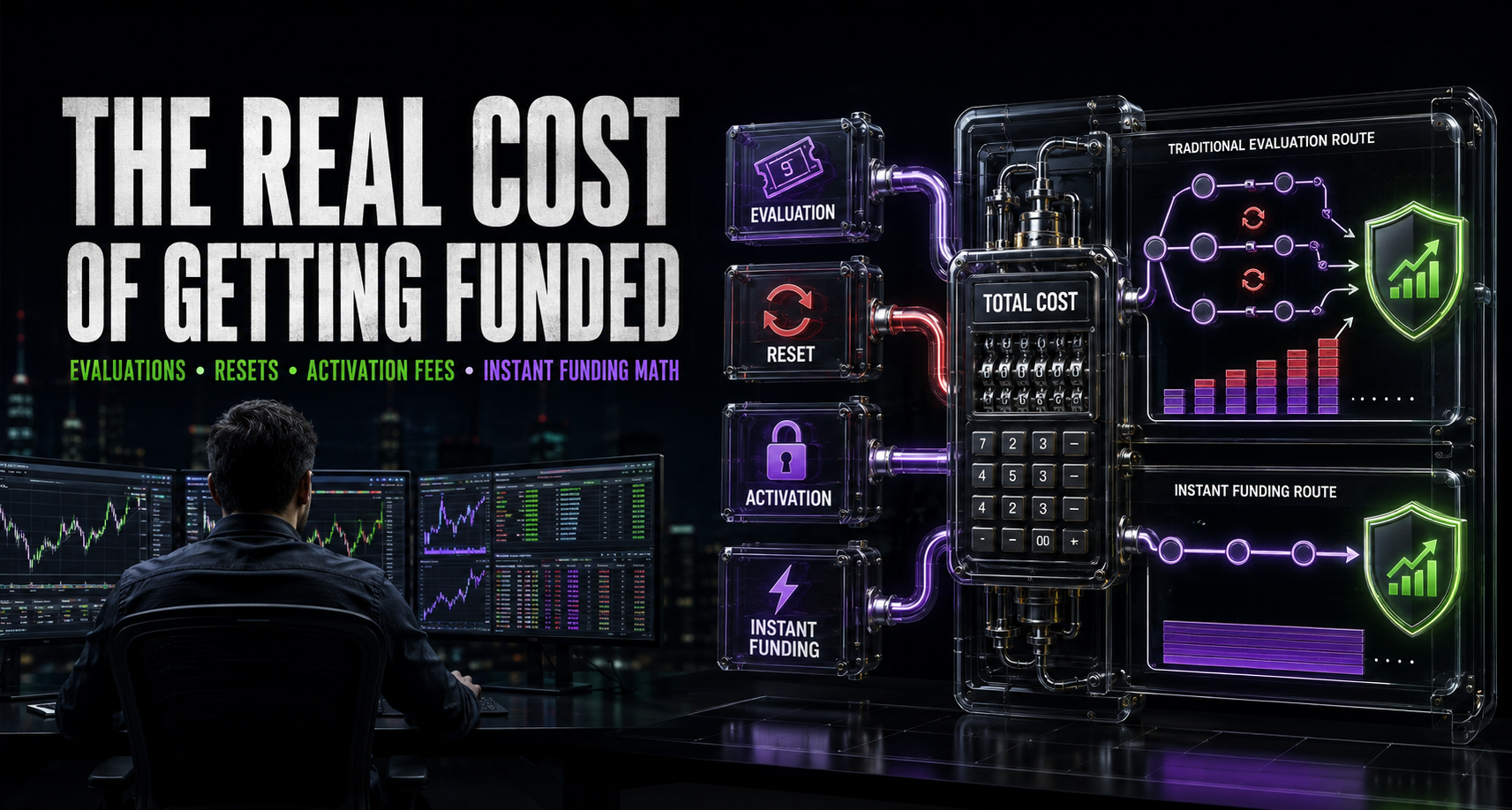
The checkout price of a prop firm evaluation is one of the most misleading numbers in retail trading, and not because anyone is lying: industry cost analyses consistently find the advertised fee represents roughly 40 to 60 percent of what a funded trader actually pays over a year once renewals, resets, activation fees, funded-account charges, and data feeds are counted, with realistic 12-month all-in figures landing between $400 and $1,800. This guide is the buyer's-side math the sales pages skip: the complete cost stack itemized, the four pricing structures the futures industry uses and how each one bills you, expected cost-to-first-payout models with the attempt math filled in, the honest economics of instant funding, when discounts genuinely change the equation, and the checkout questions that surface every hidden drain before you pay.
Pricing note: dollar figures below were accurate for mid-2026 and exist to make the math concrete; firms reprice constantly, so treat every number as illustrative and verify current pricing at checkout. The formulas are the durable part.
The Full Cost Stack, Itemized
| Layer | What It Is | Typical Range (mid-2026) | The Catch |
|---|---|---|---|
| Entry fee | The evaluation purchase, one-time or first month of a subscription | $25 to $250 for a 50K futures account at promo prices; more at list | The only number the marketing shows you |
| Renewals | Monthly billing that continues while you are still attempting a subscription-model evaluation | The entry fee again, every month, until you pass or quit | The average trader needs 2 to 4 attempts; slow attempts on subscriptions bill the whole time |
| Resets and repurchases | Paying to restart after breaching; some firms sell discounted resets, others (Apex since March 2026 for new accounts) abolished resets so a breach means a full-price repurchase | $35 to $150 per reset where offered; full evaluation price where not | One reset a month can roughly double an annual cost; "no reset fees" can mean cheaper or pricier depending on what replaces them |
| Activation fee | One-time charge after passing, before the funded account opens | $0 at several firms (MFFU, Tradeify); roughly $85 to $200 where charged (Topstep $149 one-time) | Charged per account, so multi-account traders pay it repeatedly; commonly waived in promos if you time it |
| Funded-account monthly fees | Recurring charges on the funded stage itself at some firms | $0 at many firms; around $85 per month per account at others, sometimes with a lifetime-fee buyout option (~$140) | The quietest drain in the stack: a funded account that pays you $200 quarterly while costing $85 monthly is a losing position |
| Data feeds and platform | CME market data and platform licensing, bundled at some firms, billed at others | $0 bundled to roughly $15 to $135 per month depending on feeds and platform | Futures-specific and easy to forget; it runs during evaluations too |
| Payout costs | Wire fees, processor charges, FX spreads on the way out | $0 to ~$30 plus FX per withdrawal | A $30 wire on a $500 minimum payout is a 6 percent exit tax; rail choice matters (see the payout guide) |
The Four Pricing Structures, and Who Each One Favors
- 1. Pure monthly subscription. A recurring fee while you attempt, often with no activation and no funded-stage charges (the shape of MFFU's plans, from around $77 per month for a 50K, and several newer competitors near that mark). Bills scale with how long you take, not how many times you breach: a fast decisive trader pays very little, a slow cautious one pays every month they linger. Favors traders who attempt in focused bursts.
- 2. One-time evaluation pricing. A single payment per attempt with no clock running (Tradeify's model). The sticker is higher than one subscription month but caps the cost of taking your time, which suits patient traders and anyone whose evaluation plan uses most of the calendar, like the passer profile in the behavioral data that uses 60 to 80 percent of available time.
- 3. Subscription plus paid gates. Monthly evaluation billing with an activation fee at the end and possibly funded-stage costs (Topstep's shape: monthly Combine, then a $149 one-time activation, then $0 ongoing). The gates are finish-line costs: irrelevant if you never pass, guaranteed if you do, so price them into your success scenario, not your attempt scenario.
- 4. Deep-discount entry with monetized funded stage. Very cheap heavily promoted evaluations, with revenue recovered through per-account activation and monthly funded-account fees (the classic Apex shape, including its ~$85 monthly PA fee or lifetime buyout). The cheapest way to attempt and the most expensive structure to succeed slowly in, which is why it pairs naturally with the multi-account strategy its users favor: the entry discount is harvested across many accounts while the funded fees demand those accounts actually produce.
The structural insight: every model is cheapest for a different trader. Fast passers should buy subscriptions, slow passers should buy one-time pricing, confident passers can accept back-loaded gates, and volume traders can exploit discount-entry models. Choosing a structure that fights your own pace is the most common self-inflicted cost in the stack.
The Math: Expected Cost to First Payout
The durable formula: Expected cost = (price per attempt × expected attempts) + (monthly overhead × months to pass) + finish-line fees + funded overhead until payout. The number that dominates it is expected attempts, and the honest planning figure from industry data is 2 to 4. Three worked models on a 50K account, using mid-2026 illustrative prices:
- Model A, subscription, decisive trader: passes on the second attempt, each attempt taking one billing month: 2 × $77 = $154, no activation, no funded fees, $0 bundled data. Cost to first payout: about $154. The same trader taking two months per attempt doubles it to $308: on subscriptions, speed is money.
- Model B, one-time pricing, patient trader: passes on the third attempt at $179 per evaluation: 3 × $179 = $537, no clock pressure, no activation. Cost: about $537, but crucially identical whether each attempt took two weeks or two months, which for a patient style may buy a higher pass probability per attempt, and the whole point of the formula is that raising your per-attempt odds is worth more than lowering the per-attempt price.
- Model C, discount entry with funded fees: buys three promo evaluations at $35 each ($105), passes one, pays a $130 activation, then carries an $85 monthly funded fee for the three months it takes to reach a first payout: $105 + $130 + $255 = $490, and the meter keeps running after. Cheap to try, expensive to idle in: this structure rewards traders who withdraw fast and punishes those who sit.
Two corollaries worth engraving. First, the line the cost analysts keep arriving at: the cheapest firm is the one you pass on the first try, which converts most of this guide into an argument for sim practice against the exact rule set before buying anything, since raising a 25 percent per-attempt pass probability to 50 percent halves every model above. Second, budget the whole campaign before attempt one: deciding you can spend $400 this quarter and choosing the structure that maximizes attempts-plus-quality within it beats deciding $49 at a time, four emotional times.
Instant Funding: The Real Trade
Instant funding products (Tradeify's Lightning accounts, Lucid's direct model, and the various "skip the eval" tiers) sell one thing: certainty of reaching the funded stage, priced at a large multiple of an evaluation attempt. The honest comparison is expected cost versus expected cost: if an instant 50K costs $400 and the evaluation path's expected cost from the models above is $150 to $550, the instant product is rationally priced only when your evaluation pass probability is low or your time is genuinely valuable, which is an uncomfortable pair of reasons. The fine print does the rest of the pricing: instant accounts typically carry tighter consistency rules, lower initial payout caps, stricter per-trade limits, and replacement (not reset) costs at full price when breached, so the certainty you bought is certainty of entering a harder room. The defensible use cases: a proven trader who repeatedly passes evaluations and values the skipped weeks, or a diversifier adding one instant account beside evaluation accounts. The indefensible one is the trader who cannot pass evaluations buying entry into rules that forgive even less; the consistency guide's math applies double here.
Discount Timing: When 90 Percent Off Changes the Math (and When It Warns You)
Discounts are structural in this industry (near-zero marginal cost per simulated evaluation, lifetime value in repeat attempts, as our business model guide explains), so treat them as the real price and plan around the calendar: major holidays, firm anniversaries, and month-end pushes recur reliably, and activation-fee waivers ride along often enough to be worth waiting days for. On the attempt math, discounts are enormous: at 80 percent off, Model C's three attempts cost $21, which makes the multi-attempt campaign nearly free to run and moves all your real cost to the finish-line and funded-stage fees, exactly where you should then focus your comparison shopping. One discipline and one warning. The discipline: a discount is a reason to execute an existing plan cheaper, never a reason to buy an account you had no plan for; promo-driven impulse purchases are precisely how the average buyer ends up spending thousands while telling themselves each evaluation was cheap. The warning: distinguish a promotional calendar from a one-way slide. Scheduled sales at a healthy firm and ever-deepening desperation pricing at a stressed one look similar at checkout, and the difference (payout conduct, in the same weeks) is what the red flags guide and our daily scores exist to catch.
The Checkout Questionnaire
Seven questions that surface the entire stack before you pay. Ask them in the firm's help center or support chat, and screenshot the answers with dates:
- Is this evaluation one-time or a recurring subscription, and what exactly stops the billing?
- What happens when I breach: is there a discounted reset, or do I repurchase at full price?
- Is there an activation fee after passing, how much, and is it per account?
- Are there monthly fees on the funded account itself, and is there a lifetime buyout?
- Are exchange data and the platform bundled during the evaluation and the funded stage, or billed separately, and at what level?
- What does each payout cost me in fees, by method?
- Which of these fees does the current promotion actually waive, and until when?
A firm that answers all seven crisply has, incidentally, just passed a transparency test that predicts payout conduct better than any marketing page. Evasion on question 2, 4, or 6 is information too.
True-Cost FAQ
How much does getting funded really cost?
Industry analyses put realistic 12-month all-in costs between $400 and $1,800 including renewals, resets or repurchases, activation, funded-stage fees, and data, versus advertised entry fees that represent roughly 40 to 60 percent of the true total. Your number depends mostly on attempts needed and the pricing structure you chose.
Monthly subscription or one-time fee: which is cheaper?
Neither universally. Subscriptions favor fast, decisive attempts (each month lingering is billed); one-time pricing favors patient traders who use the full calendar. Match the structure to your actual pace, and price the finish-line fees (activation, funded monthlies) into the comparison.
Are reset fees good or bad?
A discounted reset is cheaper per additional attempt than a full repurchase, so "no reset fees" is only good news when the evaluation price itself is low enough that repurchasing beats the old reset price. Compute cost per attempt under each regime; that single number settles it.
Is instant funding worth it?
Compare its price against your expected evaluation cost (price per attempt times expected attempts) and read the funded rules it carries, which are typically stricter: tighter consistency, lower caps, full-price replacement. Rational for proven passers valuing time or as diversification; irrational as a workaround for not being able to pass.
Should I wait for a promotion?
Usually yes for planned purchases: discounts are structural and calendar-driven, and activation waivers ride along. Never let a promotion create a purchase you had no plan for, and treat accelerating desperation-grade discounting at a single firm, paired with payout friction, as a warning rather than a bargain.
What is the single best way to lower my cost?
Raise your per-attempt pass probability before buying: prove your strategy against the exact rule set in sim first. Moving from a 25 to a 50 percent pass rate halves the expected cost of every structure, which no discount matches. The cheapest firm is the one you pass on the first try.
Educational content only, never personalized financial advice. All prices are illustrative mid-2026 figures that change frequently; verify current pricing, fees, and rules in each firm's own documentation before purchasing. Prop trading involves risk of losing evaluation fees; most participants do not reach a payout.